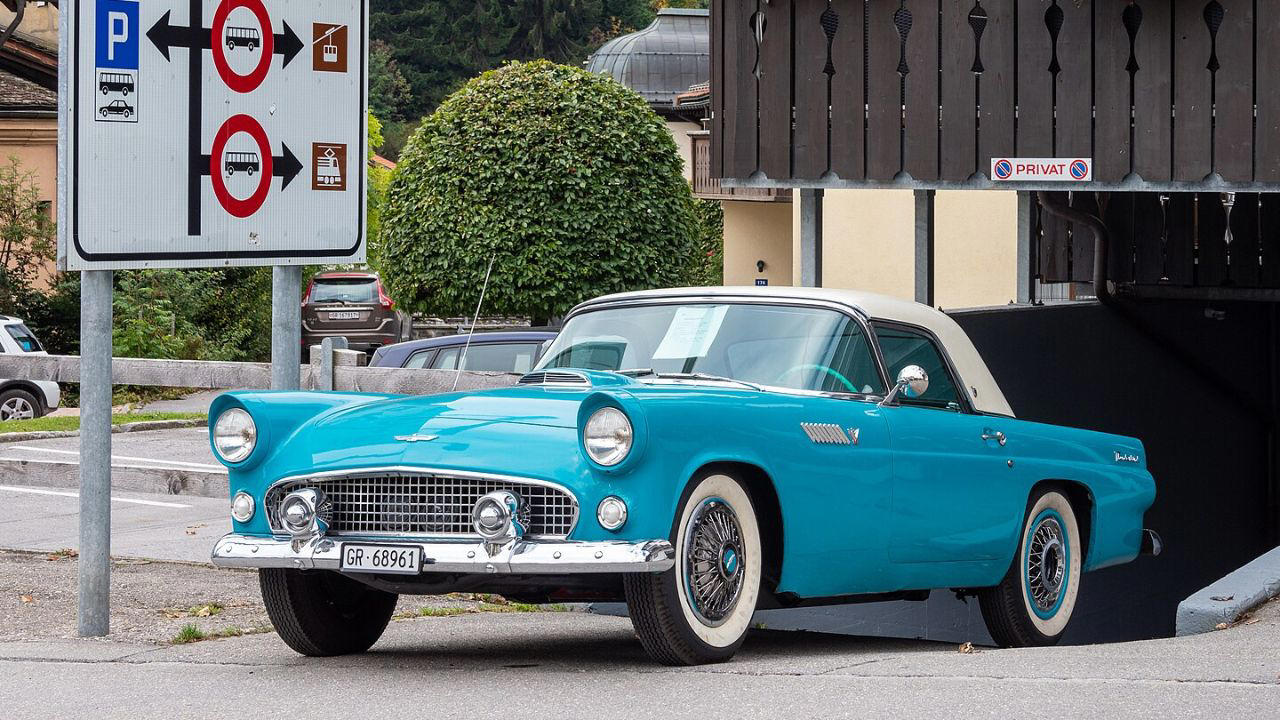
How the 1955 Ford Thunderbird created a new kind of luxuryThe 1955 Ford Thunderbird did more than answer a rival’s challenge. It introduced a new idea of luxury that wrapped style, comfort, and performance into a compact two-seater aimed at personal indulgence rather than family duty. By fusing sports car glamour with American convenience, it created a template that reshaped expectations for upscale motoring. The Corvette challenge and Ford’s different answer The story of the 1955 Ford Thunderbird begins with Motorama and the New York Auto Show, where the Chevrolet Corvette signaled that a new kind of American sports car was possible. Ford could not ignore a fiberglass two-seater from a direct competitor, yet the company chose not to copy it. As one period review of the Ford effort explains, the team in Dearbornne resisted building a stripped-down performance roadster and instead pursued a car that blended speed with comfort. That decision reflected a shrewd reading of American tastes. European-style sports cars promised purity and lap times, but they also demanded sacrifice in ride quality and amenities. Ford recognized that many buyers wanted the romance of a two-seater without giving up a smooth automatic transmission, a powerful V8, and a civilized cabin. In that gap between raw sports car and plush sedan, the Thunderbird found its opening. Defining “personal luxury” in metal and chrome The Ford Thunderbird that arrived for 1955 was marketed not as a pure sports car but as a personal luxury car. One enthusiast description notes that, unlike its competitor, the Thunderbird was never intended as a bare-bones performance machine, and that distinction shaped every design choice. As a result, the car that some fans, including one who called it a favorite in a public tribute, celebrate today was built around the driver’s comfort as much as the engine’s output. Personal luxury meant a long hood and short deck that suggested speed, yet it also meant roll-up windows, a snug removable hardtop, and a cabin trimmed to feel expensive rather than spartan. Contemporary accounts describe the 1955 Ford Thunderbird as a classic American two-seater convertible that was introduced as Ford’s answer to the Chevrolet Corvette, but with a very different emphasis on amenities and style. In that sense, the Thunderbird did not simply compete with the Corvette; it redefined what a two-seat American car could be. Design that captured 1950s American optimism The styling of the 1955 Ford Thunderbird distilled the confidence of midcentury America. One enthusiast group describes the car as a classic American two-seater whose design became tightly linked with American car culture, a connection that reflects how instantly recognizable its proportions became. A community of collectors highlights the Ford Thunderbird shape as a symbol of 1950s design, with its low roofline, round taillights, and generous chrome. Those visual cues were not simply decoration. The compact footprint and sleek profile communicated that this was a car for two people who valued style and leisure. The cockpit wrapped around the driver with a machine-turned dash and clear, circular gauges that looked more like aircraft instruments than sedan dials. The result was a car that looked sporty from every angle but felt more like a well-appointed lounge once a driver settled into the seat. Luxury from the driver’s seat outward The Thunderbird’s interior completed the personal luxury equation. Period descriptions of the 1955 cabin emphasize how the car combined bucket-style seating, a padded dashboard, and bright trim to create an upscale environment. Another detailed account of the two-seater notes that the 1955 Ford Thunderbird was presented as a classic American convertible with an interior that reflected American luxury as much as performance, with a focus on comfort and style that matched its exterior flair. That focus extended to features that were rare in small two-seat cars. Power steering and power brakes were available, as were power windows and a power seat, along with a removable hardtop that turned the open roadster into a snug coupe for cooler weather. The result was a car that a driver could use daily without feeling punished by noise or harshness, even while enjoying the immediacy of a short wheelbase and V8 power. Performance that served comfort, not lap times Under the hood, the 1955 Ford Thunderbird carried a V8 that delivered strong acceleration by the standards of its time. Yet even here, the philosophy differed from that of a track-focused sports car. The Thunderbird’s chassis tuning favored a composed ride and relaxed long-distance travel over knife-edge handling. Enthusiast commentary often stresses that the car was never meant to chase European lap records. Instead, it was built to cruise American highways at speed while keeping the driver unruffled. This balance between power and comfort helped the Thunderbird appeal to buyers who might have admired the Corvette’s daring but hesitated at its compromises. The car’s performance credentials were real enough to satisfy drivers who wanted a sense of occasion when they pressed the accelerator, yet the broader mission was to make that experience accessible and repeatable in everyday use. A new category takes hold The impact of the 1955 Ford Thunderbird went far beyond its first model year. In enthusiast circles, it is often described as the original personal luxury car, a label that captures how it blended sportiness with elegance in a way that felt uniquely American. One retrospective on The Ford Thunderbird notes that the model quickly became a popular American luxury car and that the 1955, 1956, and 1957 versions captured the style and spirit of 1950s America. Another enthusiast summary describes how the 1955 Thunderbird introduced the very concept of the personal luxury car, explaining that the model changed the American car landscape by combining sporty looks with comfort and convenience. In that view, the Thunderbird did not simply occupy a niche; it created one that other manufacturers would later chase with their own two-door luxury coupes and convertibles. From first-generation icon to long-running nameplate The success of the original Thunderbird gave Ford confidence to extend the nameplate across decades. The Ford Thunderbird became a popular American luxury car produced by the Ford Motor Company from 1955 to 2005, an extraordinary span that reflects the strength of the initial concept. A later reflection on the Ford Thunderbird legacy describes the car as an American classic born in 1955 to redefine luxury and style in the automotive world, blending sportiness with elegance. Later generations grew larger and more overtly plush, especially after 1958, when the Thunderbird added rear seats and leaned even harder into its luxury identity. Enthusiast commentary on early and later models, including discussions of why the Thunderbird grew in size, often traces those changes back to the original car’s success with buyers who wanted a glamorous yet comfortable personal car rather than a minimalist sports machine. Why the 1955 Thunderbird still matters Decades after its debut, the 1955 Ford Thunderbird continues to resonate because it captured a specific American idea of luxury. It promised that a driver could have style, performance, and comfort in a single, manageable package. Enthusiast communities still highlight the 1955 Ford Thunderbird as The Original Personal Luxury Car, and one group devoted to the Ford Thunderbird heritage describes it as a classic American two-seater convertible that expressed American luxury and automotive excellence. That enduring affection rests on more than nostalgia. The Thunderbird proved that luxury did not have to mean sheer size or chauffeur-class formality. Instead, it framed luxury as something personal, centered on the driver’s experience and taste. In doing so, the 1955 Ford Thunderbird created a new kind of automotive indulgence, one that still shapes how carmakers think about stylish, driver-focused comfort today. More from Fast Lane Only Unboxing the WWII Jeep in a Crate 15 rare Chevys collectors are quietly buying 10 underrated V8s still worth hunting down Police notice this before you even roll window down



















 +66 others