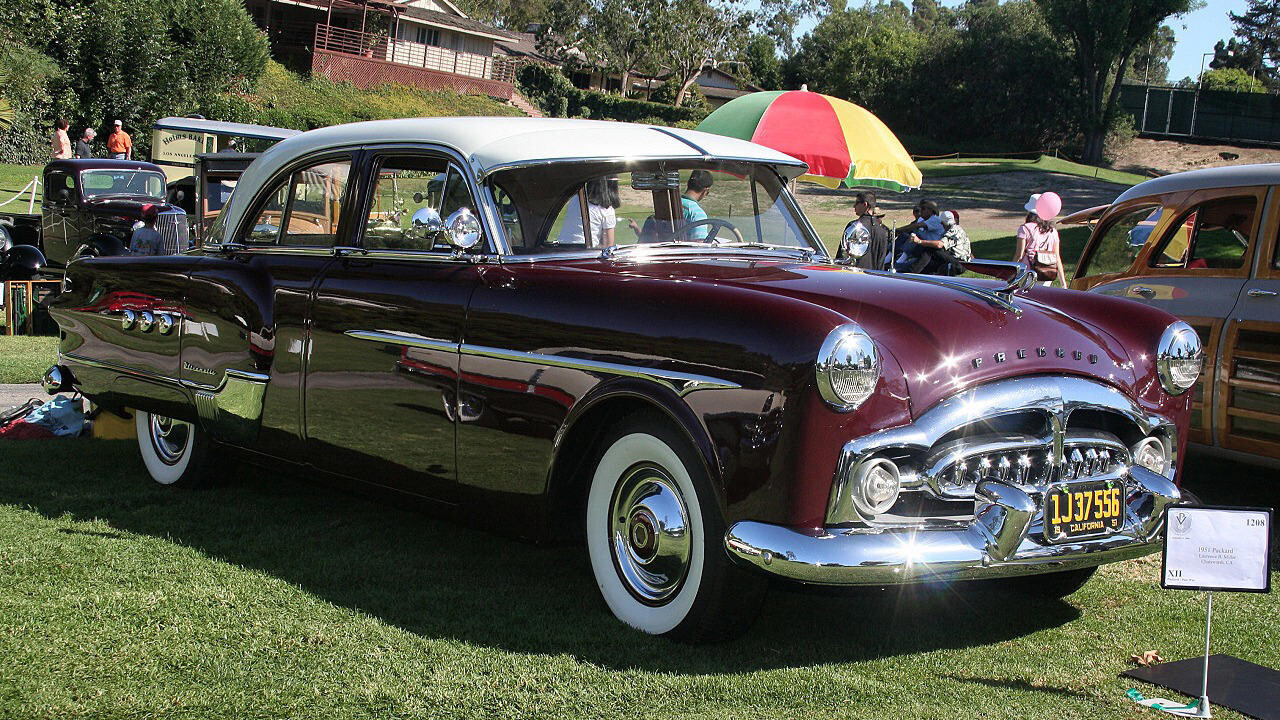
How the 1951 Packard Patrician defined postwar prestigeIn the early 1950s, American luxury motoring was being rewritten by chrome, horsepower, and the promise of effortless travel. Into that competitive arena, the 1951 Packard Patrician 400 arrived as a carefully judged expression of status, refinement, and continuity with a storied prewar marque. It did not simply chase prestige; it tried to define what postwar dignity and quiet wealth should look like on four wheels. Packard had built its reputation on reserved elegance long before tailfins and jet-age ornament took hold. The Patrician 400 translated that heritage into a modern package, setting a template for how a traditional luxury brand could respond to a rapidly changing market while still signaling that its owners belonged to the upper tier of American society. Packard’s search for a postwar flagship By the start of the 1950s, Packard faced a difficult balancing act. The company needed to replace its prewar Custom Super models with a new standard bearer that could stand alongside the latest Cadillacs and other aspirational cars. The answer was the Packard Patrician 400, which sources describe as the highest trim level that took over from the earlier Custom Super range. Packard concentrated its true luxury effort on this single sedan. Analysts of the period point out that, incredibly, for 1951, Packard offered only a genuine high-end model on a 127-inch wheelbase, the Patrician 400, and later even dropped the “400” part of the name. The decision concentrated prestige into a single body style, which some critics regarded as conservative, but it also made the Patrician the clear halo for the entire line. Meanwhile, the broader luxury market was moving quickly. General Motors, through Cadillac, was promoting a more extroverted vision of success, with tailfins and a growing emphasis on performance that can still be seen in the brand’s modern positioning on the official Cadillac site. Packard, by contrast, chose to refine understatement, betting that a significant slice of affluent buyers still preferred quiet authority over flamboyance. Design that signaled restrained wealth The Patrician’s body shared much of its basic structure with other 1951 Packards, but the detailing and proportions were carefully tuned to project senior status. Commentators have described the 1950 and 1951 Packards as modern and clean, less distinctive than contemporary Cadillacs yet intentionally understated, an impression echoed in period discussions of the 1950 Packards that led directly into the Patrician era. On the Patrician 400, brightwork was used to frame the car rather than overwhelm it. The grille was upright but not aggressive, the side trim long and linear, and the roofline formal without appearing stodgy. The long 127-inch wheelbase gave the car a planted stance that visually separated it from midline models. In an age when fins were growing taller, Packard’s choice to emphasize length and proportion over ornament signaled that the Patrician catered to buyers who did not need to shout. The interior followed the same philosophy. Contemporary descriptions of the Packard Patrician highlight rich fabrics, careful wood-grain finishes and a dashboard that blended modern instrumentation with traditional luxury cues. The environment was conceived less as a cockpit and more as a drawing room on wheels, a space where passengers could be chauffeured in comfort or where an owner-driver could enjoy a sense of club-like privacy. Mechanical refinement and the Ultramatic promise Prestige in 1951 was not only about appearance. Mechanical sophistication played a central role in the Patrician’s appeal. Packard had invested heavily in its own automatic transmission, the Ultramatic, which is documented in technical overviews of the Ultramatic system. By offering a proprietary automatic, Packard aligned itself with the most advanced luxury makers of the period and reassured buyers that they were purchasing a thoroughly modern car. Under the hood, the Patrician relied on Packard’s proven straight-eight powerplant, tuned for smoothness rather than outright speed. While rivals were beginning to emphasize higher horsepower figures, Packard’s long-stroke engine and careful sound insulation created a different kind of experience. The car’s character was defined by near-silent cruising and the sense that long distances could be covered with minimal fatigue, a quality that many owners valued more than sheer acceleration. The chassis also reflected Packard’s tradition of solid engineering. The 127-inch wheelbase not only added visual gravitas, it improved ride quality, especially on the less-than-perfect highways of the period. For buyers stepping up from smaller Packards or from other makes, the Patrician offered a tangible upgrade in comfort and road presence that justified its position at the top of the range. “400” and the language of status The name itself carried a deliberate social message. The designation “Patrician” drew directly on the Latin term for the hereditary elite of ancient Rome, a link that contemporary enthusiasts still highlight when they describe how The Packard Patrician name referenced Latin roots. The additional numeric label, 400, evoked the American concept of the “Four Hundred,” a shorthand for society’s most exclusive circle. Packard leaned into that symbolism. Contemporary club write-ups of the 1951 Packard Patrician 400 describe the model as the company’s top-of-the-line sedan, explicitly identifying the Packard Patrician 400 as the higher echelon of the brand’s offerings. The numeric tag appeared across several enthusiast summaries of the 1951 Packard Patrician 400 Sedan, introduced in 1951, which consistently emphasize that this single sedan represented the upper tier of the company’s lineup. Packard’s experiment with numeric naming extended beyond the Patrician. Archival references to the 1951 and 1952 Packard Patrician series explain that the automaker tried to use numbers to signal hierarchy across the range, with the 400 placed at the summit. That strategy created a clear ladder of status within the showroom, reinforcing the Patrician’s role as the aspirational goal for buyers of lesser models. Competition, context and quiet decline In the broader luxury market, Packard’s approach stood in contrast to the more flamboyant direction of its rivals. The same period saw Cadillac amplifying its image as the car of success, a trajectory that still shapes how the brand presents its heritage and current models on the Cadillac site. Where Cadillac embraced spectacle, Packard continued to cultivate an older idea of prestige, rooted in discretion. That strategy carried risks. Commentators looking back at the early 1950s Packards have described the 1951 design as handsome yet somewhat anonymous, a quality that could be a double-edged sword. One analysis of the 1951 Packard 300 notes how the sheetmetal carried into 1954 with only modest changes, including a more horizontal grille and a wrap-around rear window, as illustrated by period Old Car Brochures. The Patrician shared much of this conservative styling, which may have limited its impact against more adventurous competitors. Enthusiast discussions of later models underline how the Patrician name became associated with the brand’s final years. A retrospective on the Packard Patrician in the mid 1950s describes it as a classic American luxury car whose styling and positioning exemplified the closing chapter of the marque. Another enthusiast group post on the 1957 Packard Patrician explicitly connects that later sedan with the final days of Packard, reinforcing the idea that the Patrician badge carried the company’s prestige identity until the end. The seeds of that outcome can be traced back to the early 1950s. By concentrating luxury into a single 127-inch wheelbase Patrician 400 and relying on restrained styling, Packard preserved its traditional image but struggled to keep pace with the marketing and design arms race that defined the decade. The Patrician remained respected, yet it increasingly appealed to a narrower group of buyers who valued continuity over novelty. Legacy of the 1951 Patrician 400 Today, surviving examples of the 1951 Packard Patrician 400 are often treated as artifacts of a particular idea of American luxury. Enthusiast posts about the 1951 Packard Patrician 400 Sedan, introduced in 1951, such as the description that highlights the model as the higher echelon of automotive refinement in a rapidly modernizing era, show how owners still view the car as a benchmark of quiet opulence. One such summary of a 1951 Packard Patrician sedan emphasizes the 400 designation and the model’s flagship status. More from Fast Lane Only Unboxing the WWII Jeep in a Crate 15 rare Chevys collectors are quietly buying 10 underrated V8s still worth hunting down Police notice this before you even roll window down