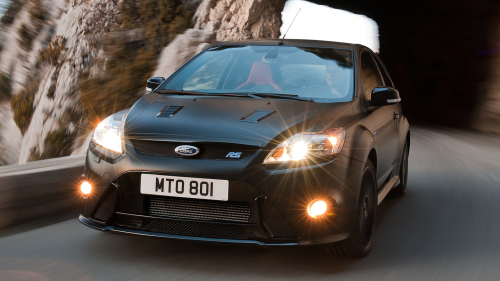
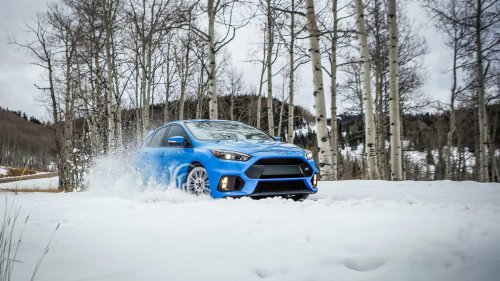
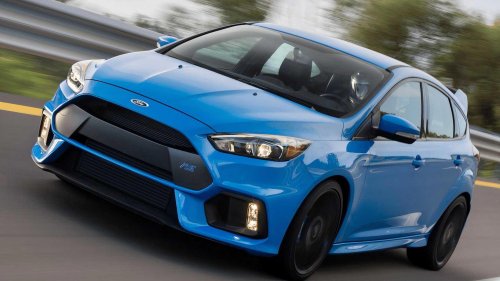
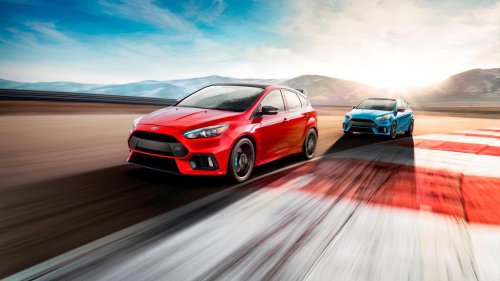



















Everybody loves a hot hatch, and few hot hatches have been as thrilling and game-changing as the third-gen Ford Focus RS. It was game-changing, not simply because it was the first Focus RS we received in the US, but because it arrived with 350 horsepower, all-wheel drive, and a six-speed manual. It was hardcore, uncompromising, and at least 75% were sold in blue (probably). In short, it was a blast, one that's kept the good times rolling years after its death.Produced from 2016-2018, it didn't have a very long run, but despite selling out its allotment, it couldn't survive Ford's decision to rid itself of passenger cars. If you did buy one, and you've held onto it, you're sitting on a sound investment that has held its value quite well. We would know, we've done the research, and if you're thinking about scooping up a Focus RS in the future, you'll want to read on to see what you can expect from a used Focus RS.To determine the current market value of the Ford Focus RS in 2025, this article uses a mix of our Drive Reviews and resale data compiled by AutoTempest. A Brief History of The Ford Focus RS Lineage ford focus rs500First, before we dive into Ford's incredible hot hatch, we wanted to do a quick dive into the Focus RS' history. The RS moniker actually goes back to the late 1960s in Ford's history, but it didn't show up on the Ford Focus until 1999 with the introduction of the Focus RS WRC. As the name suggests, this was a vehicle created to compete in the World Rally Championship as a replacement for the Escort WRC, and it was immediately a standout.As part of the homologation process, and because Ford probably saw a unique entrance into a niche segment, the company took a lot of what it learned building the rally car and other performance Focus models and put it into the 2002 Focus RS road car. Based on the first-generation Focus, the models received a slew of upgrades, including a bump in power to 212 horses and 229 lb-ft of torque, a host of aesthetic upgrades, a 5-speed manual, quicker steering, larger brakes, and a limited-slip differential. 4,501 were made and only sold in Europe, with the UK being its largest market.The second generation didn't arrive until 2008, and this one was even more foreign to us Americans thanks to being based on the Focus the rest of the world received outside the US. This other Focus featured many chassis, body style, suspension, and engine changes from our own, and received another RS version thanks to the success of the first. This one featured a Duratec engine based on the Volvo Modular Engine architecture, that sent 301 hp and 325 lb-ft of torque strictly to the front wheels.With the addition of another Quaife LSD and a new suspension set, it was a hot hatch revelation, that only got better with the introduction of the more powerful and exclusive RS500. Of course, we received nothing here, because Ford didn't believe we were interested enough in a high-performance hot hatch from the company. This didn't stop us from complaining, however, and with the introduction of the third-generation Ford Focus, not only did we receive a respectable ST version, but we were given the full-fat RS version the rest of the world was given, and it was every bit as good as we'd have hoped. How Ford Made One Of The Greatest Hot Hatches Of All Time _P9A1634_HRAnd finally, we get to the third generation Ford Focus RS, the king of them all. The last generation Focus that we had in the US was better than all the others. It was larger, more comfortable, and more refined than its predecessors, but that didn't stop Ford from unearthing the wild child within thanks to the work done by the merger of Ford's SVT and Europe RS divisions.The plan was simple: turn this Ford Focus RS into the greatest production RS model of all time. It was no small task, but they found the right formula. It started with the new, 2.3-liter EcoBoost engine also found in the redesigned Ford Mustang at the time, but while it made a mere 310 horsepower there, in the Focus it was punched up to 350 horses, with an equal 350 lb-ft of torque to match thanks to a myriad of RS-specific upgrades. Only one transmission was offered - a six-speed manual - so if you didn't know how to row your own, the Focus RS wasn't the car for you.This is a respectable power figure in 2025, meaning in 2016 it was nearly unheard of in anything in any car of this caliber. That power was then sent to Ford's new torque-vectoring all-wheel-drive system that was capable of sending up to 70% of the car's power to the rear wheels, a necessary feature given the car introduced an industry-first Drift Mode, which allowed drivers to explore their inner Colin McRae when they found an empty gravel road or snow-covered parking lot.The suspension and chassis were revised to handle the extra power and more aggressive cornering the car was going to be capable of, and your choice of Michelin Pilot Sport tires meant you could optimize your RS for the track or the road. In addition to the added performance, it was given significantly improved looks compared to the regular Focus or even Focus ST, with an aggressive front fascia that looks like it's going to swallow any competitor in its path, a large rear wing for improved stability, and 19-inch tires that helped the RS look the part.In addition to the twin exhaust pipes, aggressive rear diffuser, and Recaro bucket seats, this was a model that meant business inside and out. Yes, you could tell where money was saved in the interior, but this was a car that was all about the driving experience and bragging rights, and those bragging rights didn't come cheap. The Market Value in 2026 2016 Ford Focus RS front 1/4When the Ford Focus RS hit dealer lots in 2016, it started at $36,605, which equates to a whopping $50,500 in 2026, when accounting for inflation. The price of the car increased over the following two years to $41,120, but this was still reasonable for a car with the performance this one had. Prices fell marginally in the couple of years after it was first discontinued, but they never fell substantially as buyers immediately understood they had something special on their hands, especially once the Focus as a whole was discontinued here.Here are some examples currently on sale at the time of writing, listed from oldest to newest, and then cheapest to most expensive:The cheapest examples we found cost under $20k, with mileage varying from 75,000 to over 110,000 on the clock. Most of the used examples on sale at the time of this writing were around the $25k and up mark, with really pristine examples prices as high as $53,000 - the latter having just over 4,000 miles driven, and a clean history devoid of any accident damage.If we assume an average price for good condition used models of around $25k, you can score a hot hatch with unique looks and a lot to offer for the same price as a really basic new compact sedan like the Hyundai Elantra or entry-level crossover like the Kia Seltos. however, completed sales are much truer signifiers of value than listings, and in that case, you can see that resale prices have gone up over the years, meaning you have a solid investment on your hands, ten years later. Should You Buy One Now? 2016 Ford Focus RS Driving Red And Blue The age-old question is: when should I buy it? It's a tough one to answer, but the consensus is you need to seize the moment, so it's always best to buy when you can. A good rule of thumb is that the winter is generally a better time to buy than the summer because less foot traffic into dealerships gives dealers an extra incentive to be more aggressive with discounts and deals.If you're looking at a car from a private seller, however, that advice goes out the window. This is when it pays to be vigilant and do your homework. Scrolling through an online marketplace, you may have found what appears to be the perfect vehicle, but don't let your desire for the vehicle cloud your judgment. Here are some common things to keep in mind:Maintenance Records: Ensure the car has a complete service history, particularly for the head gasket issue common in earlier models. Modifications: Check for aftermarket modifications, as these can affect reliability and resale value. Drivetrain and Suspension Wear: Inspect these components for signs of excessive stress or wear from spirited driving. Body and Paint Condition: Look for any signs of accident repairs or rust, especially in regions prone to harsh winters. There have also been grumblings of suspension troubles and electrical gremlins when it comes to Drive Mode selection, but for the most part, these seem to be isolated issues. If they haven't cropped up on the used example you're looking at yet, odds are you're good, but we still recommend you take the model on a long test drive (NOT the time to learn how to drive a manual) and get a pre-purchase inspection. Yes, it'll cost you a few hundred more dollars, but if it saves you thousands down the line, it's worth it.