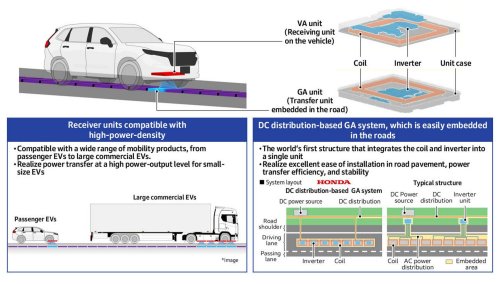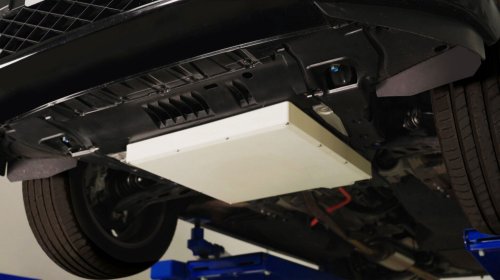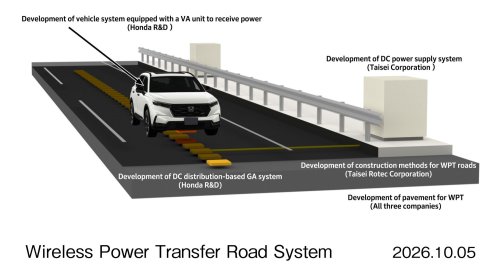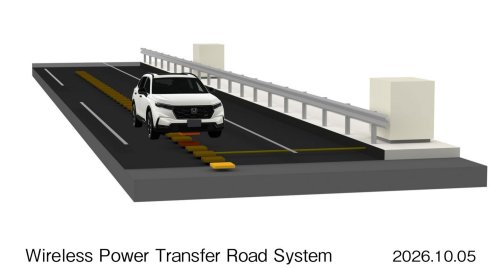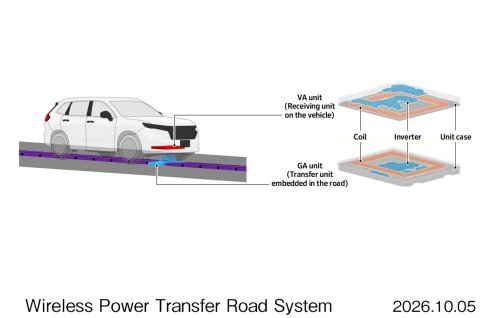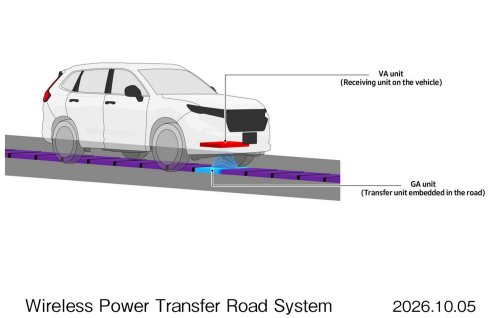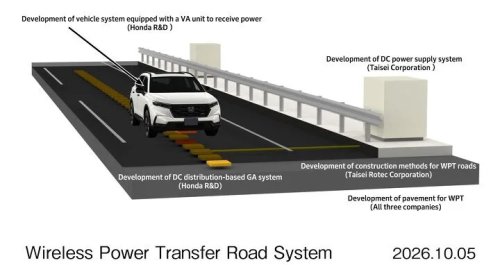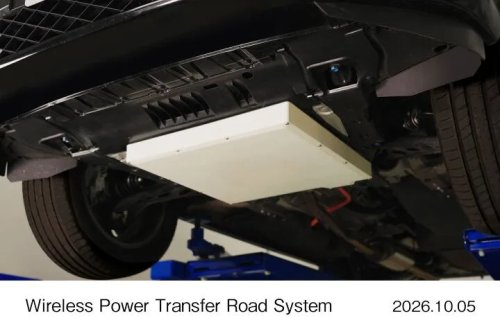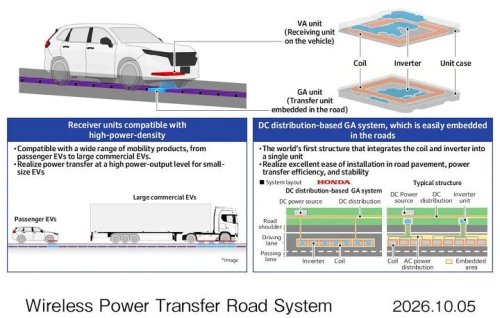



















1 / 2Honda Wants to Charge Your EV Through the Road, and It’s Squaring Off With Toyota on a Japanese ExpresswayHonda has spent five years figuring out how to push electricity through asphalt into a moving vehicle. Now it says the core hardware works. The harder part comes next: proving that the hardware survives years of loaded trucks driving over it at expressway speed.On October 5, Honda R&D announced that it had developed the base technology for an in-road magnetic coupling charging system with general contractor Taisei Corporation and paving specialist Taisei Rotec. Public-road demonstrations are planned from Japan's 2027 fiscal year, which starts April 1, 2027. Honda says the first target is logistics and transportation, not your commuter car.Where the test happensThe public road is a short piece of real expressway. East Nippon Expressway's May 2026 release describes the Tateyama Project, a roughly 300-meter section of the E14 Tateyama Expressway main line near Kimitsu Parking Area. NEXCO East calls it Japan's first in-motion wireless charging trial on an expressway main line. Multiple runs are scheduled from fiscal 2027, with technical support from the University of Tokyo's Fujimoto-Shimizu lab.Dodge's 1,348% Charger Sixpack Jump Started From 238 Leftover CarsA Stolen $50,000 Chevelle Allegedly Went for $9,500 Cash and No Title. The Buyer Is Charged Too.The detail most people will skip is the most interesting one. Two teams share that 300 meters: Honda with Taisei, and Toyota with Denso and Obayashi. That makes this a head-to-head bake-off on the same stretch of pavement, with Japan's road operator watching.How Honda's version worksThe system has three parts: a DC power supply at the roadside, a chain of "ground assembly" units buried in the lane and linked by DC cabling, and a receiver mounted under the vehicle. Honda's headline claim is that each buried unit combines inverter and coil in one package. By Honda's own research, no one had publicly disclosed that design before the end of September 2026.The reason is practical. If each puck has its own inverter, the cable under the road can carry plain DC, and Honda says that cuts wiring and parts count. The units are also designed to drop into milled-out slots in existing pavement and to be upgraded during future resurfacing. That's the real business pitch: wire the road the next time a crew is already tearing it up, instead of building a special charging lane from scratch.The punishment phaseStarting in late 2026, the partners will build a new test road at Taisei's T-FIELD/TAMRA facility. It will absorb 1 million wheel loads at 49 kN per wheel, which is about five metric tons pressing down through a single tire, again and again. The same program will test leakage of the electromagnetic field. Earlier validation at Taisei's Satte site was aimed at vehicles of roughly 20 tons gross.Only after that phase does Honda plan to verify output of up to 150 kW and reliability at high speed. Read that carefully: 150 kW is a goal, not a demonstrated result.Napkin math, and the competitionAt 80 km/h, a truck covers 300 meters in about 13.5 seconds. At a full 150 kW, that's roughly 0.56 kWh, which won't move the gauge much. A demo strip proves the hardware works. Only many kilometers of strips would add real range.Honda also isn't first. The Indiana DOT says a Purdue-designed segment delivered 190 kilowatts to a Cummins truck traveling at 65 mph. Electreon says a 1.5-kilometer stretch of France's A10 near Paris now charges moving trucks, buses, vans, and cars. Honda's angle is cheaper installation and easier upgrades, not raw power.Honda changed its mindThis is not Honda's first attempt at an electric road. In 2021, a Honda presentation outlined a conductive Electric Road System for heavy trucks. It used a collector arm reaching out to a powered roadside rail, charged at 450 kW, and paired that with a 100 kWh battery and an 80 km/h speed limiter. A JSAE paper abstract from Honda R&D the same year confirms the side-contact approach.GM Lost 41,028 EV Sales After the $7,500 Credit Died. Its Entire U.S. Drop Was 39,373.Iowa Lawyer Gets Prison for Telling Medicaid the Rolls-Royce He'd Crashed Was Worth $194,000Moving from a physical arm to magnetic coupling gives up peak power for fewer moving parts and no exposed conductors. It also produces something that could, in principle, serve passenger cars as well as trucks. That tradeoff says Honda now cares more about building something a road agency will actually approve than about setting records.What it means for ownersFor now, nothing changes for American Honda buyers. No US deployment has been announced. What's still unsettled:NEXCO East says the coils only energize when they detect an equipped vehicle passing overhead. Ordinary traffic driving over them gets nothing.Repair and liability questions are unresolved: who pays when a crash or a tire fire damages a buried unit, and whose insurer covers it. The modular, upgradeable design looks built for quick swap-outs, but no one has published a claims framework yet.The electromagnetic leakage tests matter for regulators long before they matter for drivers.Honda will show the hardware at Japan Mobility Show Bizweek, October 13–16, and at the ITS World Congress in Gangneung, South Korea, October 19–23. Trade-show booths are easy. The real test is about 300 meters of Tateyama Expressway with loaded trucks rolling over it, starting in 2027.If a crash tears up a buried charging coil, who should pay: Honda, the road operator, or the driver's insurer?⚡ Read the full article on The Auto Wire