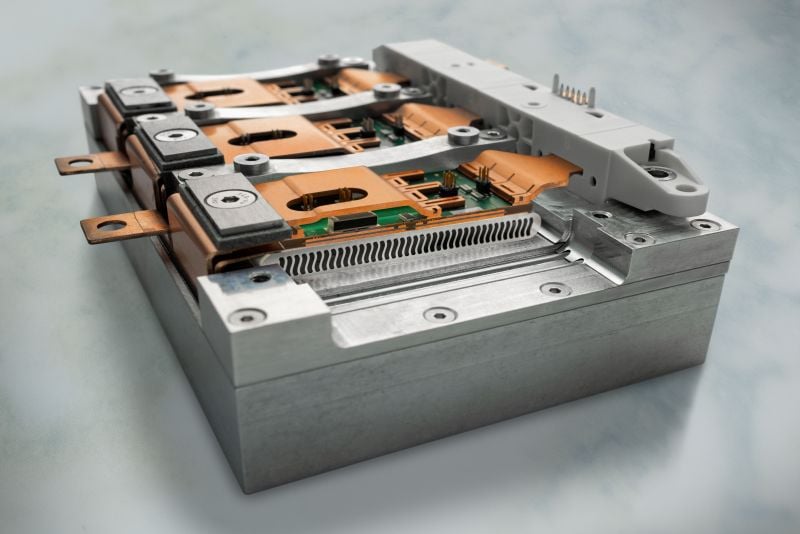
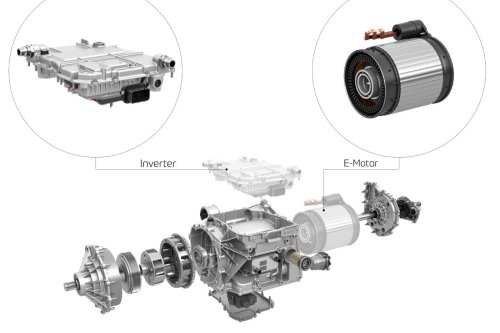
Image: Fraunhofer IZM | Volker MaiInverters are central components in electric drivetrains. They control the energy flow between the battery and the motor, determining efficiency and performance. Led by Wiljan Vermeer, the Power Electronic Systems group at the Fraunhofer Institute for Reliability and Microintegration (IZM) has focused intensively on this key component. The latest project was commissioned by Mitsubishi Heavy Industries (MHI), a Japanese conglomerate with over 300 subsidiaries primarily active in heavy industry, mechanical and vehicle engineering, aviation, and the electronics sector. In the electromobility sector, Mitsubishi Heavy Industries Thermal Transport Europe GmbH, based in Osnabrück, is a well-known name.According to Fraunhofer IZM, their work has fundamentally advanced inverter technology. The result is a novel, cost-effective inverter that delivers 500 kilowatts of power in a volume of just one litre and achieves an efficiency of 99 per cent thanks to its extremely low inductance. According to the developers, this was made possible by ‘four tricks’ which give the inverter its edge.The first trick involves twelve SiC semiconductors per embedded power module. This module is installed in the inverter in triplicate – one for each phase. The researchers state that the modules are decoupled from the DC-link capacitor by an RC damper (“to reduce unwanted oscillations and increase the switching speed”) and are equipped with twelve silicon carbide switches. These are MOSFETs specified by the partner and customer, MHI, and they are embedded right onto the PCB to save space. “The end result is highly compact modules with an extremely small electromagnetic footprint. Their effective inductance is just one nanohenry – low enough to not limit the switching speed and allow switching at the MOSFETs’ limit, with 63 volts per nanosecond. Faster switching means lower losses, which in turn reduces the need for cooling,” explained Fraunhofer IZM.The second key aspect is extruded aluminium coolers. Beneath the three modules lies a flat aluminium cooler. Its low-profile design not only saves significant space but also allows for a short thermal path from the semiconductor to the coolant, the experts say. Inside, more than 40 thin, slightly corrugated fins provide the flowing coolant with sufficient contact surface for heat exchange. “Aluminum offers the advantage of low material costs and highly cost-effective production via the extrusion process: The entire heat sink is produced in a single step, a design that saves both space and money,” the team comments.The third innovation is laser welding as a connection technique. “The contacts of the busbars were formed just so that we could laser-weld them directly onto the circuit board. That means we could get rid of screws that would not only eat up valuable space but increase inductance as well,” explains project leader Wiljan Vermeer. The vertical integration of the two input busbars also allows them to be positioned close enough to one another so that their fields nearly cancel each other out, further minimising inductance.The fourth design trick relates to the technology and arrangement of the DC-link capacitors, which buffer the power of the modules. In collaboration with the company PolyCharge, their NanoLam capacitors were specifically configured for this purpose, and “arranged side by side with the busbars, so that the DC link reaches a total inductance of only two nanohenries despite a capacity of 300 microfarads,” according to the research team. The nanotechnology of the capacitors enables a very high power density but also results in increased thermal losses – another challenge for the cooling system.“We picked copper contacts for their better dissipation of the heat,” says Vermeer. “Our system was designed so that the electrical connections balance the poorer heat distribution, spreading the heat equally both horizontally and vertically. The capacitors can stand a maximum temperature of 150 degrees centigrade, but we limited them to 130 degrees in the interest of reliability.” By conventional standards, this is still a very high value. The excess heat is transferred over a short path to the aluminium cooler described above, which also dissipates the heat from the power modules, the experts add. To achieve this, the capacitor unit is positioned beneath the aluminium cooler and integrated within the housing, further reducing the required space.The team is convinced: “With its combination of innovative power electronics, capacitors, and cooling systems, the inverter takes 800-volt drive technology to a new level.” With 500 kilowatts, it surpasses many current alternatives by a factor of five and the previous state-of-the-art technology by two and a half times. The efficiency of 99 per cent also sets a new benchmark – and with comparatively moderate production costs.Wiljan Vermeer will present the new inverter to the public at PCIM Europe in Nuremberg from 9 to 11 June 2026 at the Fraunhofer IZM stand (Hall 6, Stand 440).izm.fraunhofer.de