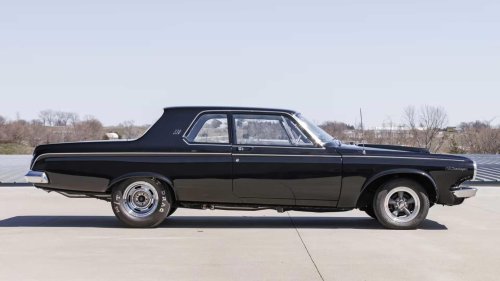
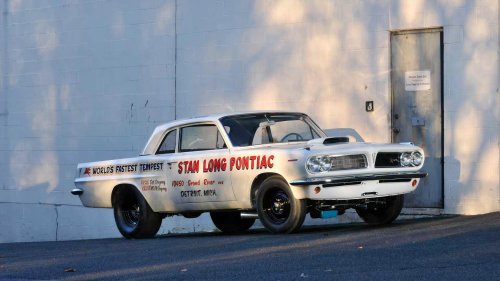
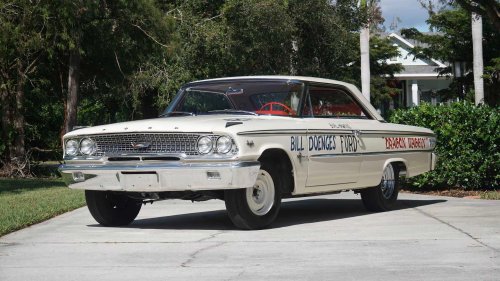
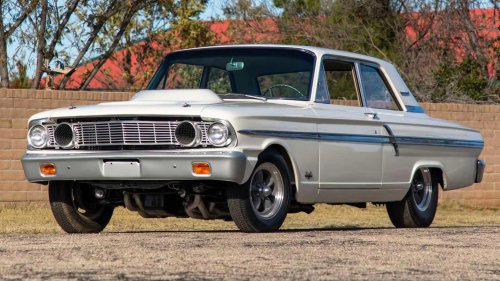
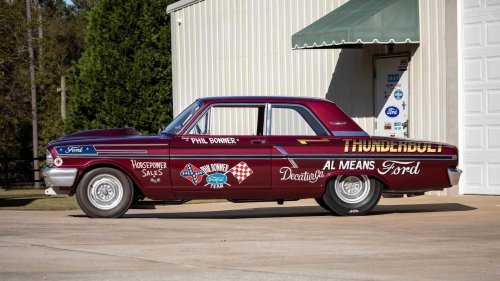
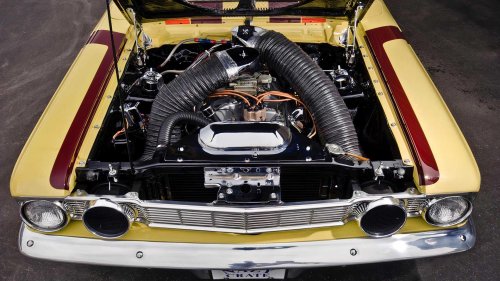
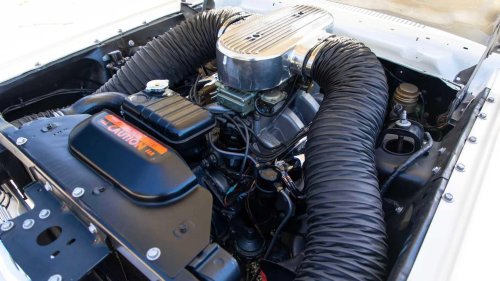
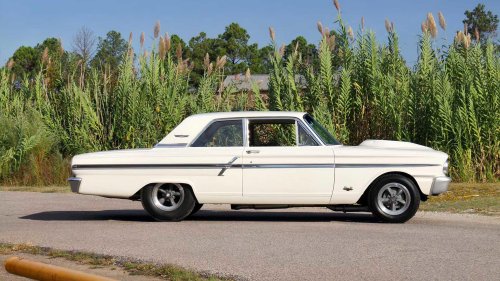
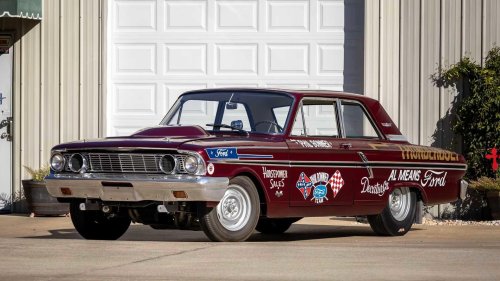
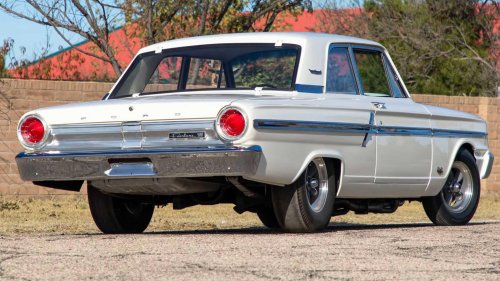


















If you walked into a Ford dealership in early 1964 to see what they have to offer, you'd walk past polished Galaxies and small Falcons, and then you would spot a Fairlane that looks unfinished, skeletal, and completely out of place. The first thing you notice is the inner headlights are gone, replaced by mesh-covered gaping holes. Once you take a peep inside, you notice that the carpet and sound deadening have vanished, the dash is missing a heater and radio, and the standard Fairlane seats have been replaced by two flimsy Econoline van seats bolted to the floor.After a bit of sleuthing, you discover a plaque riveted behind the glovebox door, and after reading it, it all makes sense, as it bluntly informs you this is a purpose-built weapon for sanctioned competition. Suddenly, it dawns on you that you're looking at the wildest Fairlane you've ever seen. When Factory Race Cars Roamed Dealer Lots Via Mecum AuctionsTo understand why Ford was suddenly selling skeletal Fairlane race cars to the public, you have to look at the lawless, high-octane world of early 1960s drag racing. After World War II, returning veterans with military-honed technical skills started tinkering with cars to see how fast they could get. They then started facing off on dry lake beds and wartime runways, giving birth to the drag racing fever that gripped the American car scene from the 1950s onwards.Drag racing quickly became one of America's fastest-growing motorsports, especially after the establishment of the NHRA, and as the crowds grew, Detroit took notice. Manufacturers realized that a trophy on Sunday meant sales on Monday, turning the local drag strip into the ultimate proving ground for performance. Fighter Jets With Blinkers: When Street-Legal Meant Nothing Via Mecum AuctionsAs drag racing became more mainstream, the line between a family car and a professional dragster kept getting thinner. Back then, NHRA rules dictated that parts used on the track had to be available for purchase by the public, and to win on Sunday, manufacturers were forced to sell legitimate, factory-built weapons on Monday.These cars technically carried license plates and VINs to satisfy the rulebook, but they were about as street-legal as a fighter jet with blinkers. Technically, anyone with a fat wallet could walk into a local dealership and leave with a lightweight, high-compression monster.Ford's Rivals Set The Early PaceVia Mecum AuctionsBy the mid-1950s, the Big Three were deep into drag racing culture and were openly promoting their high-performance machines to racers and regular performance-oriented buyers. But in 1957, the party came to a screeching halt. Cars were getting too fast, and facing mounting pressure over safety, the Automobile Manufacturers Association (AMA) passed a resolution banning factory-backed racing and performance-based advertising.Eager to maintain its corporate dignity, Ford initially upheld the ban. Its rivals didn't. While Dearborn sat on the sidelines, Chevrolet and Pontiac simply moved their racing budgets under the table, as did Chrysler. Pontiac was particularly successful with the Super Duty 421 program, which helped make it the third best-selling brand in the country. Ford Decided To Fight Back FordIn 1962, Ford realized that while it was following the AMA resolution, the competition was cleaning up at the track and siphoning off young buyers as a direct result. Furious about Ford's cratering market share, Henry Ford II tore up the AMA resolution and launched the Total Performance campaign.This wasn't just a clever marketing slogan; it was a top-down, no-expense-spared mandate to dominate every quarter-mile, oval, and road course on the planet. The gentleman's agreement was dead, and the horsepower war was officially on. The Galaxie Gave Ford Real Momentum, But It Wasn't Enough MecumFord's initial weapon of choice for the Total Performance era was the full-size Galaxie, a massive cruiser that relied on the legendary 427 "High-Riser" V8 to bully its way to the winner's circle. The Galaxie was surprisingly effective, especially in NASCAR, but by 1964, the full-size platform had reached its absolute limit. The competition was getting leaner and meaner, and even the "Lightweight" Galaxie versions couldn't get down to the 3,200 pounds required to stay competitive in NHRA Super Stock.The Blue Oval needed a new, lighter weapon fast, and Dearborn's skunkworks team turned its attention to theFord Fairlane, which had adopted a new midsize platform in 1962. What came out of Dearborn was a lightweight, stripped-to-the-bone weapon that blurred the line between a factory production car and a professional dragster. Meet the 1964 Ford Fairlane Thunderbolt. 1964 Ford Fairlane Thunderbolt: A Purpose-Built Race Car Pretending To Be A Production Car MecumThe star of the show is the Ford Fairlane Thunderbolt, which was designed to turn the mild-mannered Fairlane 500 two-door "post" sedan into a world-beater by shedding some weight and stuffing the 427 "High-Riser" V8 under the hood. This wasn't just a trim package; it was a full-blown racing conversion so radical that Ford's own assembly lines couldn't handle the job, which is why the management partnered with Dearborn Steel Tubing.Since the engine was originally built for the full-size Galaxie platform and wouldn't be an easy drop-in into the smaller Fairlane, DST's job was to perform a brutal surgery on the Fairlane chassis to ensure that the engine could fit, which required extensive modifications. Once that was done, DST's next job was shedding unnecessary weight. Ford Put The Fairlane 500 On A Serious Diet Mecum AuctionsWhile the Fairlane platform was much lighter than the Galaxie's, Ford still had to perform extreme weight-saving measures to hit that 3,200-pound NHRA sweet spot. For starters, the hood, front fenders, and doors were replaced with featherweight fiberglass, while the side and rear windows were swapped for thin Plexiglas. Aluminum bumpers also replaced the heavy steel units in some cars.The weight-saving measures continued inside, which looked more like a barren wasteland than a midsize family hauler. The Thunderbolt had no radio, no heater, no sun visors, no carpets, and no sound-deadening material. Ford even went so far as to rip out the front bench seat and replace it with two Econoline van seats bolted to the floor. After the work was done, the Thunderbolt reportedly weighed approximately 3,203 pounds. Ford's 600-Hp 427 Was The Heart Of The Madness MecumOne of the first Thunderbolt features that caught the eye was the massive, teardrop-shaped bulge on the hood. This wasn't a styling feature; it was a preview of the monstrosity that lived underneath. The soul of the Thunderbolt was the legendary 427 High-Riser V8, a massive, no-compromise, racing weapon that had no business being in a midsize car.The High-Riser V8 was specifically over-engineered to crush the competition in NASCAR and drag racing, and featured an FE block with cross-bolted main caps and forged internals to survive the brutal stress of high-RPM racing. The "High-Riser" name itself refers to the tall intake ports and high-rise manifold designed for maximum airflow, which is why the now-iconic teardrop-shaped hood bulge was necessary. The Numbers Backed Up The Insanity MecumFord conservatively rated the powerhouse at 425 horsepower, but the truth was more terrifying. With its dual four-barrel Holley carburetors and a stratospheric compression ratio, actual output was estimated to be closer to 600 horsepower, enough to turn the lightweight Fairlane into a literal rocket on the strip.The Thunderbolt didn't just fire warning shots at Detroit on spec sheets. In initial testing at Lions Drag Strip in late 1963, before any customer was able to buy one, a four-speed Thunderbolt clocked a blistering 11.61-second quarter-mile at 124.8 mph, putting it in a class of its own. Ford built enough cars to satisfy NHRA homologation rules before the February 1964 Winternationals, with final production amounting to just 100, including 49 four-speeds and 51 automatics. The first 11 Thunderbolts were Vintage Burgundy, and the remaining 89 were Wimbledon White. Ford Sold It Through The Dealer Network With A Built-In Disclaimer MecumBecause of the NHRA's rules at the time, Ford had to make this monster available to the public. That meant a buyer could walk into a select dealership, hand over their cash, and drive away with a title, a VIN, and enough power to warp the pavement.The Thunderbolt was technically street-legal, but Dearborn wasn't pretending this was a commuter. They knew this vibrating, Plexiglas-windowed beast wasn't meant for the average Joe, and they made sure to communicate that by riveting a blunt disclaimer behind the glovebox door:"This vehicle has been built specially as a lightweight competitive car and includes certain fiberglass and aluminium components. Because of the specialized purpose for which this car has been built and in order to achieve maximum weight reduction, normal quality standards of the Ford Motor Company in terms of exterior panel fit and surface appearance are not met on this vehicle."This was the ultimate enter at your own risk warning and also served as a legal shield for the Blue Oval. Ford Thunderbolt Legacy Today Mecum AuctionsFord didn't just build the Thunderbolt to flex in brochures. They built it to dominate, and it delivered exactly that. In its 1964 debut, the Thunderboltcaptured the NHRA Manufacturers' Cupand the Super Stock world title with Gas Ronda behind the wheel, leaving a trail of broken Mopars in its wake. However, its dominance was so absolute that class rule changes effectively outlawed it after just one year.Beyond its heroics on the track, the Thunderbolt represents an era when corporate suits gave Detroit's engineers a blank check for absolute track madness and a time when local dealerships were essentially fronting as arms dealers for the NHRA. It also helped launch Ford's Total Performance era, which ended up giving us icons like the Ford Mustang and Ford GT40, among others that gearheads still love today. From Dealer Oddity To Six-Figure Classic MecumSource: Hagerty Valuation ToolThe Thunderbolt is a rare, factory-built dragster with one of Ford's greatest V8 engines, a body sculpted with domination in mind, and a racing pedigree so lethal the NHRA had to ban it after just one season. It's a recipe that sets the collector world on fire, but it doesn't come cheap. A Thunderbolt would set you back just under $4,000 back in 1964, which was a steep price for a car with no heater and van seats, but a bargain for those who knew what it was. That figure pales in comparison to the eye-watering prices collectors have to pay for one today, even after adjusting for inflation. A genuine Thunderbolt costs about $204,000 on average, with pristine examples fetching higher prices.From its missing headlights to its humble Econoline seats, every inch of the Thunderbolt was designed to dominate the quarter-mile. It stands today as Ford's most lethal drag weapon and the ultimate symbol of a lawless frontier where the Big Three fought for cultural relevance one quarter-mile at a time. Even though it requires deep pockets to own today, it's worth every penny.Sources: Ford Racing, Hemmings, Hot Rod, Hagerty, Classic.com