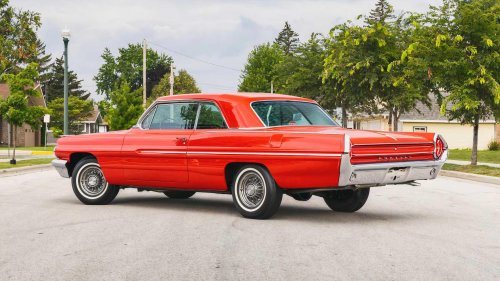
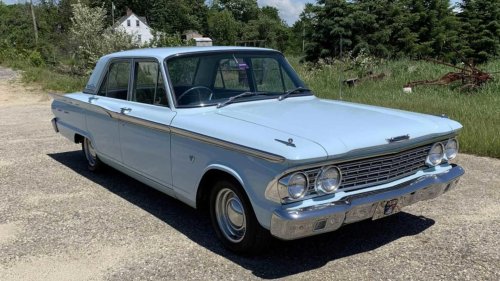
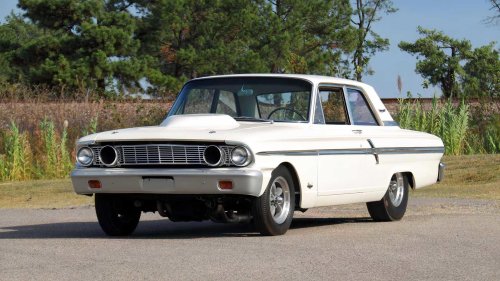
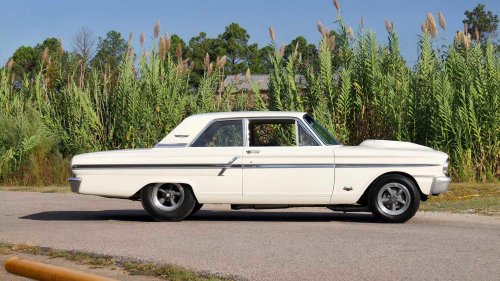
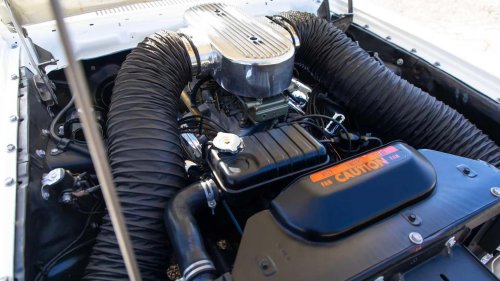
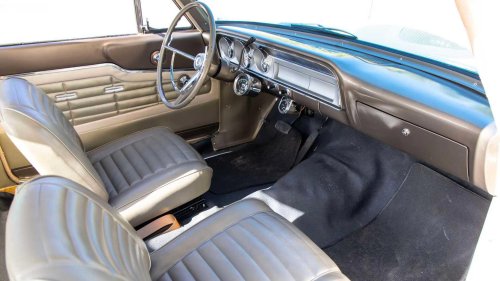
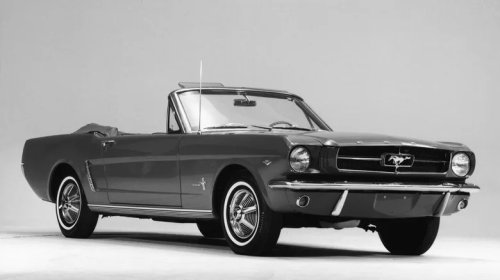
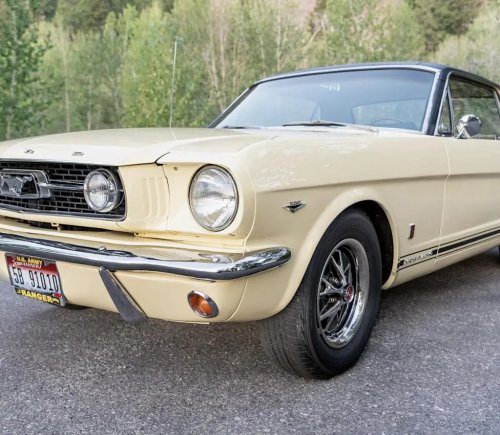
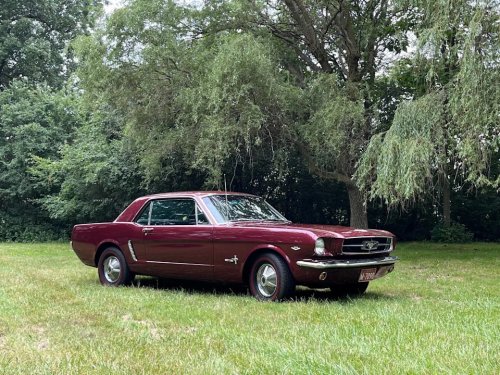
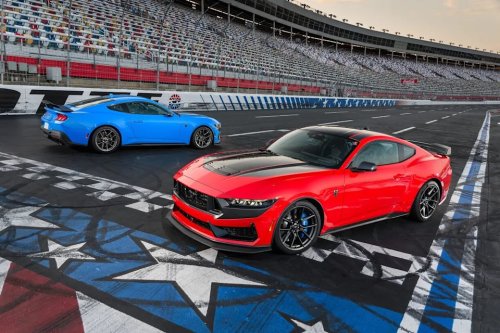
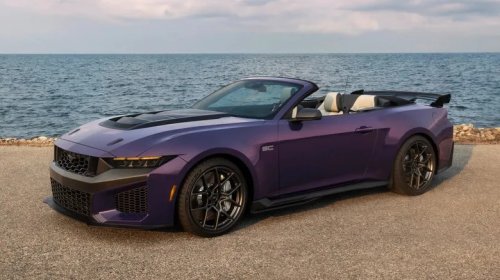
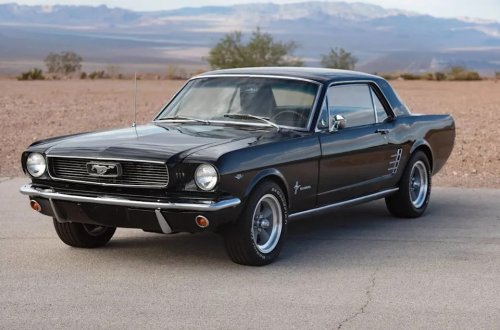
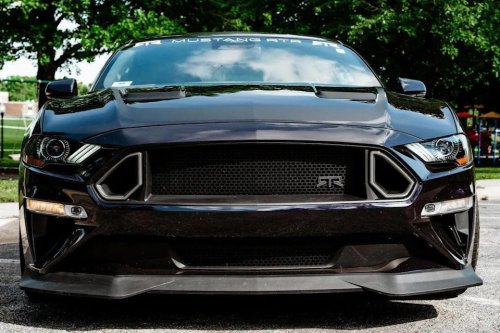
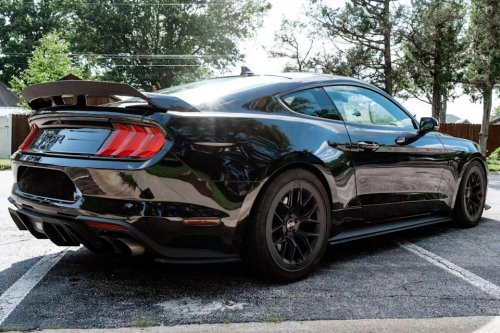
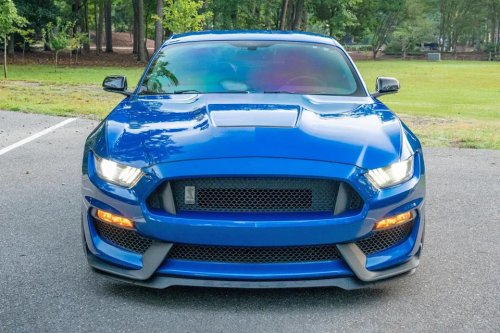
The Ford Mustang was the car that put the Blue Oval on the map, right? The iconic pony car, which still exists today in a number of flavors right up to an 815-horsepower GTD, was the sales success that changed the company's fortunes. It is true that Ford sold almost half a million Mustangs in the first year alone, and that the model helped give the company a more youthful vibe. But there was a performance car that predated the Mustang that helped change the perception of what was possible from Dearborn. This machine was a fairly sedate and boxy coupe that Ford turned into a drag racing monster, and not much could touch it on the track. Ford Was Looking For Racing Cred In The '50s And '60s Mecum At the beginning of the '60s, young people were losing interest in cruising down to a diner in their dad's Buick for a milkshake. The new affluent car buyer seemed to be interested in one thing: speed.Pontiac was one of the carmakers leading the charge into this brave new market, with cars like the wide-track Catalina, a stylish model that appealed to a younger generation.Sensing this step change, Ford launched Total Performance, a new ethos that filtered motorsport success into mainstream cars. Henry Ford II himself called for this new image and advertising strategy to be put into place as soon as possible. The new models would be more angular and aggressive, with speed at the forefront of design rather than cushy comfort. Ford Was Serious About Winning On The Track And In Showrooms FordOne of the clearest examples of Total Performance was the 1962 Mustang I. This wild concept featured a 1.5-liter V4 drivetrain from the Euro Ford Taunus and was very much in line with the lightweight Porsches of the time. But while the Mustang I would take a couple of years to turn into the iconic pony car that we recognize the Mustang as today, Ford was working on a souped-up version of another model to bring the customers in.Drag racing had gone from being popular in the '50s, to becoming a national sport, thanks to the National Hot Rod Association. But while the sport had its roots in backstreet hot rodding, by the early '60s the big manufacturers were getting involved, sensing a marketing opportunity. Ford just needed a car. The 1964 Ford Fairlane Thunderbolt Was Wild Mecum 1964 Ford Fairlane Thunderbolt SpecsFord had been using the huge Galaxie for drag racing, but had come to the end of the road. Almost everything that could be removed was, and nothing was going to make the Galaxie lighter. So, the carmaker was looking for a smaller mode. The Fairlane nameplate had been given to a new "senior compact” line in 1962, running 11.7" shorter than regular Fords. The Fairlane 500 Sport Coupe was the sporty option, but it was only fitted with a 260 cubic-inch V8, and later a hot 271 hp 289 V8.The Fairlane had plenty of potential for racing, it just needed the right engine. Ford sourced a massive 427 from the Galaxie line-up and shoehorned it into 289 Hi-Po Fairlanes, which came fitted with a chunky 9-inch axle. The engine was mated to either an aluminum-cased top-loader four-speed or a reworked Lincoln Cruise-O-Matic. Power was officially rated at 425 hp and torque at 480 lb-ft, although the former figure was likely more like 500 hp. The Fairlane Thunderbolt Was Unbelievably Fast Mecum Even by today's standards, a Fairlane Thunderbolt was incredibly fast. The Ford could hit 60 mph in 4.7 seconds, according to Hemmings. This puts this early '60s car a whisker behind a 2026 Ford Mustang GT with the manual transmission, which hits 60 mph in 4.2 seconds. The EcoBoost Mustang is even closer to a Fairlane Thunderbolt, hitting 60 mph in 4.5 seconds. But the Fairlane wasn't really about hitting 60 mph, it was about demolishing the quarter mile.Dick Brannan, something of a drag racing legend, covered a quarter mile in a Thunderbolt in 11.08 seconds at 128 mph. That would be way ahead of a modern Ford Mustang GT, which would cover the quarter mile in 12.5 sec at 114 mph. Gaspar “Gas” Ronda also managed an ET of 11.78 at 123.4 mph at the wheel of a Thunderbolt. The Fairlane Thunderbolt Was An Exotic Straight Out Of Detroit MecumIt wasn't just brute power that made the Thunderbolt quick. Ford put in extensive work to make the car as exotic as possible. Dearborn Steel Tubing took delivery of the standard cars for the Thunderbolt conversion, curving tubular headers around suspension components just to fit in the engine bay.Ford got the car down to just over 3200 pounds, the NHRA minimum to compete in the Super Stock class, with drastic measures. The sound-deadening material, heaters, seam sealer, radio, spare tire, and carpeting were all tossed, with fiberglass doors, front fenders, and hood bolted on. Plastic side windows were added, too, and the factory seats were replaced with a pair of Econoline van buckets. A high-rise bonnet was created to fit the 427, with air fed through two snorkels where the high-beam headlights should be. The Fairlane was a wild-looking drag machine, and anyone lining up against it probably felt like running for cover. The Fairlane Is A Rare Buy Today Via: Mecum AuctionsThe Fairlane Thunderbolt was never intended to be a mass-produced model. Ford produced the minimum 50 cars to homologate the Thunderbolt for 1964 competition, and it is thought that just 100 cars were built in total for racing. The Thunderbolt was only available for 1964, but Ford launched the Mustang that year with almost immediate success.The Thunderbolt is a pretty cool precursor to the big block muscle cars that hit the streets in the late '60s, and today doesn't come cheap. Expect to pay $201,000 for a Thunderbolt in good condition, says Hagerty. Following the Thunderbolt, Ford's racing aspirations headed in a different direction. By 1966, Ford had taken the GT40 to Le Mans and managed a clean sweep of the podium. The Fairlane Thunderbolt lives on, however, as one of the company's most focused, but yet wildest, motorsport creations to date.Sources: Hagerty.com; Hemmings