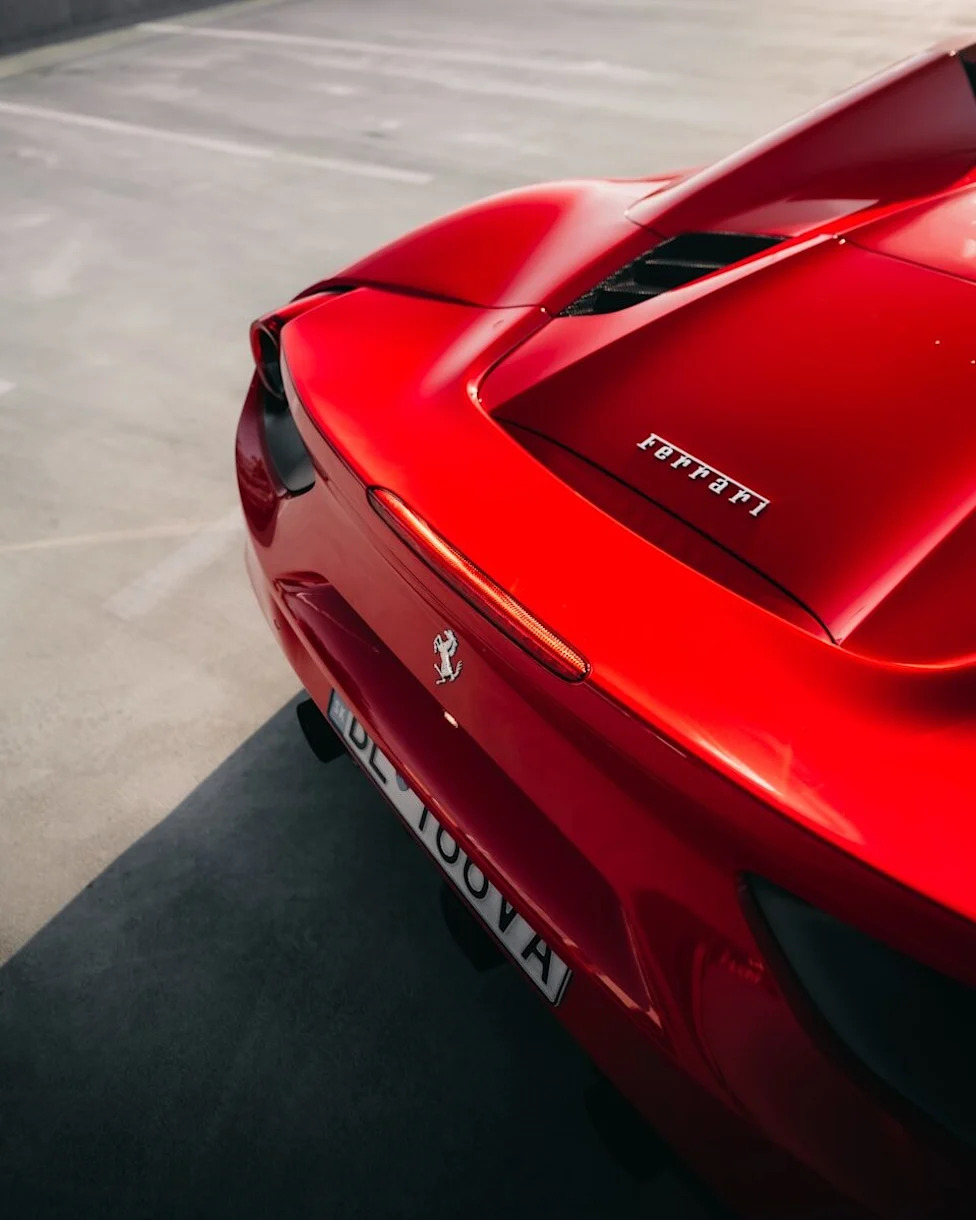
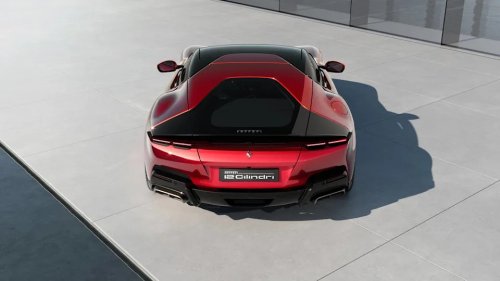
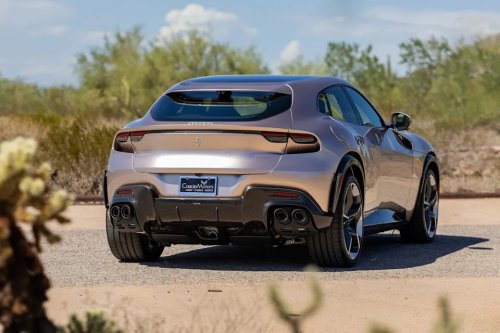
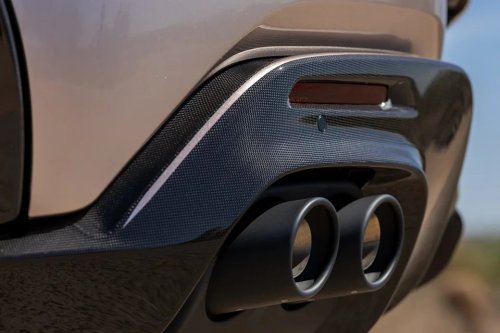
Ferrari Patents a Taillight That Doubles as a SpoilerFerrari's engineers spend plenty of time solving problems nobody outside Maranello asked them to solve, and a patent application the company just published with the U.S. Patent and Trademark Office is a good example of that instinct at work. Publication US 2026/0242013 A1, titled "Sport Road Vehicle With Variable Rear Aerodynamic Load," lays out a taillight assembly that physically moves to change how the back of the car handles airflow. Ferrari S.p.A. filed it on February 11, 2026, tracing priority back to an Italian application from February 14, 2025, and credits engineers Salvatore Sedda and Jason Lopes Furtado, both based in Modena, as inventors.Set aside the hypercar speculation for a moment, because that's not really what the filing describes. The patent lays out a rear end where a light assembly sits between a fixed aerodynamic body — a wing or a spoiler — and the road surface below it. In its default state, that light housing does exactly one job: it lights up. It sits low enough and tucked in enough that the airflow spilling off the wing's trailing edge never touches it, so it contributes nothing to downforce. Switch it into its second configuration, though, and the assembly tilts upward and rearward until part of it juts out past the wing's trailing edge, straight into that departing airflow, turning the same housing into a second load-generating surface. The taillight, in other words, gets a side job.Two rear-end layouts show up in the application. The simpler one builds the moving light straight into a conventional transverse wing or spoiler, rotating around a hinge point to swing between "lighting only" and "lighting plus aero." The more elaborate layout buries the light assembly inside an aerodynamic channel that runs from behind the cockpit back to a diffuser, with the housing forming a bridge across that channel; a separate airfoil back there can extend outward to choke the channel's exit for a third, even more aggressive configuration. Ferrari's claims also specify that the housing can split into independently movable left and right modules, which means a production version could, in theory, run more rear load on one side of the car than the other — an aerodynamic cousin of torque vectoring, deployed through what used to be a simple brake light.AdvertisementAdvertisementOne line in the filing is worth pausing on, because it shows how patent attorneys actually think. Rather than naming a motor, hydraulic ram, or specific mechanism, the application states that "the related actuator may be different, according to requirements and to the type of vehicle." That's deliberately vague, and deliberately so: it keeps the claims broad enough to cover whatever hardware Ferrari or a supplier eventually settles on, rather than boxing the company into one implementation a competitor could design around.Ferrari's Already Done Half of ThisThis isn't Ferrari's first attempt at merging lighting and bodywork. In August 2025, the USPTO granted the company a separate patent, US 12,392,471 B2, for a backlit light assembly built around a methacrylate light guide shaped to physically form a rear spoiler — a taillight that's already a spoiler, just a fixed one that can't change position. Line the two filings up and a clear progression appears: Ferrari fused the light into the spoiler's shape first, and only afterward started working out how to make that fused piece move on command. That's a company iterating on its own idea over roughly three years, not chasing a headline.A Patent Filing Isn't a Confirmed FeatureReading a patent filing takes a certain kind of skepticism, the same kind worth applying when Kawasaki's patents get parsed apart to figure out how its CORLEO robot horse actually thinks — filings describe a mechanism's outer boundaries, not a finished product. It's worth being precise about what an "A1" publication actually is, too. That suffix means the USPTO has published the application, not examined and allowed it — there's no guarantee any of these claims survive prosecution in their current form, let alone reach a production car. Automakers file constantly on ideas that never leave the parts bin; a search of Ferrari's own recent filings turns up patents on everything from dual-clutch gearbox housings to steering assemblies to an internal-combustion piston rethink filed around the same time as this one. A patent application is a company paying to reserve the right to sue someone else for copying an idea — it's a legal placeholder, not a spec sheet.The dramatic, low-slung proportions sketched in this filing's drawings have understandably fueled talk of a hypercar successor, but patent illustrations are drawn to describe a mechanism as broadly and abstractly as possible, not to preview a production silhouette. Ferrari, a company that has been unusually blunt lately about which technologies it will and won't chase, files plenty of concepts it has no near-term intention of building, partly to keep rivals guessing about which ones it does.What It Would Actually Cost YouFor anyone who eventually owns a car with this hardware, the more useful question isn't whether this is a new hypercar but what a moving taillight costs to fix. A part that has to double as a structural aero surface needs an actuator, a control module, position sensors to confirm it's where it's supposed to be, and enough strength to survive being hit by high-speed air thousands of times over a car's life. That's a meaningfully pricier component to engineer, build, and eventually replace than a taillight that just illuminates — anyone who has priced out an active rear spoiler motor on a modern exotic already knows that motorized body panels are rarely the cheap fix after even a minor rear-end bump. Insurers writing policies on cars with electromechanical bodywork like this will be pricing in sensor and actuator replacement costs right alongside the carbon fiber and horsepower.Lights Are Doing More Than Lighting EverywhereFerrari isn't alone in deciding a taillight is wasted space if all it does is turn red under braking. The prior art Ferrari's own filings cite includes a Porsche patent for a rear wing with an integrated brake light, plus separate filings from Valeo and PSA/Peugeot for light guides built into bodywork panels — evidence that several manufacturers have independently arrived at the same real estate. What makes Ferrari's filing distinct is the attempt to make that shared space move, which is a harder problem than making it glow, and one with considerably more ways to fail. It's the same appetite for aerodynamic theater on display at Gordon Murray Automotive, whose $20 million hypercar leans just as hard on active surfaces to justify its price tag.AdvertisementAdvertisementNone of this confirms a shape-shifting Ferrari taillight is landing in a showroom anytime soon. It confirms Ferrari's engineers filed paperwork protecting an idea clever enough to get people speculating about hypercars a full publication cycle before anyone outside Maranello has seen a running prototype. Worth watching. Not worth a deposit.