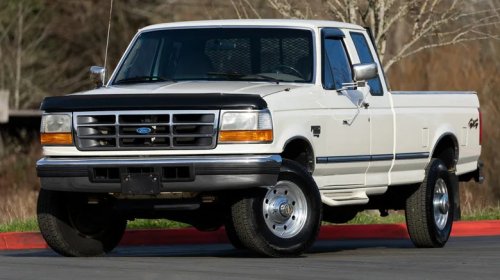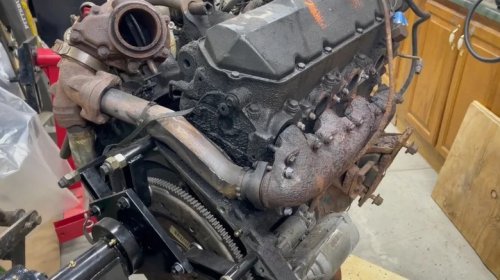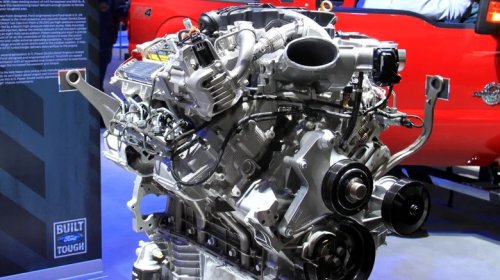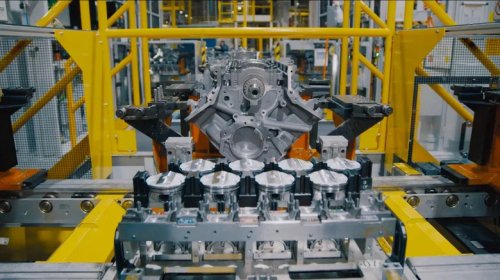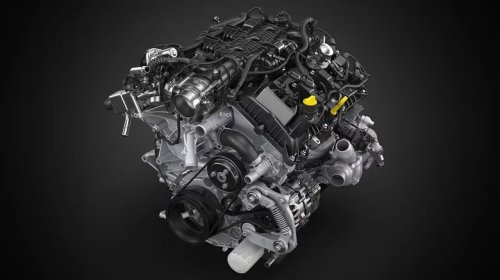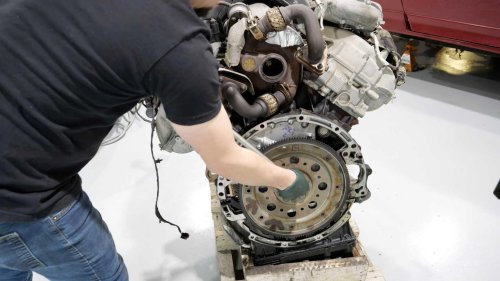
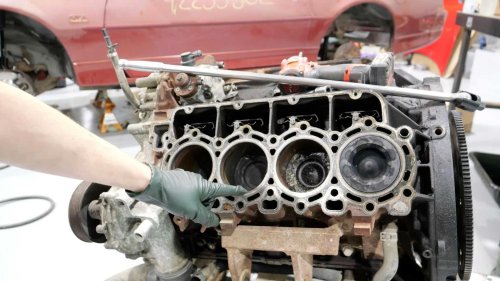
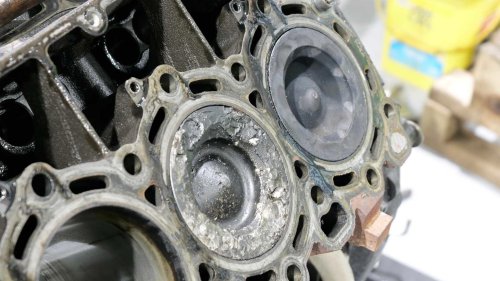
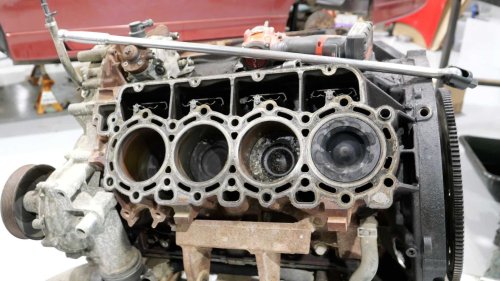























Diesel engines tend to be tough, overbuilt, and capable of withstanding lots of use before failure. There are always exceptions, obviously, especially as modern technology has made the compression-ignition engine more complicated than ever, but by and large, a diesel is going to be able to put in some hard miles before needing major engine work.That's the case with the Ford 6.7-liter Power Stroke turbodiesel V8, which first entered production in the 2011 F-250 and F-350 Super Duty pickups and has generally been a reliable workhorse. But again: exceptions, exceptions. YouTube dismantler I Do Cars recently got a Power Stroke core return into his shop, which has certainly seen some things in its 200,000-mile life. Things Look Decent For Awhile If you're not aware, the host of the channel – Eric – is a car dismantler, breaking down wrecked vehicles and selling good parts to his customers. That includes whole engines, which is how he got his hands on this particular 2011-era Power Stroke 6.7. One of his customers bought a non-running F-250 (not the heavier-hauling F-350) with more than 200,000 miles at an auction and ordered a decent used engine for it, in the process returning the bad engine to Eric as a core return.Digging right in, I Do Cars takes the entire Power Stroke in as a whole, and the host is a little confused at its non-running status. There's no obvious external trauma to the engine, and it even turns over via the crank without any significant issues despite having sat in Eric's shop for a couple years. The teardown begins without too many issues – the nearly 1,000-pound assembly does take some muscling to get its aged bolts loose – with the intake manifold, coolant pipes, single turbocharger, and fuel rails coming off without any obvious damage. I Do Cars/YouTube The Damage Reveals Itself So do the valve covers and head bolts. Even the head gasket looks usable despite the engine's advanced age and mileage. But removing the cylinder head reveals what likely caused the Power Stroke's demise. The second and third pistons on the right engine bank show a shocking amount of damage to the crowns, with massive gouges taken out of the metal and a foreign object embedded into the top of piston 2. Flipping the cylinder head shows that the wear extended to the combustion cylinder – a chipped valve could be the source of that aforementioned foreign object.I Do Cars/YouTubeThat amount of internal engine damage is very hard to diagnose, especially since every other cylinder looks relatively clean and serviceable. The teardown continues with the lower oil pans and rotating assembly, where Eric makes another discovery. The piston skirt from Cylinder 2 has broken off, and pieces of the shattered metal made their way into the oil pan. The screen and filter seem to have prevented them from circulating around the engine, but it just raises the question of what could've caused that much piston damage.I Do Cars/YouTubeOtherwise, the rest of the engine looks clean enough for its suspected mileage. The camshafts, crankshaft, rod bearings, and connecting rods all look relatively free of wear and heat damage, indicating that this was probably a pretty solid engine before the foreign object entered those two cylinders. How Did This Engine Fail? I Do Cars presents a couple theories for why an otherwise-healthy 2011 6.7-liter Power Stroke diesel V8 would suddenly experience such catastrophic failure. Sucking down a foreign object during otherwise normal operation is one potential excuse, but given the damage inside the cylinders, it would've had to be pretty big, and getting something like that past the turbocharger and intercooler without hurting either seems unlikely.I Do Cars/YouTubeIt's more plausible that a previous owner or mechanic accidentally dropped something into the intake manifold or charge pipes while doing some maintenance or carrying out a repair. But even that cause is suspicious, because Eric says that whenever that's the case, there are usually clearly identifiable signs – some socket material or the impression of a hex bolt or screw threads inside the mill.The host seems to be certain, therefore, that his third suspect is the culprit: engine over-rev. If one of the truck's previous owners installed a tuner to raise the rev limit, the valves could've potentially floated open and impacted the fast-approaching piston faces, but even that theory has some holes since the engine damage is so localized.But the peanut gallery has some theories of its own. One commenter noted that very early 2011 builds had bad exhaust valves that would fail in this way, while another points out that several serialized runs of 2011 and 2012 trucks suffered from faulty glow plug elements that would overheat and break off in the engine. If either of those are the case, it's odd that this particular Power Stroke made it to 200,000 miles without experiencing those rare and specific build-quality issues before.Whatever the case may be, this engine suffered an untimely and seemingly random death, but the fine state of most of its components should reassure any 6.7 owners out there. As long as you care for your truck (and it isn't as randomly unlucky as this one was), you should be good for at least 200k or more.