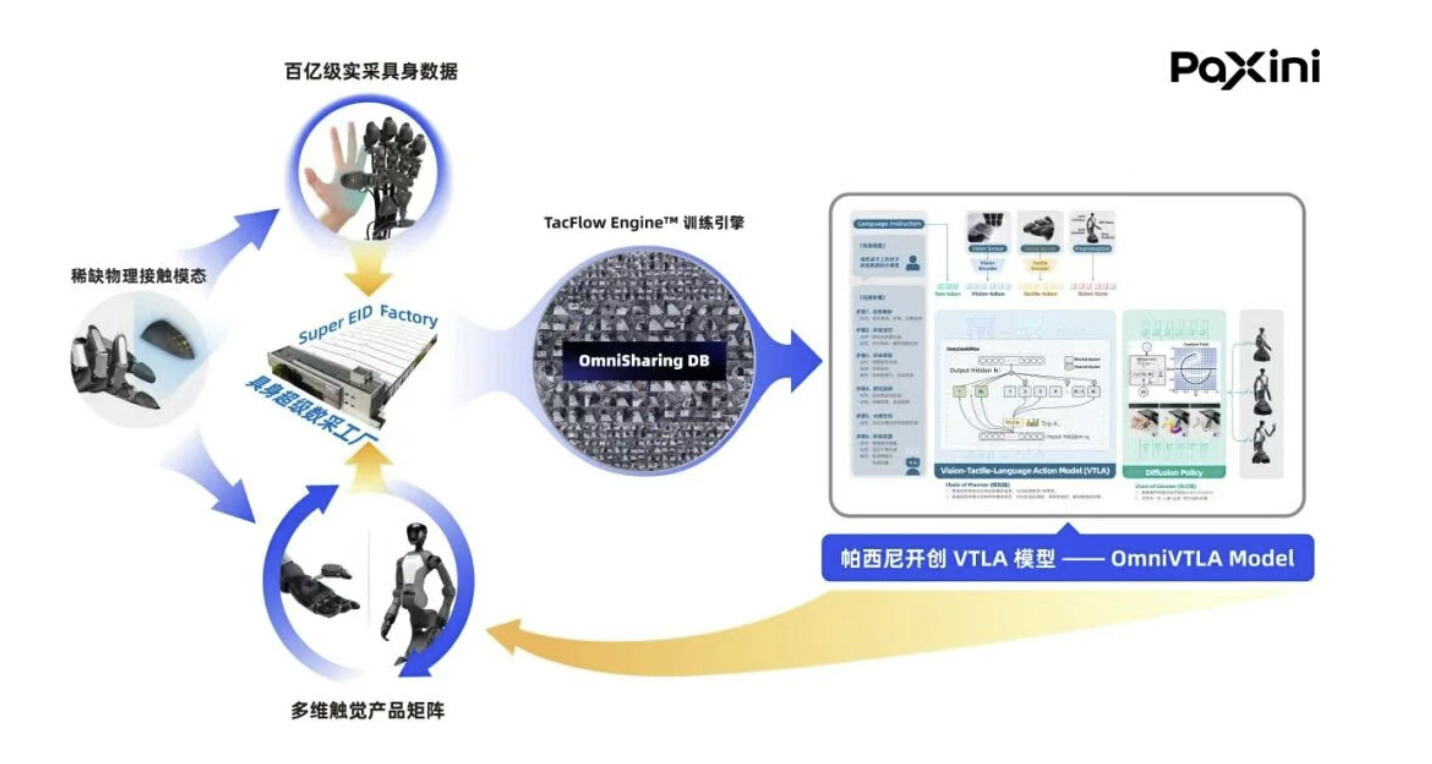
Gasgoo Munich- PaXini Sensing Technology (Tianjin) Co., Ltd. has reached a milestone: the first cross-border transaction of embodied intelligence data in China.This marks Tianjin's first filing under the negative list for data exports—and signals that Chinese embodied intelligence data is now officially moving down the path of compliant cross-border transfer.Breaking the Ice on Cross-Border DataEvery force feedback loop from a robot gripping, pushing, or rotating an object forms the bedrock of a model's generalization ability. Every frame of texture and temperature data captured by tactile sensors does the same.Yet, Chinese firms in this space have long faced a structural dilemma. The domestic market has the richest scenario data and production capacity, while overseas demand for such high-quality data is intense. However, regulatory hurdles, security assessments, and a lack of standards have largely stalled the connection between supply and demand.The vast majority of high-quality data remains trapped within China, unable to legally enter the global R&D ecosystem.PaXini's launch of the "first domestic embodied intelligence data cross-border project" is a direct answer to this challenge.Image Source: PaXiniSpecifically, the project centers on PaXini's proprietary dataset product—the "OmniSharing DB PaXini Multimodal Embodied Intelligence Dataset"—and establishes a dual milestone for the industry:First, at the institutional level, it has charted a complete compliance path for the industry.Data export is not merely a technical issue; it requires satisfying multiple legal requirements. These include the Cybersecurity Law, Data Security Law, and Personal Information Protection Law, alongside security assessments and filing approvals. PaXini has successfully navigated this entire process and obtained authoritative export approval. This effectively provides a replicable "template path" for other companies looking to export their data.Second, it has built an end-to-end cross-border circulation mechanism spanning from collection to delivery.Securing approval is just the beginning. The process also involves secure encapsulation, technical safeguards against data leaks, and legally compliant delivery to overseas clients.Partnering with leading global cloud service providers, Panini has established a dedicated large-scale data delivery channel. It created a domestic closed loop covering "collection—processing—certification—export." This end-to-end mechanism allows embodied intelligence data to flow directly from domestic collection factories to international R&D platforms. The data remains fully traceable and auditable throughout the journey.In terms of industry significance, this breakthrough answers a critical question. Under a strict data security regulatory framework, China's high-value data products can indeed "be exported compliantly and monetized securely." For the embodied intelligence sector, the door has been opened for data assets to move from "internal use" to "global circulation."As more companies replicate this path, China is poised to evolve from a "major data producer" into a "data service exporter," securing a stronger position within the global embodied intelligence R&D ecosystem.Of course, this is just the beginning. Given the varying requirements for data sourcing, privacy protection, and security reviews across different nations, PaXini's example primarily solves the "first kilometer" of domestic compliance. Adapting to compliance requirements in specific overseas destinations will still require further exploration and refinement by the industry.Why PaXini?Founded in 2021, PaXini's founding team traces its roots to the Sugano Laboratory at Waseda University in Japan—the birthplace of the world's first humanoid robot.From the outset, PaXini chose a challenging path: tactile sensing technology. The goal was to equip robots with anthropomorphic fine tactile perception, resolving the critical bottleneck of lacking refined touch during interactions with the physical world.In the robotics sector, visual perception is relatively mature, but tactile perception has long lagged behind. The root cause lies in complexity: tactile sensors involve multidisciplinary challenges spanning materials science, microstructure design, signal processing, and algorithms. Combined with complex manufacturing processes and high costs, this has long been a bottleneck in China's robotics supply chain.PaXini has shifted this dynamic over the past four years. Its proprietary third-generation multi-dimensional tactile sensor, the PX-6AX-GEN3, features the world's first 6D Hall array tactile sensing technology. It can measure 15 tactile dimensions—including six-axis force, texture, temperature, and rebound. Force recognition precision reaches 0.01 Newtons.More importantly, through technological iteration and scaled manufacturing, Panini has reduced the price of similar sensors from tens of thousands of yuan to the hundreds. This has transformed high-precision tactile perception from a laboratory luxury into a mass-deployable industrial standard component.Image Source: PaXiniLeveraging this core capability, PaXini has built a full-link product matrix of high-precision tactile hardware. This spans "tactile sensors, dexterous hands, and humanoid robots." It has also established a full-stack embodied intelligence technology system covering hardware packaging, data collection, algorithm integration, and its first VTLA embodied intelligence model, OmniVTLA.Notably, PaXini's multi-dimensional tactile dexterous hand integrates up to 1,140 ITPU tactile sensing units. It is capable of identifying multi-dimensional environmental data such as friction, texture, temperature, and hardness. The DexH13 can even precisely detect the faint signal of a feather sliding across a fingertip.Meanwhile, the TORA robot relies on the proprietary OmniVTLA embodied intelligence large model. By continuously "feeding back" massive amounts of high-fidelity physical interaction data, it iterates on models and algorithms. TORA can handle flexible grasping, assembly, and loading and unloading of various workpieces in industrial settings. Pilot projects are already underway.According to industry statistics, PaXini currently ranks first globally in shipments within the tactile sensor segment, holding an 80% market share.This clearly demonstrates that tactile technology is Panini's foundation—and a key differentiator from other robotics companies.However, what truly enabled PaXini to pivot from a "hardware company" to a "data company" was its early strategic positioning on data.As early as 2024, PaXini proposed a "human-centric" system of high-precision, real-world embodied data that incorporates scarce tactile modalities, creating a new approach to overcome the data bottleneck in embodied intelligence.In 2025, PaXini launched the world's largest embodied intelligence data collection factory in Tianjin—the Tianjin Super EID Factory. The facility deploys over 150 standardized collection units covering vertical scenarios such as industrial manufacturing and daily life. It can produce 200 million high-quality data points annually for embodied intelligence training. This provides robust support for model training and scenario deployment.Image Source: PaXiniThis year, PaXini expanded its footprint by building four additional super data collection factories in Suqian (Jiangsu), Wuhan (Hubei), Zigong (Sichuan), and Ganzhou (Jiangxi). Combined with the Tianjin facility, this creates a strategic depth covering North, East, Central, Southwest, and South China. The result is the world's largest cluster of embodied intelligence data collection factories. It features the greatest scale, most comprehensive modalities, highest standards, and strongest synergy.To accelerate the efficient circulation and innovative transformation of data elements, PaXini recently partnered with three leading cloud service providers. JD Cloud, Tencent Cloud, and Baidu Intelligent Cloud helped launch the world's first cloud marketplace for multimodal embodied intelligence data at a scale of 10 billion units. This industry-first initiative aims to break down the "data silos" constraining the sector's development.Additionally, PaXini has been deeply involved in developing the world's first international standard for embodied intelligence, ISO 26264-1, covering "Humanoid Robot Datasets," which has officially been approved for project establishment by the International Organization for Standardization.This signifies that practices by Chinese enterprises in data standards and governance are entering the international rulemaking framework.ConclusionFrom ranking first in global tactile sensor shipments to pioneering cross-border embodied intelligence data, PaXini's evolution has been clear and measured. It uses tactile technology as a foundation and data as a lever to gradually build global infrastructure for embodied intelligence.The implementation of PaXini's data export project is just one milestone in this long-term strategy, yet it sends a clear signal: Chinese embodied intelligence companies are shifting from "hardware exports" to the "export of data and standards."