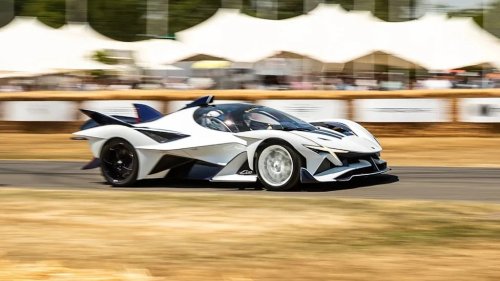
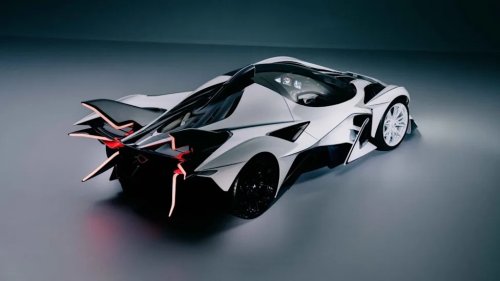
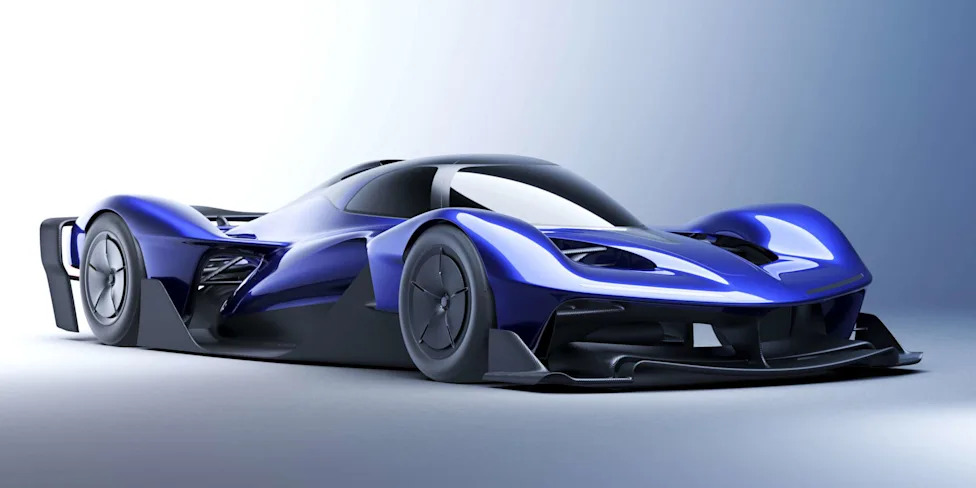
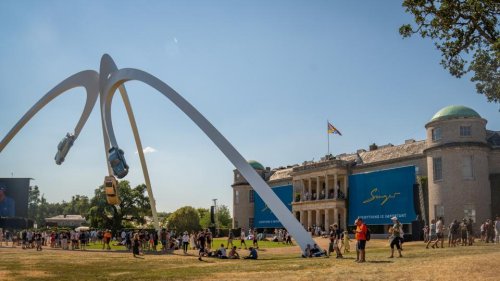
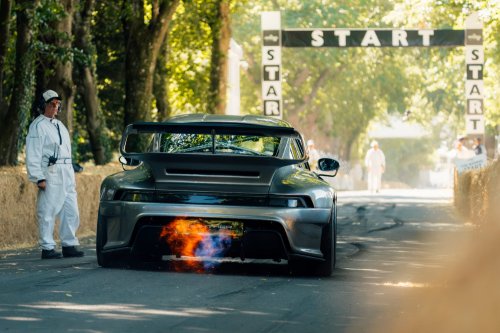
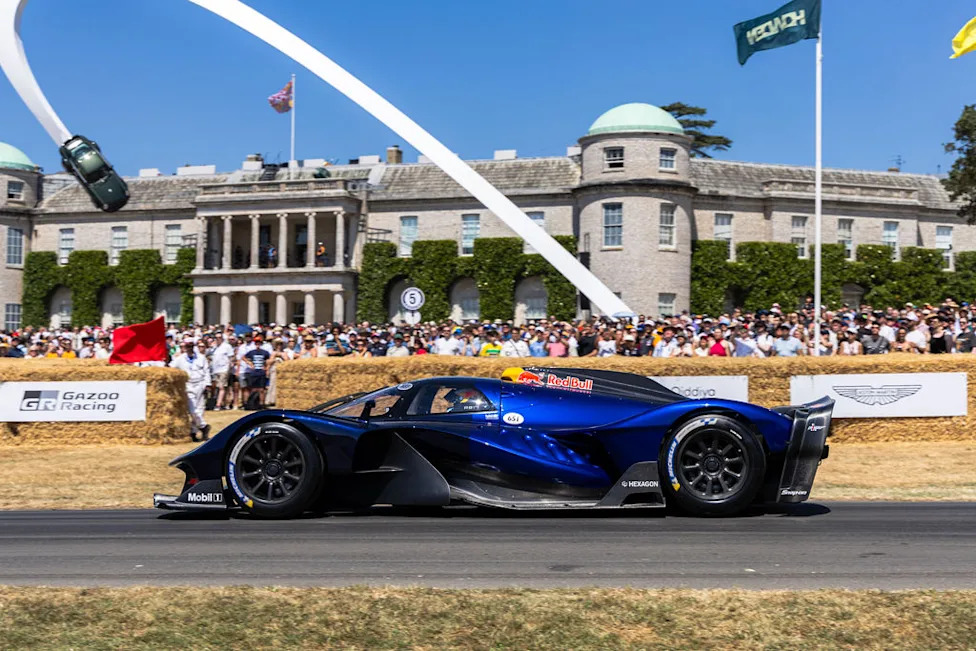
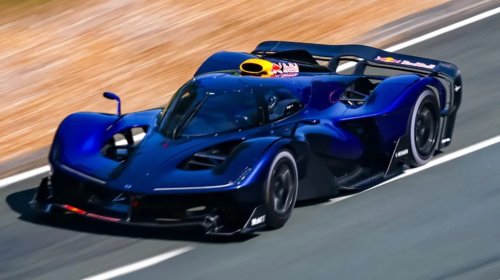
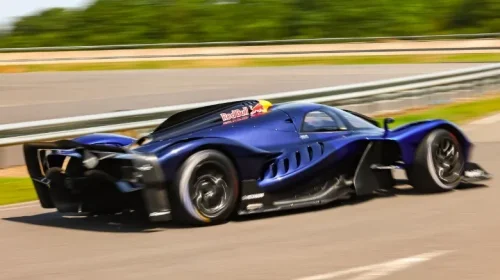
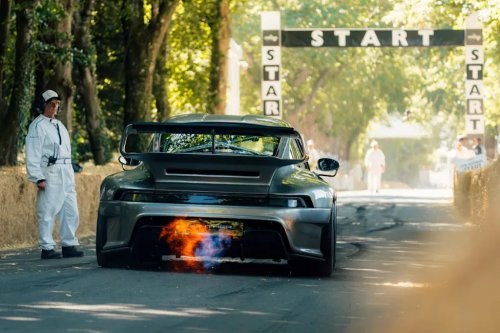
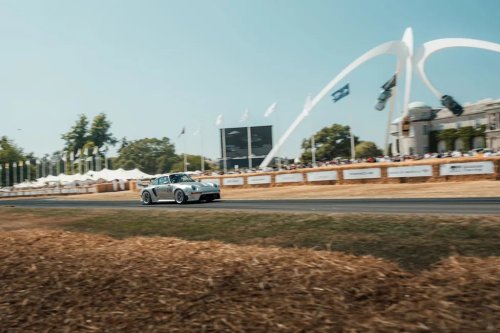
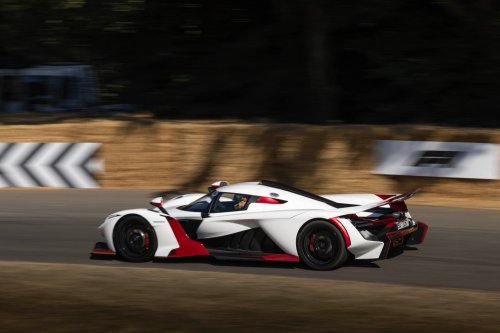
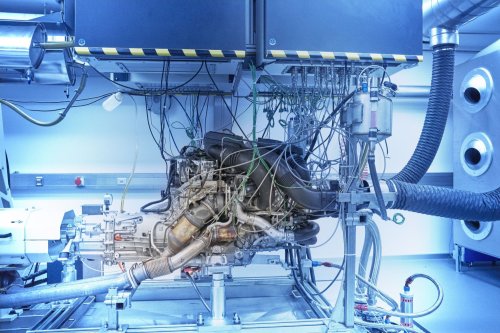
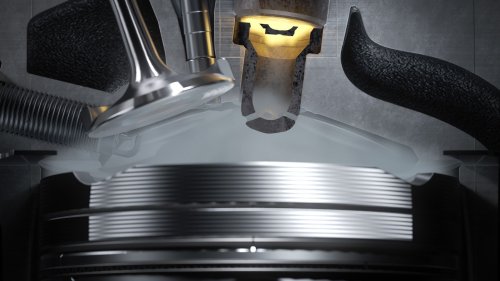
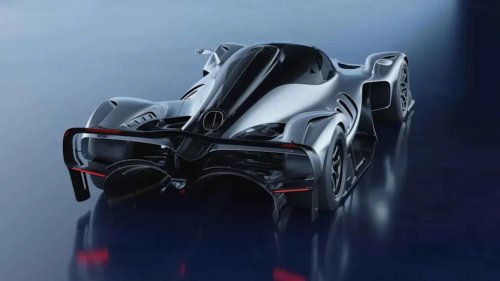
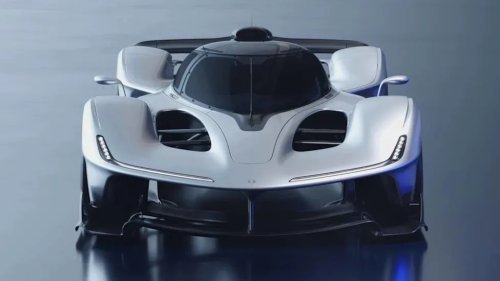
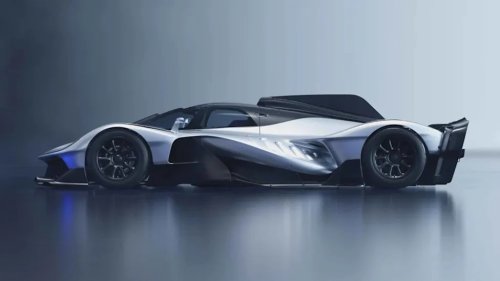
$7.5 Million Red Bull RB17 Shows Up at GoodwoodJack Whyte - Car and DriverOn a pedestal at the Goodwood Festival of Speed this year, Red Bull's highly anticipated RB17 hypercar spent most of the weekend covered in a visible layer of fine dust. Thronging fans and dry winds in Southern England, which seemingly grows hotter and hotter each summer when the annual hillclimb even takes over the 11th Duke of Richmond's estate, only accounted for some of the grit accumulating on the svelte aerodynamic surfaces. Instead, blame also falls to designer and engineer Adrian Newey, who may or may not have dipped a wheel or two into the grass while cutting the RB17 prototype through Turn 2 of said hillclimb.For fans following Formula 1, the question of why Newey drove the RB17 at all probably comes to mind, given that the famed aerodynamicist departed Red Bull for Aston Martin in March 2025. Red Bull originally showed a styling model at Goodwood in 2024, though, even if that first show car was already months out of date by that point in time. Now, returning two years later, the running and driving prototype arrived with enough in place—doors that open, functional mirrors, and safety equipment—for at least a spirited, if not quite race-pace, run up the hill."Adrian sadly left Red Bull 16 months ago," Rob Gray, technical director at Red Bull Advanced Technologies, told Car and Driver. "But this is his passion project, this is his vision for this car. And so he's kept in touch over the last few months, and when we came to talk about who was going to drive here, he was an obvious candidate."AdvertisementAdvertisement"I'd say he pushed exactly as hard as we wanted him to. We're not in the timed shootout at this weekend. We've done 500 kilometers on the car in total. We've only really done a shakedown. So, yeah, it's very much a case of drive it up the hill, look good, sound awesome. He did take a bit of grass on Turn 2, but apparently that's the normal line, so we're forgiving him for that."Outside of historical formula cars or the handful of brutish American NASCAR race cars at Goodwood, the RB17 might just have been the single loudest soundtrack on site. Fittingly, since Red Bull needed to cater neither to racing regulations nor road requirements for homologation while developing the project. Instead, the RB17 quite possibly broke cover as the most hardcore track toy on the planet—not least among the reasons being a bespoke 4.5-liter Cosworth V-10 engine that is easily capable of pricking up ears from miles away.Cosworth last built an F1 engine for the 2013 season but more recently has left racing in the past to focus more wholeheartedly on the supercar and hypercar industry. The RB17's origins trace back as far as 2022, when the first announcement from Red Bull included a planned twin-turbo V-8. Shortly thereafter, Red Bull and Cosworth made the somewhat rational choice to switch to a V-10 and a hybrid powertrain instead."There is a sort of emotional side of it," admitted Cosworth commercial director Chris Willoughby. "There was a lot of simulation and analysis that went into the engine choice, but then there was also a bit of heart. And the heart definitely said V-10, naturally aspirated, high-revving was the way to go."AdvertisementAdvertisementVersus a twin-turbo V-8, the V10's more immediate throttle response came into play. But uniqueness in comparison to other V-12-powered cars, including the Gordon Murray Automotive lineup and Aston's own Valkyrie, also factored into the choice. Not to mention that iconic scream, which harks back to the signature sound of arguably F1's greatest aural era, from 1989 to 2005.A V-10 also takes up less physical space than a V-12 while providing more rigidity as a load-bearing element of the chassis. Cosworth's contribution to the project began development over three years ago, and in similar fashion to GMA's V-12s, it uses gear-driven cams and pneumatic valve springs derived from F1 and MotoGP to prevent valve float while revving up above 12,000 to 13,000 rpm.Building 100 engines for Gordon Murray each year is a much different job than 100 power units for F1 teams, though. All the littlest details make a big difference, quite literally, since an F1 engine's tolerances are so tight the rotating assembly can't even turn over without a block heater bringing the internals up to temp first. By contrast, the RB17 needed to be drivable for customer track days without requiring a full team of engineers—and each engine won't get tossed into the scrap heap after one qualifying session, either.But some surprising lessons learned from racing do carry over to projects like this. For example, in racing Cosworth always pushed the piston rings as far as possible to the top of the piston, to reduce trapped air during combustion in the name of extracting more performance. But doing so also eliminates a space for unburned hydrocarbons to hide, thereby reducing emissions as well.AdvertisementAdvertisementAt Goodwood, the RB17's Cosworth engine only revved to 10,000 so far. The rest of the car, from the 200-hp hybrid motor tucked into the gearbox to the aerodynamics developed by Newey and Red Bull, reached a similar level of finish. The aero concept in particular evolved significantly since the 2024 show car, from a more integrated wing to a semi-detached and finned rear end working in concert with massive underfloor ground effects and an active diffuser that can reduce downforce, preventing excessive tire wear for longer driving sessions.Naturally, for something so hardcore, Red Bull will offer customers plenty of ways to adapt to the car, or even adjust the car's setup, before unleashing full power and performance."We've got a simulator program," Gray explained. "We'd encourage that, as that's a great place to start learning the car. And then the car has a lot of different modes, so you can turn the power down, you can turn the rev limit down, you can basically adjust all sorts of different parameters on the car to make it easier to drive and take the edge off it slightly. The idea is that if you're a relatively inexperienced track driver, maybe you play in a Porsche GT3 or something like that, then you can get in, you can put it into a setup that is very user-friendly, and you can start growing with the car."In addition to Newey, another driver who likely needed no acclimation period also piloted the RB17 up the hill: Red Bull reserve driver Yuki Tsunoda. Even abuzz at ripsaw idle while parading back down to the start line, the Cosworth engine sounded more similar to other race cars than any of the road-legal supercars in the paddock. Yet naturally, rumors and innuendo spread among fans, including that a separate company onsite at Goodwood may well attempt to homologate the RB17 for road use somehow.AdvertisementAdvertisementThe eventual run of 50 customer cars still looks a ways off, however. It was originally promised for 2025, but Red Bull has announced that assembly began only in May of this year. Deliveries will now more likely commence in 2027 or even 2028, with pricing that starts at the equivalent of around $7.5 million at today's currency exchange rates.That seven-figure sticker still pales in comparison to the price for a brand-new Formula 1 car, which would also lack the thrilling V-10 engine. So, to the well-heeled enthusiasts clad in panama hats and the finest linens at Goodwood, an RB17 may well look (and sound) like a screaming deal.Unlike Newey and Tsunoda, however, Red Bull's own four-time world champion, Max Verstappen, has not contributed to the project, other than providing a decade's worth of driving data that fed into the simulations and knowledge that only a company like Red Bull can rely upon while developing a car as radical as the RB17.You Might Also LikeGift Guide: Best Ride-On Electric Cars for KidsFuture Cars Worth Waiting For: 2025–2029
















 +24 others





![Range Rover, Rover, SUV, Range Rover's next EV breaks cover, and it's not an SUV [Images]](https://cdn.topcarnews.net/thumb/id/aHR0cHM6Ly9pMC53cC5jb20vZWxlY3Ry-ZWsuY28vd3AtY29udGVudC91cGxvYWRz-L3NpdGVzLzMvMjAyNi8wOC9SYW5nZS1S-b3Zlci1HVC1FVi1zcG90dGVkLmpwZWc_-dz0xNTAwJmFtcDtxdWFsaXR5PTgyJmFt-cDtzdHJpcD1hbGwmYW1wO3NzbD0x/d917768ef46e35c406d19711ba3fd796.jpeg?t=20261005&post_id=57612)
![Range Rover, Rover, SUV, Range Rover's next EV breaks cover, and it's not an SUV [Images]](https://cdn.topcarnews.net/thumb/id/aHR0cHM6Ly9pMC53cC5jb20vZWxlY3Ry-ZWsuY28vd3AtY29udGVudC91cGxvYWRz-L3NpdGVzLzMvMjAyNi8wNy9SYW5nZS1S-b3Zlci1HVC1lbGVjdHJpYy1zaWRlLmpw-Zz9zdHJpcD1pbmZvJmFtcDt3PTEwMjQm-YW1wO3NzbD0x/7920ad0d955e4a637bb7c1d9fb552573.jpg?t=20261005&post_id=57612)
![Range Rover, Rover, SUV, Range Rover's next EV breaks cover, and it's not an SUV [Images]](https://cdn.topcarnews.net/thumb/id/aHR0cHM6Ly9pMC53cC5jb20vZWxlY3Ry-ZWsuY28vd3AtY29udGVudC91cGxvYWRz-L3NpdGVzLzMvMjAyNi8wNy9SYW5nZS1S-b3Zlci1HVC1lbGVjdHJpYy1yZWFyLmpw-Zz9zdHJpcD1pbmZvJmFtcDt3PTEwMjQm-YW1wO3NzbD0x/d394a095ce14decd525aa1a431b8c700.jpg?t=20261005&post_id=57612)
![Range Rover, Rover, SUV, Range Rover's next EV breaks cover, and it's not an SUV [Images]](https://cdn.topcarnews.net/thumb/id/aHR0cHM6Ly9pMC53cC5jb20vZWxlY3Ry-ZWsuY28vd3AtY29udGVudC91cGxvYWRz-L3NpdGVzLzMvMjAyNi8wNy9SYW5nZS1S-b3Zlci1HVC1lbGVjdHJpYy1mcm9udC5q-cGc_c3RyaXA9aW5mbyZhbXA7dz0xMDI0-JmFtcDtzc2w9MQ/015144e1d0c18a629ec4e14e7a5743c4.jpg?t=20261005&post_id=57612)
![Range Rover, Rover, SUV, Range Rover's next EV breaks cover, and it's not an SUV [Images]](https://cdn.topcarnews.net/thumb/id/aHR0cHM6Ly9pMC53cC5jb20vZWxlY3Ry-ZWsuY28vd3AtY29udGVudC91cGxvYWRz-L3NpdGVzLzMvMjAyNi8wNy9SYW5nZS1S-b3Zlci1HVC1lbGVjdHJpYy1mcm9udC1x-dWFydGVyLmpwZz9zdHJpcD1pbmZvJmFt-cDt3PTEwMjQmYW1wO3NzbD0x/5e86d9df288947bfe3be821d933b98cd.jpg?t=20261005&post_id=57612)
![Range Rover, Rover, SUV, Range Rover's next EV breaks cover, and it's not an SUV [Images]](https://cdn.topcarnews.net/thumb/id/aHR0cHM6Ly9pMC53cC5jb20vZWxlY3Ry-ZWsuY28vd3AtY29udGVudC91cGxvYWRz-L3NpdGVzLzMvMjAyNi8wNy9SYW5nZS1S-b3Zlci1HVC1lbGVjdHJpYy1pbnRlcmlv-ci1pbmZvdGFpbm1lbnQuanBnP3N0cmlw-PWluZm8mYW1wO3c9MTAyNCZhbXA7c3Ns-PTE/8a79fa0ff16ab71451db94963ad3fd16.jpg?t=20261005&post_id=57612)