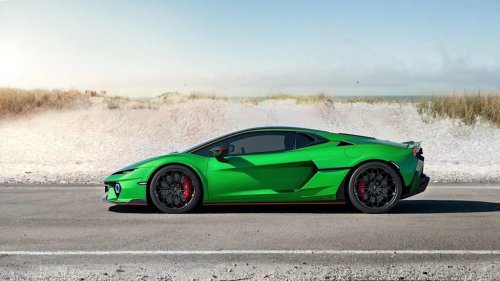
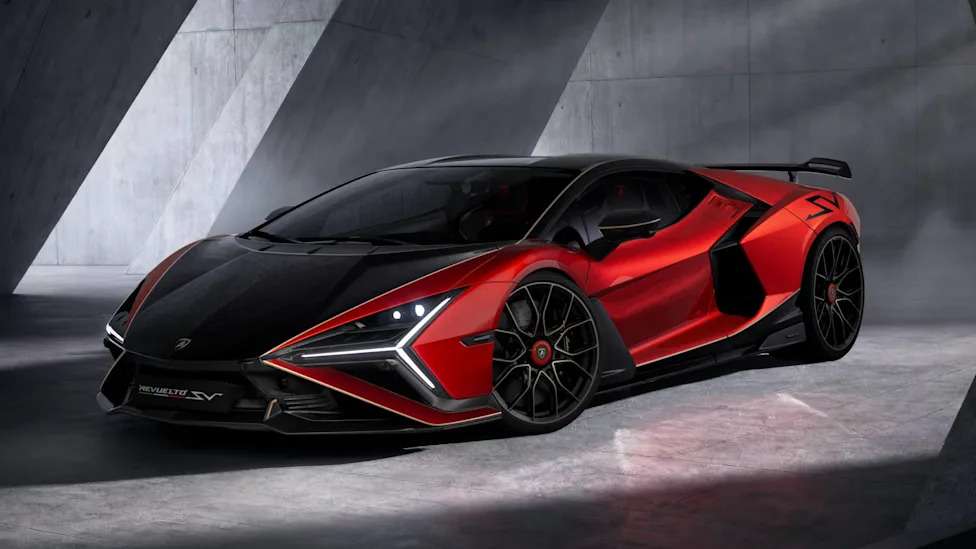
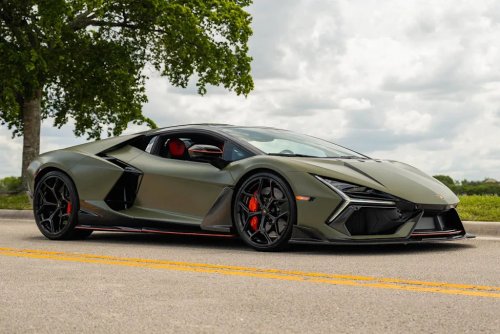
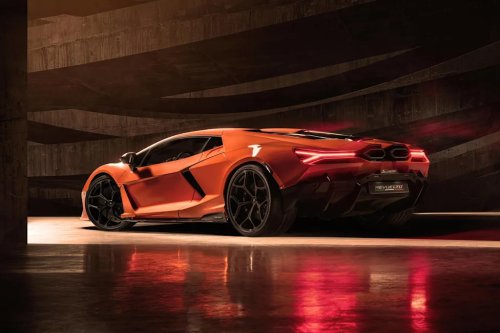
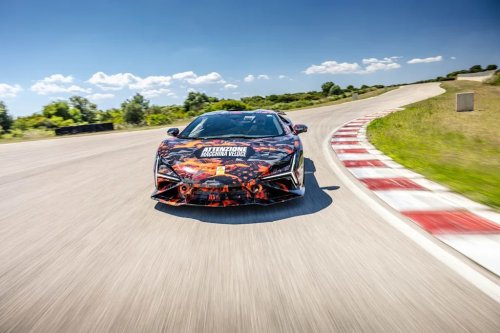
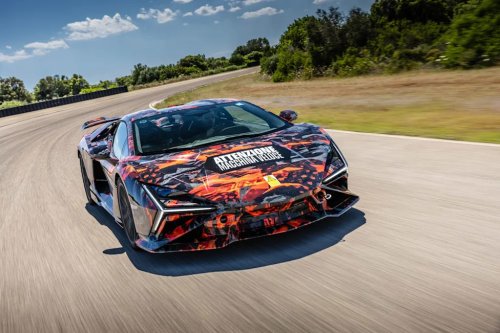
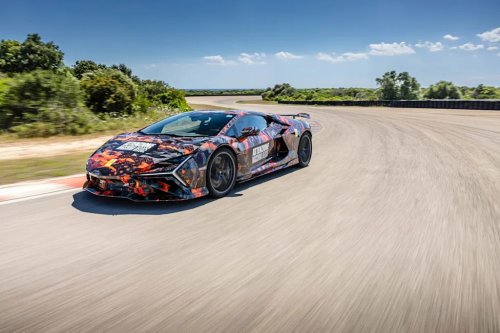
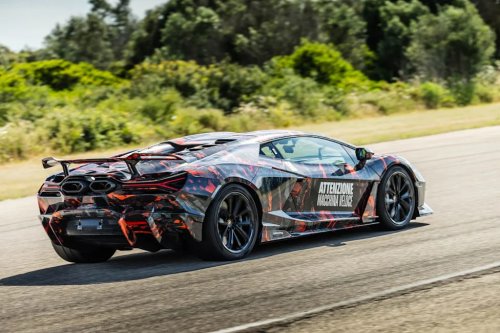
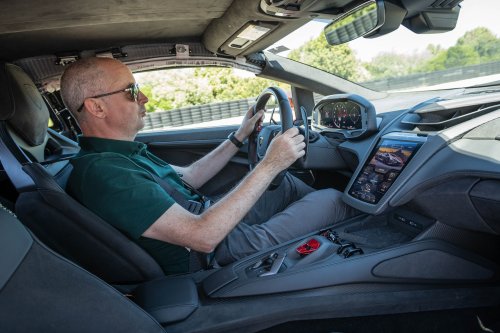
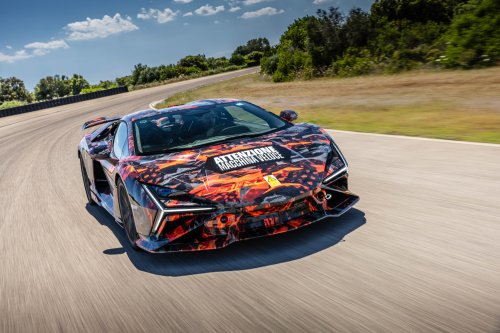
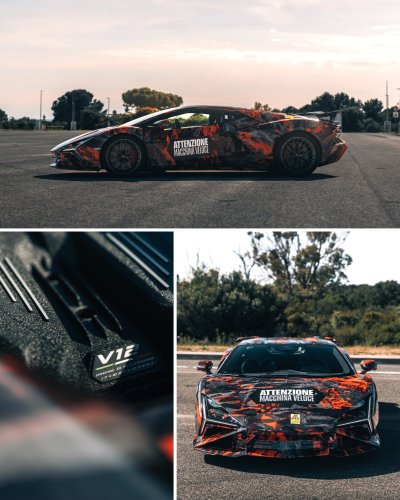
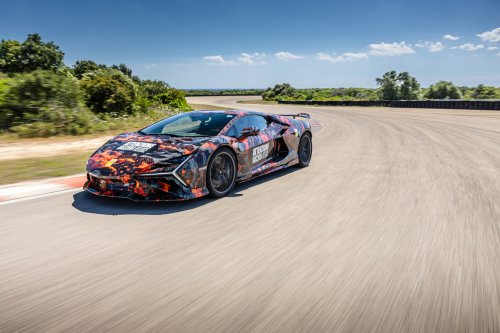
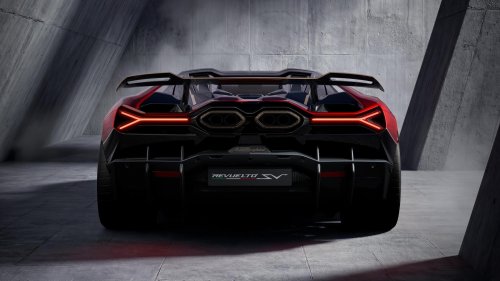
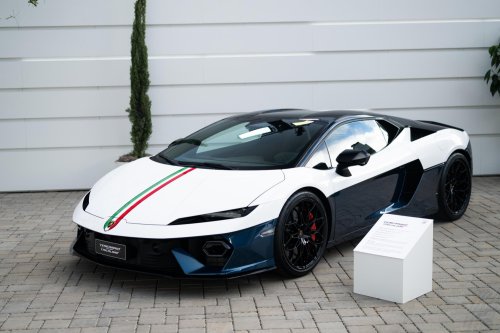
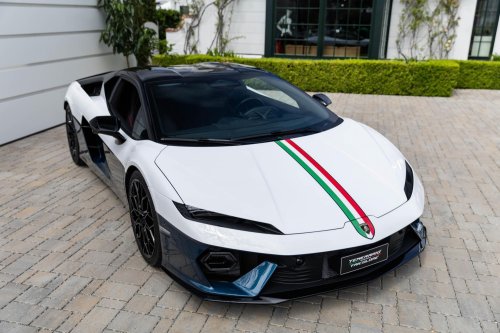
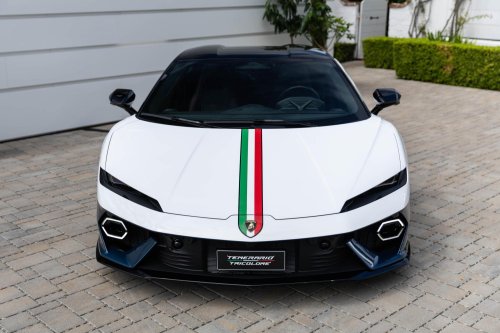
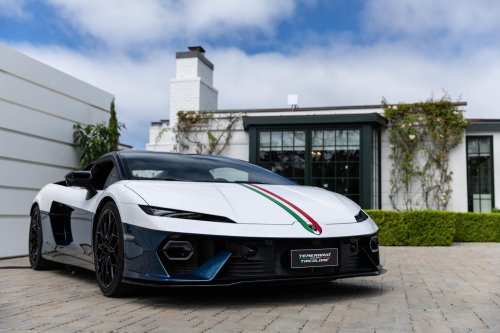
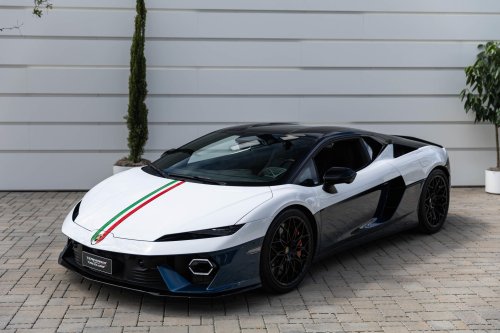
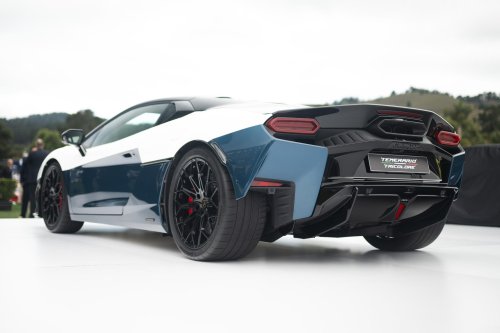
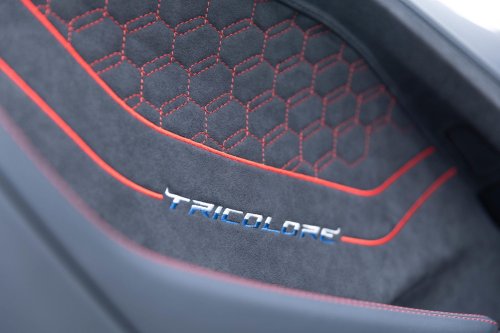
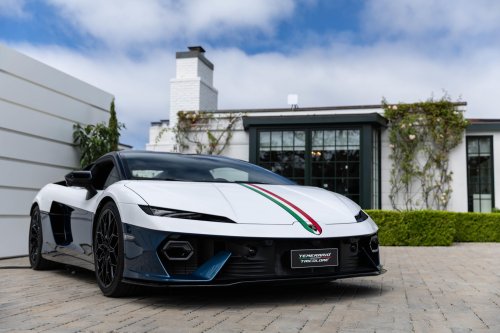
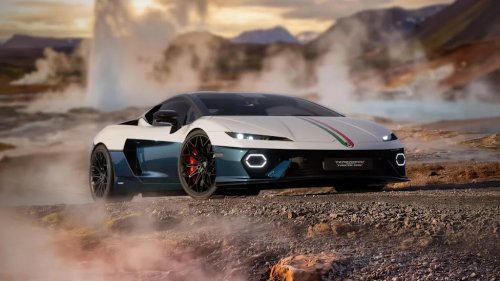
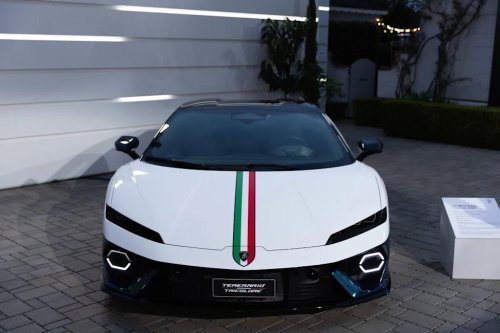
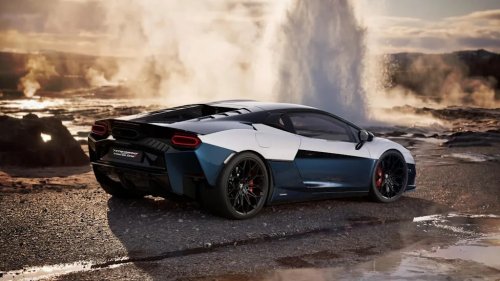
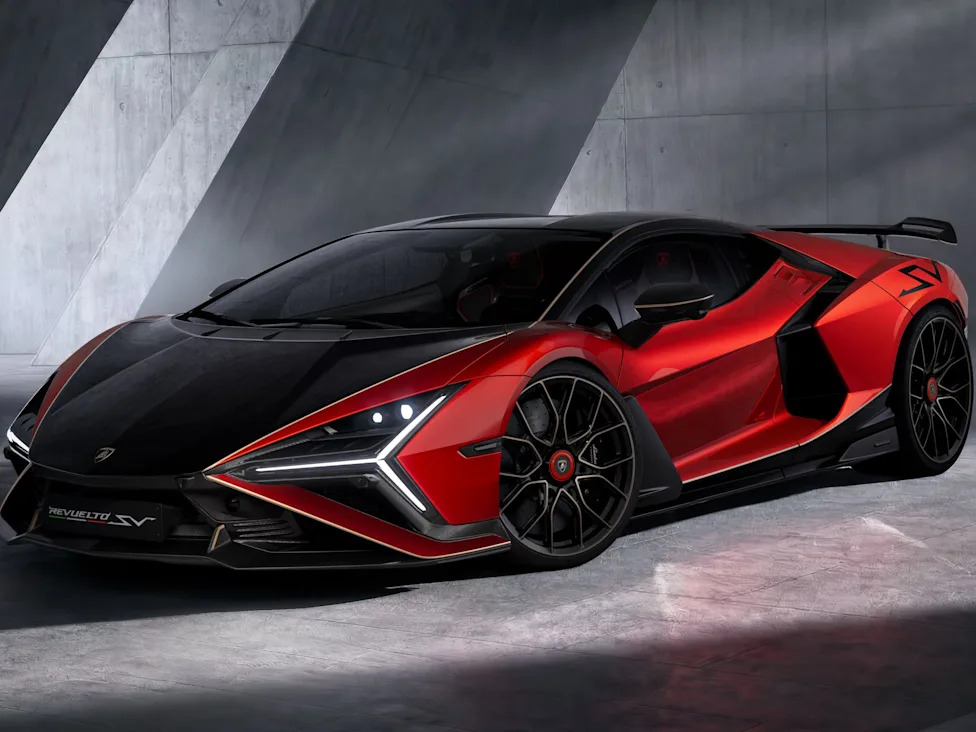
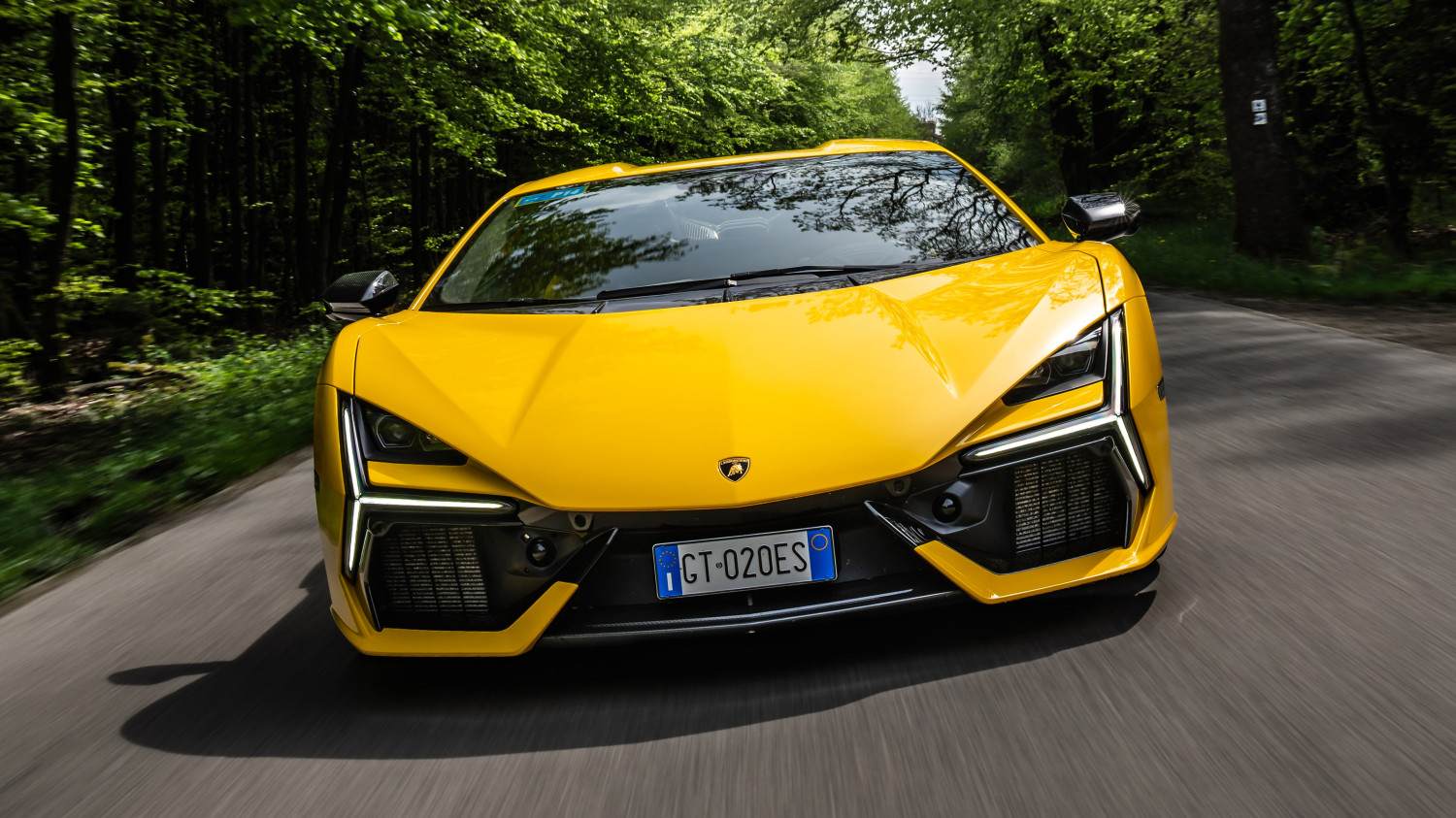
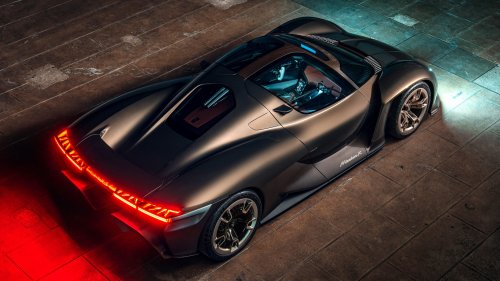
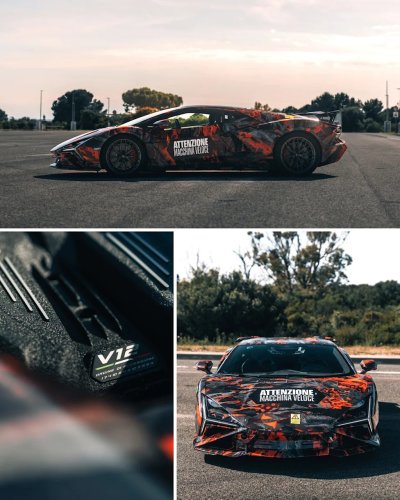
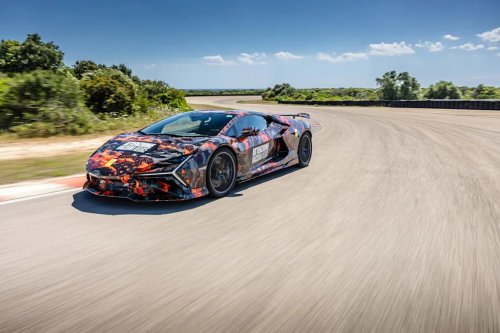
Revuelto SV Prototype Delivers on "Super Veloce"wolfango spaccarelliHow much is too much? The question arrived, fleetingly, on the main straightaway of the handling circuit at Porsche's Nardò proving ground in southern Italy, just after a glance at the Revuelto SV prototype's speedo showed the unlikely figure of 300 km/h. That's 186 mph, on a 1000-meter straight—so, 3330 feet—with the rate of acceleration not appreciably diminishing by the point I had to brake for the hugely fast Turn 1. Does any mere mortal need to go so quickly in what will always be, primarily, a road car?This is the wrong question, of course. When the Revuelto was introduced two years ago it seemed simultaneously impossible and inevitable that Lamborghini would make it go even faster. But that's what the brand does, especially when it breaks out the SV ("Super Veloce") branding that has been applied to the choicest performance versions since the 1971 Miura P400 SV. While nobody with the existing 1001-hp Revuelto has any reason to feel shortchanged, there's no doubt many potential customers will be happy to pay a supplement for the slightly faster SV.LamborghiniYet power has only risen by a small amount. The naturally aspirated 6.5-liter V-12 that supplies the majority of the thrust—and all of the Revuelto's charisma—is pretty much entirely unchanged beyond a louder exhaust. Alterations have been made exclusively on the electrical side of the Revuelto's plug-in hybrid powertrain. The SV gets a 7.3-kWh battery, nearly double the capacity of the standard car's 3.8-kWh unit and able to supply higher current. Up to 190 kilowatts can now go to the three electric motors, a 50-kW increase over the regular Revuelto, increasing total system output to 1050 hp. The new battery pack weighs an additional 26 pounds by Lamborghini's numbers but fits into the same space as the regular version in the SV's central tunnel.AdvertisementAdvertisementOther hardware changes? A full set of the ones you would expect for a quasi-motorsport variant at the top of the tree. The standout is the arrival of new CCM-R brakes, these constructed from carbon fiber arranged in a radial pattern to correspond with the shape of the disc and capable of even higher levels of thermal abuse. Together with the cooling changes of the redesigned ducting, this results in a claimed 23 percent improvement in heat dissipation from the brakes and an 11 percent increase in peak deceleration.wolfango spaccarelliThe regular Revuelto's electronically adaptive dampers also go, replaced by adjustable ones with stiffness altered through race-style clickwheels on the shocks themselves, these allowing for adjustment of both bounce and rebound separately. The prototype I drove on the handling track was sitting on the new option of Bridgestone Potenza Race-R tires, street-legal semislicks designed around optimal lap times. Choosing these is necessary to unlock the full performance, but buyers will still be able to stick with more everyday Potenza Sport rubber or buy a set of both and switch as appropriate. New center-lock magnesium wheels will also be available, although the prototype used conventional rims to make it easier for the support crew to swap wheels as different journalists took stints, something the mechanics did with the speed and precision of a GT3 pit crew.Visually, the most obvious change to the SV, even under the prototype's strident design wrap, is the arrival of a new fixed rear wing in place of the regular Revuelto's much smaller pop-up flap. Working in conjunction with more aggressive front aero elements and some underbody changes means Lambo claims that peak downforce rises by 80 percent for the SV. Although, sadly, that figure is necessarily without context, as Lamborghini refuses to release an actual number for either variant. But I can confirm from my time at Nardò that the Hand of God was very obviously present as speeds rose.LamborghiniThis being the mid-Twenties of the 21st century, numerous software systems have also been tweaked to sharpen responses and reactions of different active systems. In the most aggressive mode, Lamborghini says the twin-clutch gearbox now shifts between ratios 30 percent faster, and nobody has been criticizing the existing car for tardy swaps. The SV also gains an adjustable traction-control function, with five positions to allow managed levels of rear-end slip for anyone in search of edgier thrills.AdvertisementAdvertisementBefore driving the SV prototype, I got a few laps in the standard Revuelto sitting on the regular Potenza Sport tires. It was good to reacquaint myself with our Performance Car of the Year from 2025. Nárdo's technical and demanding 3.9-mile handling track mixes high-speed and low-speed corners with some tricky elevation changes and even features a wheels-off jump that delivers an adrenaline jolt in any car. Around the track, the stock Revuelto felt stable and hugely fast with instant torque from its electric motors and the snarling V-12 delivering searing top-end power. Grip was copious and the handling balance neutral and forgiving, making it easy to correct slippage from either axle. With only fractionally more power, was the SV really going to feel like an upgrade?wolfango spaccarelliTo no great surprise: Yes. The hard-worked SV prototype obviously lacked the niceness of the regular car, the disguise wrap looking a little ragged in places and with its cabin fitted with a roll cage and various supplementary switches. But by the end of the out lap it was clear that the new variant does feel like a significant upgrade in multiple areas.Much of this was down to the Race-R tires. Riding on a fresh set, I experienced half a lap of slipping and sliding before they came up to temperature. From that point onward they felt almighty, doubtless helped by the extra downforce. The SV felt supremely confident through the faster sections at speeds beyond those where the standard car felt like it was on the very edge of adhesion. The prototype was noticeably better under braking, too, the front end staying locked to a line at the edge of the anti-lock braking system's intervention, where the standard Revuelto wandered a little. The SV also has a firmer-feeling brake pedal.LamborghiniIt wasn't just high-speed heroics, though. There was more magic at lower speeds as well. The SV prototype skewered the apexes of slower corners with unerring accuracy, turning with a willingness that seemed alien considering it weighs over 4000 pounds and also finding more traction on its way out of turns. The stock Revuelto isn't a car that suffers from excessive understeer or feels unable to get its power down, but the SV was operating on a higher plane. The Lamborghini engineers on hand said the lap-time difference between the two cars on the handling track is around two seconds with one of the company's hot shoes behind the wheel. From my lowlier perspective, the difference felt like more than that.AdvertisementAdvertisementNor do the changes seem to have removed the visceral thrills of pushing the Revuelto SV to the limit, or to have turned it harsh. While no example is ever going to be chosen by somebody seeking limolike comfort, I know from previous drives that the standard version is much more comfortable than earlier Lamborghini supercars. Based on the limited drive at Nardò, that hasn't been sacrificed, with the adjustable dampers in what were apparently fairly soft positions to deal with the track's bumps and curbs. Given the awkward procedure for physically altering the settings, I suspect that most future SV owners will choose a level based on how they use their cars and stick to it.wolfango spaccarelliThe development team was also proud of the SV's enhanced launch control, giving me the chance to experience this on the handling track's main straight. This was in a car swapped to the regular tires rather than the Race-Rs, but the experience was still brutal, the car hurling itself off the line with neck-snapping force and with every upshift accompanied by a savage bump of torque. Frankly, I'd be amazed if the SV doesn't prove itself considerably quicker than its official performance numbers. Lambo claims a 2.4-second 0–62-mph time and a 6.7-second 0–124-mph time (100 km/h and 200 km/h), but as Car and Driver has already recorded a 2.2-second sprint to 60 mph in the standard Revuelto, I'm predicting the SV will likely prove itself another member of the two-second club. For perspective, the official acceleration numbers mean the SV is quicker than the one Bugatti claims for the fastest version of the Veyron over the same benchmarks. Supercars are now well inside what was previously hypercar territory.Do the raw numbers really matter? Other than for the purpose of corporate boasting, not really. More important is that the SV feels even more exciting. Delivering that experience requires a huge amount of mostly invisible intervention from a battery of dynamic systems. This is an area that Ferrari used to enjoy a clear lead in, but with the Revuelto Super Veloce, it feels as if Lamborghini is playing the game just as well. In short, based on a limited first experience, this feels like a perfect amount of too much.You Might Also LikeIf You Can Only Own One Car, Make It One of TheseThese Are the Most Popular Cars by State





















 +15 others