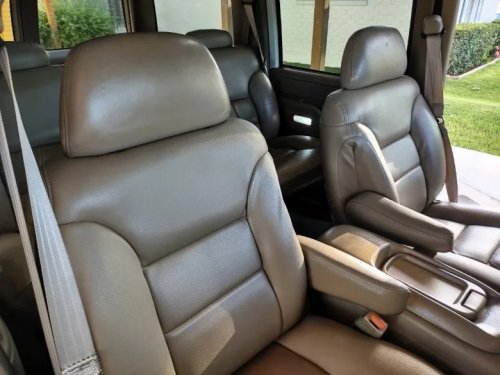
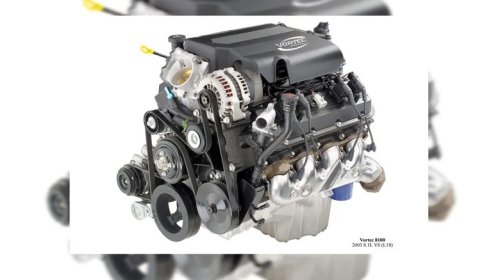
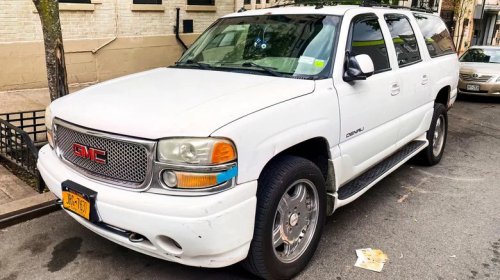
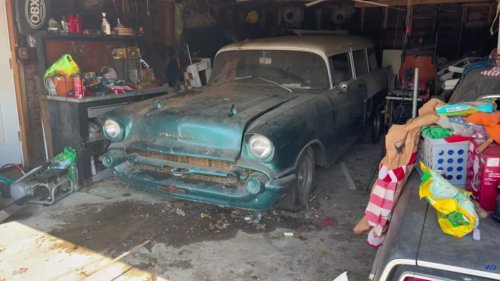
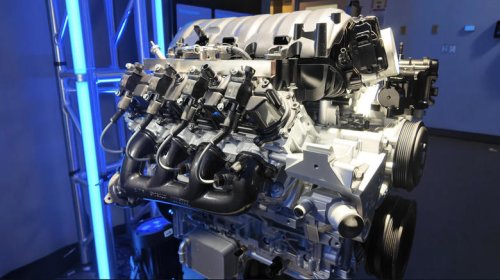
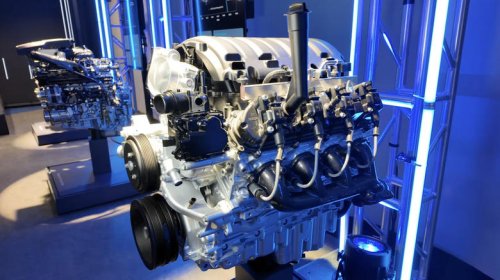
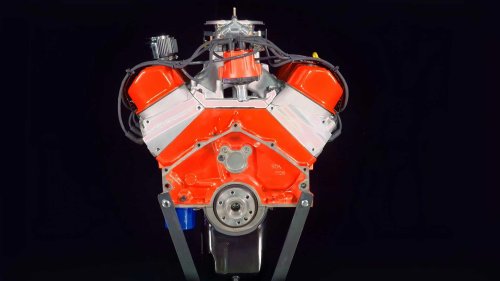
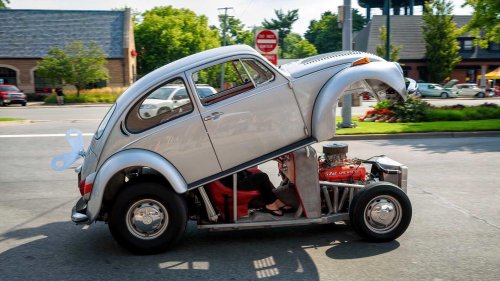
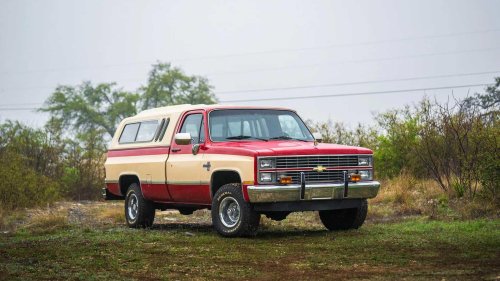
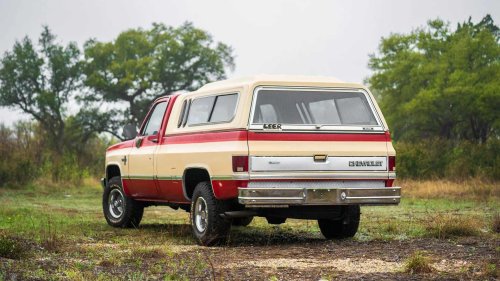
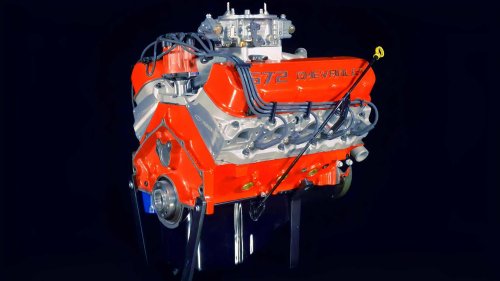
Muscle car dudes and truck guys will be very familiar with the crate engine. For those who aren't in-the-know, a crate engine is a mill that can be bought from the manufacturer as a fully assembled unit, ready to be dropped into whatever sort of project you have in mind. Buying a crate engine can be a much more convenient way to up your power output than, say, buying a donor car, because it's already assembled and ready to go in. Not to mention, it's brand-new.Arguably, Chevrolet has been one of the leading lights in the world of crate engines. The iconic brand offers loads of different engine options and sizes, ranging anywhere from 350 cubic inches (5.7L) of displacement all the way up to 632 cubes (10.4L). However, Chevy's 572 CID crate motor is a special one in its own right. Not only does it come with a choice between two variants, it's also relatively cheap, and incredibly powerful right out of the box. It'll even accept modifications, should you require more oomph out of it for some reason. All The Numbers Behind The 572 Big Block ChevroletBack in the late 1990s, Chevrolet decided it was time to up their crate engine ante in a significant way. At the time, the largest crate motor offered by Chevy was a 502 CID big block, alongside a 454 CID, as well. But, with competition beginning to heat up and interest in hot-rodding growing quickly, the brand wanted to offer more to its fans. Not to mention, with drag racing and hot rodding becoming more and more popular at the time, custom engine builders began charging a fortune for builds, paving the way for a factory-supported crate engine that was ready to go straight out of the gate.In 1998, the 572 CID V8 crate motor officially hit the market. In essence, the mill is based on Chevy's standard Big-Block V8 family. However, both its bore and stroke differ from standard big blocks. There are two distinct versions of the engine, the standard of which being the "ZZ572/620". A hotter version called the "ZZ572/720R" is also available, but it requires the use of 110-octane racing fuel thanks to its extremely high compression ratio. The standard version is perfectly happy running on 92-octane fuel.Chevrolet Underneath its skin, the ZZ572 takes advantage of things like forged steel connecting rods and a forged crankshaft. Its pistons are also forged, but use aluminum instead of steel. A single, four-barrel 850-CFM carburetor sits atop the motor's single-plane intake manifold in its "620" iteration. The engine block itself is made from cast iron, as it prioritizes strength over lightness. A pair of aluminum heads sit on top of the block, and the mill is also internally balanced, meaning the crankshaft itself is machined in such a way that most of the engine's vibrations seen when running are negated by the crank. Specs ChevroletIt's important to note that we're discussing the "Deluxe" version of the engine, which comes equipped with every single thing you need to plop it into a car and go.There's another option that buyers could opt for that's slightly cheaper, called the "Base". If the Base is selected, the buyer is shipped a long block, which consists of the engine block and cylinder heads, along with other bottom-end components. However, the buyer is responsible for sourcing their own intake, carburetor, and ignition system, among other things.Typically, springing for the Base iteration will save you roughly $6,000–$8,000. However, you'll have to ask yourself if the money saved is worth the headache of sourcing, installing, and fine-tuning parts. What Should You Swap A 572 Into? Wikimedia Commons: Mustang JoeWell, there aren't many models you shouldn't swap one into, really. One of the largest benefits of using a 572 Chevy is the wide array of available adapter kits for both the engine itself, along with whatever sort of transmission you might decide to use. Of course, it would be hard to mate one with a Porsche gearbox, but Chevy's aftermarket parts selection is vast and nearly all-encompassing, meaning virtually any car can house a 572. Just look at the Beetle above, if you don't believe us.However, it's best to stick to full-size trucks and classic muscle cars if you're considering a swap, as smaller vehicles will require extensive modifications in order to even consider fitting the huge engine. 1981 Chevrolet K10 Bring a TrailerOne of the most iconic pickup trucks to come out of post-War America is the Chevrolet C/K Series. By 1981, the model lineup was already well-established in the world of pickups, and did direct battle with the Ford F-150. The Dodge Ram was also a competitor, although much less so. From the factory, the most powerful engine available for use within a Chevy K10 was the 454 CID (7.4L) big-block V8 producing just 210 hp and 340 lb-ft of torque.Bring a Trailer If you're planning on swapping a 572 into an '81 K10, you'll need a bit more than just the engine. The Turbo-Hydramatic TH400 transmission that came with some 454-equipped 1981 K10s could potentially handle the ZZ572/620's power short-term, but it would be best to upgrade to a beefed-up 4L80-E four-speed automatic.Or, if you're more of a coal-stirrer, a built NV4500 five-speed manual will do the trick, too. You'll also need a high-performance fuel pump, some cooling system upgrades, and an upgraded driveshaft to remove the risk of twisting it from all the 572's torque.All told, be prepared to sink anywhere from $30k–$40k into this project, assuming you're buying all brand-new components, so make sure it's worth it to you first. 2004 Cadillac Escalade CadillacOn the flip-side, you could always toss a 572 into something a bit more luxurious than a 45-year-old pickup truck. The '04 Cadillac Escalade is a decent contender for the swap due to its use of a full-size, GMT800 frame, which was already built to accommodate the Vortec 8100 engine, which was a massive, 8.1-liter V8. Even still, some extensive modifications will be required to shoehorn the crate engine into an Escalade. But, once you complete the swap, you'll drastically increase its power output from its standard measurements of 345 hp and 380 lb-ft of torque.Cadillac Under the hood, a new set of motor mounts will need to be fabricated. JEGS, a popular performance parts brand, happens to sell universale big-block motor mounts which can be welded into place.The 4L60-E automatic transmission will need to be swapped out, too, as the 572 would turn its insides into pulp. A built 4L80-E should do the trick, as many custom builders regularly produce versions that can reliably withstand upwards of 700 lb-ft of torque. You'll also need to find an adapter for the Escalade's AWD system, so that it can be used with the new gearbox. Of course, new driveshafts will also be needed, along with a new oil pan. Is The 572 Big-Block Worth It? ChevroletIt's a good question, especially considering you're spending close to $30k right off the bat for 621 hp.In order to see how the math "maths", let's break it down into a simple horsepower-per-dollar equation. If you simply take $30,000 and divide it by 621 hp, you end up with $48.31 per single horsepower. On the flip side, you'll get 0.21 horsepower for every dollar you spend. However, what if you found something like a used Chevrolet 454 CID V8 and threw some high-quality performance upgrades at it?If you do it that way, the average used 454 costs around $3,000 for the complete assembly, with one example found on eBay for $2,614 currently. From there, you're going to have to tear the engine apart and completely rebuild it with forged internals, new heads, a new camshaft, all-new valves and valve springs, and upgraded fueling. However, the popular muscle car publication Hot Rod Network claims to have built a 700-hp 454 CID V8 for just $2,403. Albeit this was over 10 years ago, but we can't imagine inflation would cause its price to jump to above the cost of a brand-new, dressed 572 big-block.Chevrolet If the pricing holds up in this day and age, or at least close enough to it, you can have yourself a 700-hp big-block V8 for substantially less than a brand-new 572 CID V8. With that being said, we know which choice we'd opt for.
























 +2 others