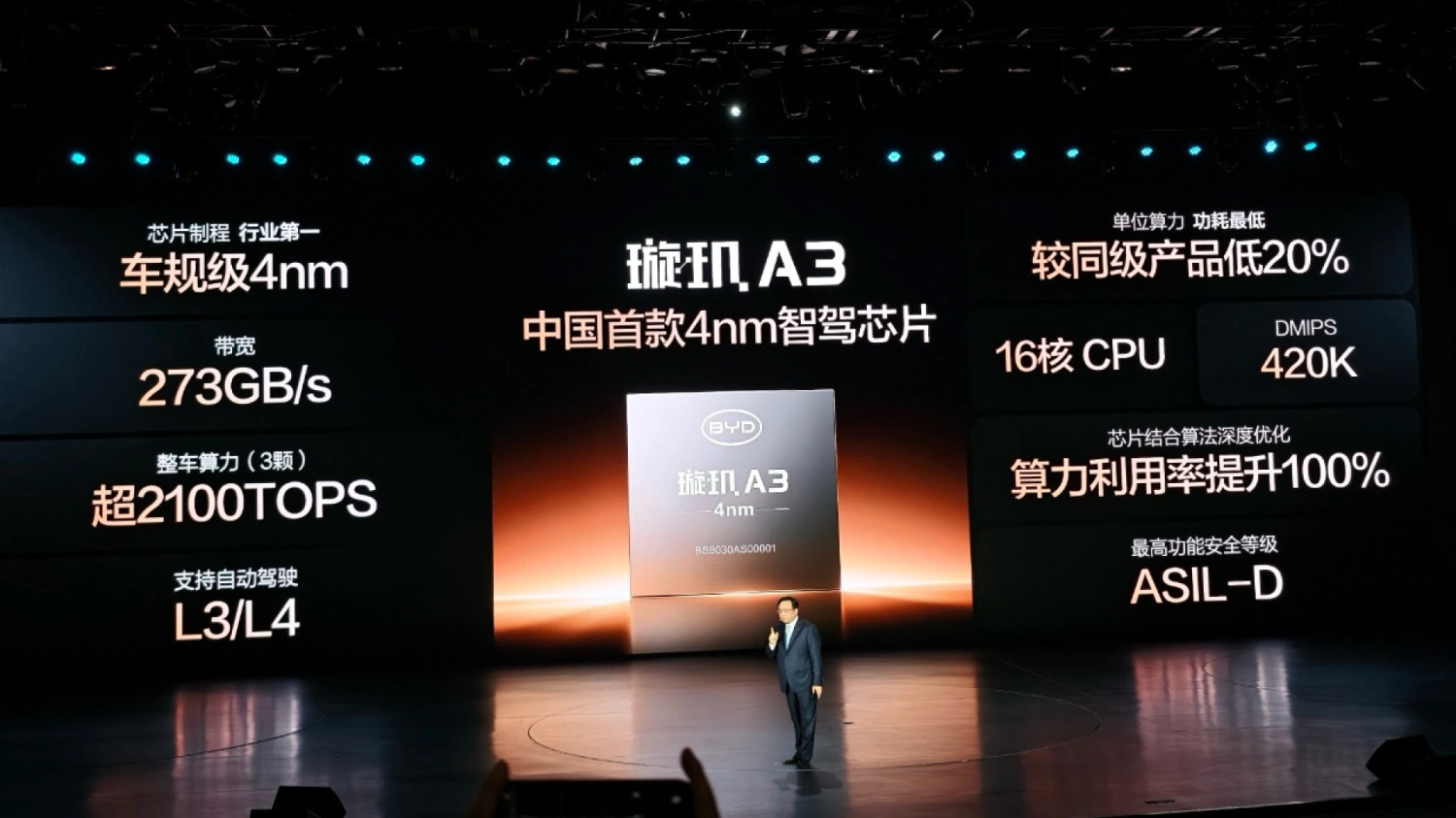
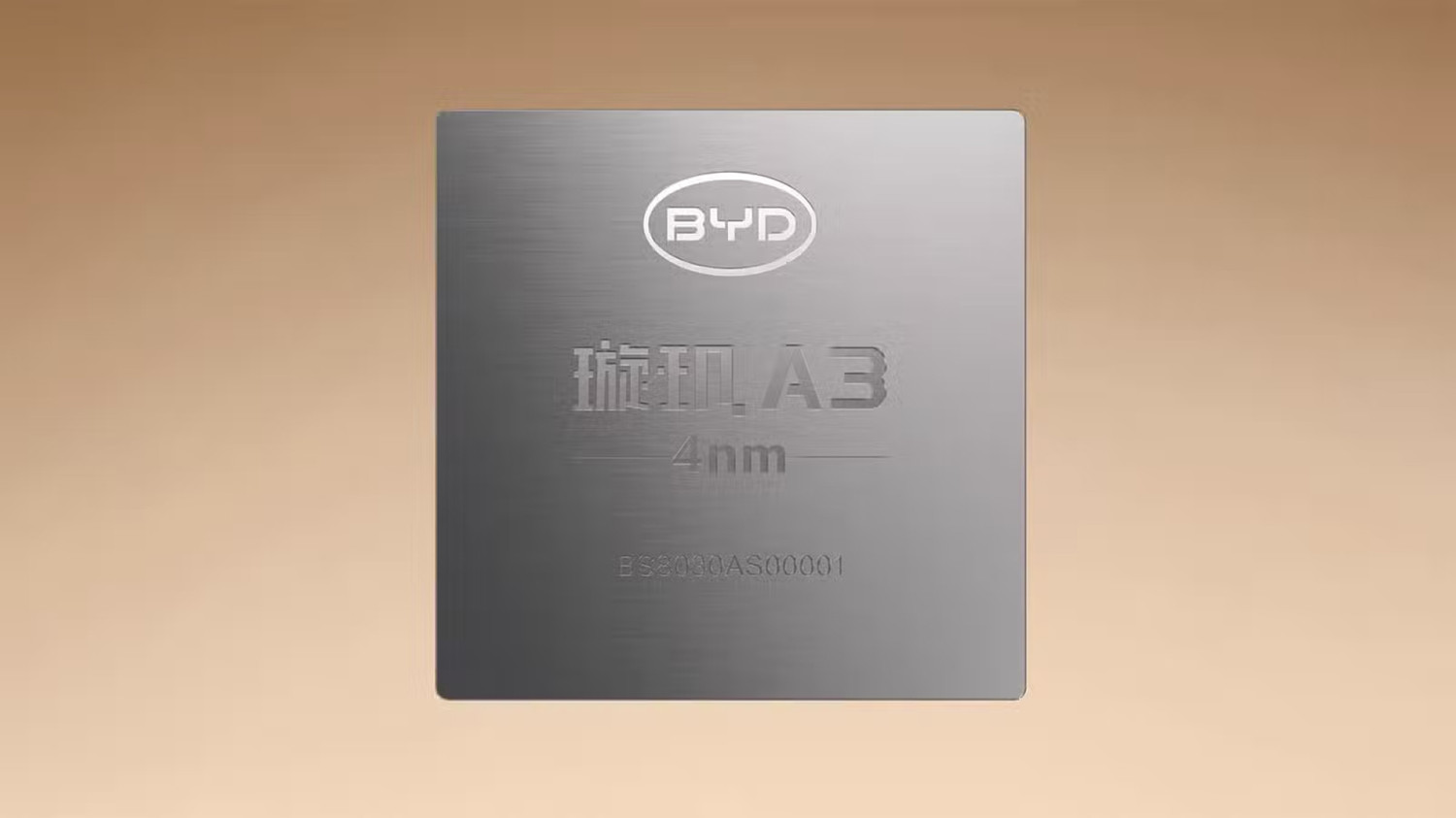
The BYD Xuanji A3 chip. Credit: BYD Understand China EV’s Market Real-time notifications when critical EV data is released All important data in one place 2,000,000+ data points Become a member BYD released the new self-developed 4-nm Xuanji A3 assisted driving chip capable of L3 and L4 autonomous driving functions. The company kicked off mass production of this computing unit, underlining the long-term goal of accident-free traffic. During the launch event of the new chip, BYD chairman Wang Chuanfu shared that the company currently has over 7,000 people in its chip R&D team as well as a long-running semiconductor business. On May 28, BYD responded to the growing number of self-developed ADAS chips from other automakers, including the recent Mach 100 chip from Li Auto, Turing AI from Xpeng, and NX9031 from Nio. More about the Xuanji A3 chip The new Xuanji A3 is China’s first mass-produced 4-nm autonomous driving chip. BYD officials highlighted that this chip supports L3 and L4 driving solutions. The company will be able to integrate these computing units in upcoming robotaxi fleets. BYD shared that the Xuanji A3 chip boasts full-chain control over assisted driving, allowing integration of software and hardware. Despite BYD sharing a lot of exciting information, it is worth noting that the combination of three Xuanji A3 chips has a combined peak computing power of 2,100 TOPS. It means a single Xuanji A3 chip offers 700 TOPS of computing power. It is in line with the Nvidia Drive Thor. However, the Mach 100 chip from Li Auto delivers 1,280 TOPS. And the Xpeng’s Turing AI chip offers 750 TOPS. The BYD Xuanji A3 chip It means the Xuanji A3 chip isn’t the best in terms of computing power. However, BYD shared that its power utilization rate had increased by 100%, compared to previous chips. It will also be compatible with a thousand-line LiDAR sensor. Previously, BYD-backed Robosense revealed a sensor with up to 2,160 lines. The company’s thousand-line LiDARs will be adopted by L3- and L4-ready cars. It promises to be more precise than the current 896-line LiDAR from Huawei, widely adopted by cars under the HIMA umbrella. Wang Chuanfu added that BYD has a long-term goal of zero traffic accidents. He shared that every BYD car will be equipped with the DiPilot 300 (“God’s Eye B”) LiDAR-based assisted driving system. It will be available even for the entry-level models as a paid extra option worth 12,000 yuan (1,770 USD). With this step, BYD aims to enhance its domestic sales volume. According to China EV DataTracker, BYD delivered 156,944 units in April in China, down 19.8% Year-Over-Year.



















 +17 others


![BYD, BYD Seagull, BYD offers a closer look at the new Seagull EV [Images]](https://cdn.topcarnews.net/thumb/id/aHR0cHM6Ly9pMC53cC5jb20vZWxlY3Ry-ZWsuY28vd3AtY29udGVudC91cGxvYWRz-L3NpdGVzLzMvMjAyNi8wOS9CWUQtbmV3-LVNlYWd1bGwtRVYtdXBkYXRlLmpwZWc_-dz0xNTAwJmFtcDtxdWFsaXR5PTgyJmFt-cDtzdHJpcD1hbGwmYW1wO3NzbD0x/9c0b758dc4a218f611566b2a03c52e8a.jpeg?t=20261002&post_id=64651)
![BYD, BYD Seagull, BYD offers a closer look at the new Seagull EV [Images]](https://cdn.topcarnews.net/thumb/id/aHR0cHM6Ly9lbGVjdHJlay5jby93cC1j-b250ZW50L3VwbG9hZHMvc2l0ZXMvMy8y-MDI2LzA5L0JZRC1uZXctU2VhZ3VsbC1F-Vi0xLmpwZWc_c3RyaXA9aW5mbyZhbXA7-dz03MDA/9f44752c6c4b6208b3a29d7e2ceaf455.jpeg?t=20261002&post_id=64651)
![BYD, BYD Seagull, BYD offers a closer look at the new Seagull EV [Images]](https://cdn.topcarnews.net/thumb/id/aHR0cHM6Ly9lbGVjdHJlay5jby93cC1j-b250ZW50L3VwbG9hZHMvc2l0ZXMvMy8y-MDI2LzA5L0JZRC1uZXctU2VhZ3VsbC1F-Vi0zLmpwZWc_c3RyaXA9aW5mbyZhbXA7-dz03MDA/53e754be2aacba076b7b389ef9413f41.jpeg?t=20261002&post_id=64651)
![BYD, BYD Seagull, BYD offers a closer look at the new Seagull EV [Images]](https://cdn.topcarnews.net/thumb/id/aHR0cHM6Ly9lbGVjdHJlay5jby93cC1j-b250ZW50L3VwbG9hZHMvc2l0ZXMvMy8y-MDI2LzA5L0JZRC1uZXctU2VhZ3VsbC1F-Vi5qcGVnP3N0cmlwPWluZm8mYW1wO3c9-NzAw/3b0cb7f441d090c464769d93120d8543.jpeg?t=20261002&post_id=64651)
![BYD, BYD Seagull, BYD offers a closer look at the new Seagull EV [Images]](https://cdn.topcarnews.net/thumb/id/aHR0cHM6Ly9lbGVjdHJlay5jby93cC1j-b250ZW50L3VwbG9hZHMvc2l0ZXMvMy8y-MDI2LzA5L0JZRC1uZXctU2VhZ3VsbC1F-Vi0yLmpwZWc_c3RyaXA9aW5mbyZhbXA7-dz03MDA/ea2b4ebf38c4e9bf732d179d639b1562.jpeg?t=20261002&post_id=64651)
![BYD, BYD Seagull, BYD offers a closer look at the new Seagull EV [Images]](https://cdn.topcarnews.net/thumb/id/aHR0cHM6Ly9lbGVjdHJlay5jby93cC1j-b250ZW50L3VwbG9hZHMvc2l0ZXMvMy8y-MDI2LzA3L0JZRC1TZWFndWxsLUVWLXVw-ZGF0ZS0zLmpwZWc_c3RyaXA9aW5mbyZh-bXA7dz0xNDAw/02a0f7b5011767092a1ea11a79495fc7.jpeg?t=20261002&post_id=64651)


![BYD, BYD's $10,000 EV has a big sibling on the way: First look [Images]](https://cdn.topcarnews.net/thumb/id/aHR0cHM6Ly9pMC53cC5jb20vZWxlY3Ry-ZWsuY28vd3AtY29udGVudC91cGxvYWRz-L3NpdGVzLzMvMjAyNi8wOS9CWUQtR3Jl-YXQtU2VhZ3VsbC1FVi1maXJzdC1sb29r-LmpwZWc_dz0xNTAwJmFtcDtxdWFsaXR5-PTgyJmFtcDtzdHJpcD1hbGwmYW1wO3Nz-bD0x/4dd4fa96cdf12559891b44c0ae18cc65.jpeg?t=20261002&post_id=64341)
![BYD, BYD's $10,000 EV has a big sibling on the way: First look [Images]](https://cdn.topcarnews.net/thumb/id/aHR0cHM6Ly9lbGVjdHJlay5jby93cC1j-b250ZW50L3VwbG9hZHMvc2l0ZXMvMy8y-MDI2LzA3L0JZRC1TZWFndWxsLUVWLWxv-bmdlci5qcGVnP3N0cmlwPWluZm8mYW1w-O3c9MTQwMA/a412dc5ddf85cc7d169d4bcc3fdd7798.jpeg?t=20261002&post_id=64341)
![BYD, BYD's $10,000 EV has a big sibling on the way: First look [Images]](https://cdn.topcarnews.net/thumb/id/aHR0cHM6Ly9lbGVjdHJlay5jby93cC1j-b250ZW50L3VwbG9hZHMvc2l0ZXMvMy8y-MDI2LzA3L0JZRC1TZWFndWxsLUVWLXVw-ZGF0ZS5qcGVnP3N0cmlwPWluZm8mYW1w-O3c9MTQwMA/fecda1af96dbaf70d574ec2f9e5deb7a.jpeg?t=20261002&post_id=64341)
![BYD, BYD's $10,000 EV has a big sibling on the way: First look [Images]](https://cdn.topcarnews.net/thumb/id/aHR0cHM6Ly9lbGVjdHJlay5jby93cC1j-b250ZW50L3VwbG9hZHMvc2l0ZXMvMy8y-MDI2LzA3L0JZRC1TZWFndWxsLUVWLXVw-ZGF0ZS0xLmpwZWc_c3RyaXA9aW5mbyZh-bXA7dz0xNDAw/8dbbcf9dde61eec3ff01de1121cdaaf5.jpeg?t=20261002&post_id=64341)
![BYD, BYD's $10,000 EV has a big sibling on the way: First look [Images]](https://cdn.topcarnews.net/thumb/id/aHR0cHM6Ly9lbGVjdHJlay5jby93cC1j-b250ZW50L3VwbG9hZHMvc2l0ZXMvMy8y-MDI2LzA3L0JZRC1TZWFndWxsLUVWLXVw-ZGF0ZS0yLmpwZWc_c3RyaXA9aW5mbyZh-bXA7dz0xNDAw/5aa4369f36f3e45cef0b6dd83ae6128a.jpeg?t=20261002&post_id=64341)
![BYD, BYD's $10,000 EV has a big sibling on the way: First look [Images]](https://cdn.topcarnews.net/thumb/id/aHR0cHM6Ly9lbGVjdHJlay5jby93cC1j-b250ZW50L3VwbG9hZHMvc2l0ZXMvMy8y-MDI2LzA3L0JZRC1TZWFndWxsLUVWLXVw-ZGF0ZS0zLmpwZWc_c3RyaXA9aW5mbyZh-bXA7dz0xNDAw/02a0f7b5011767092a1ea11a79495fc7.jpeg?t=20261002&post_id=64341)


