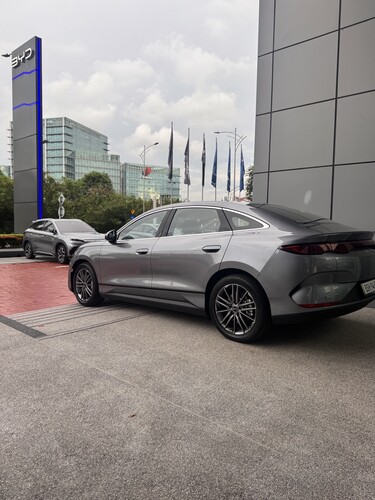
Mason Wilson · 3 months ago@masonwilson87BYD reveals $44,000 sedan with 626 miles of range, undercutting many EV rivals Liked by+71 othersPost commentRelated PostsChina and EU reportedly reach understanding on hybrid vehicle trade, averting potential tariffsGabriel White · 15 days agoBYD unveils design for its first self-developed humanoid robotOliver Macdonald · 15 days agoChina’s busiest holiday reveals Nio’s swapping efficiency triples BYD’s Flash ChargingNicole Carter · 15 days agoChery’s Plug-In Diesel Stockman Pickup Has 469 HPAva Lewis · 15 days agoHave Chinese EVs peaked in the UK? BYD and Leapmotor hit record sales numbers, but new tariffs could put the brakes onAva Poirier · 15 days agoGeely Is Officially Coming To CanadaGabriel Nelson · 15 days agoChina’s Geely to Start Selling Cars in Canada In a Matter of Months, According to the CompanyJenna Brown · 15 days agoBYD launches pre-orders for new Seagull, its $10K EV gets biggerThomas Leblanc · 15 days agoIn Japan, Suzuki's first mini EV could take the budget crown with rival BYD cells insideVictoria Bouchard · 15 days agoBYD Ocean MPV spied testing with roof LiDAR ahead of year-end launchMadeleine Gagnon · 15 days agoBYD’s Yangwang responds to Huawei MPV brake failures, shows off “full metal pedals”Charlotte Wilson · 15 days agoParis Motor Show 2026: your guide to the most important carsNoah Gagnon · 15 days agoSecond-gen BYD Seagull became available for pre-orders in ChinaLiam Clark · 16 days agoBYD Fang Cheng Bao Ti 9 reveals a new body color ahead of Q4 launchKayla Scott · 16 days agoNissan's New Plug-In Hybrid Pickup Is Part Of A Much Bigger China TrendAiden Morgan · 16 days agoThe BYD Seal 6 Is A Perfectly Adequate EV Sedan, But That’s About It | ReviewKaitlyn Scott · 16 days agoBYD reveals tech-savvy 5-seat SUV interior with two 30" screensCarter Smith · 16 days agoGas Prices Mean It Now Costs Six Times More To Drive a Regular Car 1,000 Miles Versus an EVOliver Bouchard · 16 days agoOnly 5% Use In-Car Fridges: It's Time to End the NEV Feature Arms RaceMason Pelletier · 16 days agoBYD Seal owner loses speedometer to blacked-out dash, tries every reset before serviceRyan Gagnon · 16 days ago


 +71 others+71 others
 +71 others