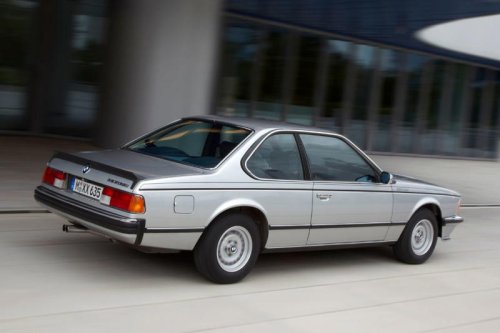
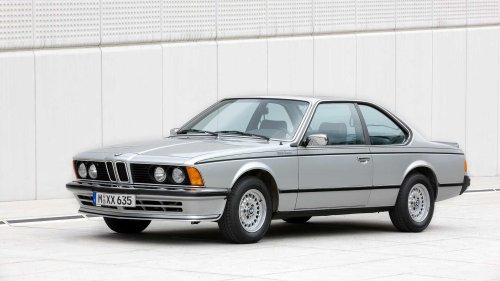
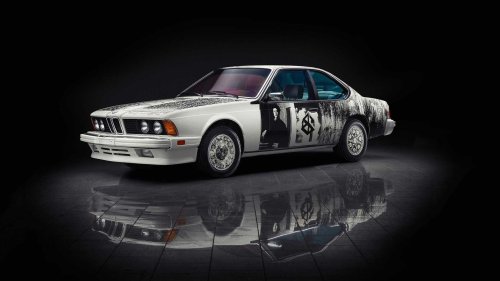
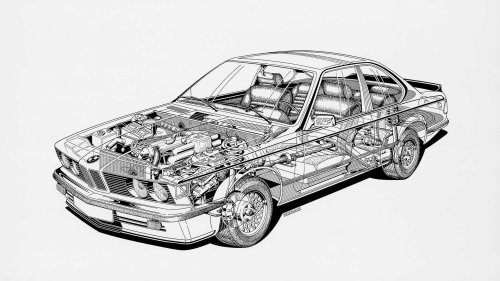
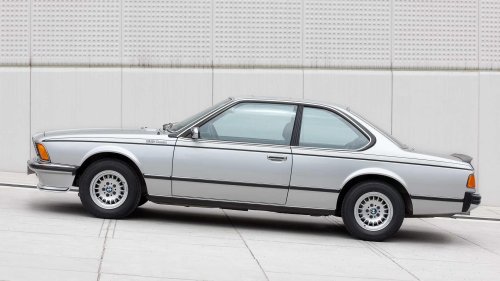
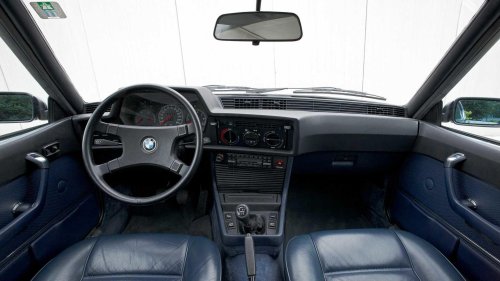
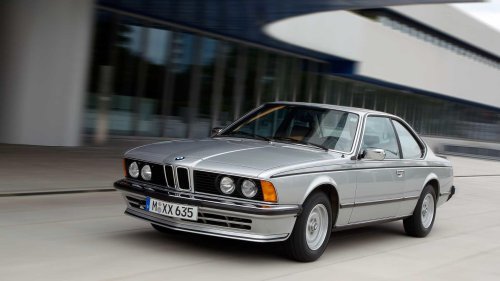
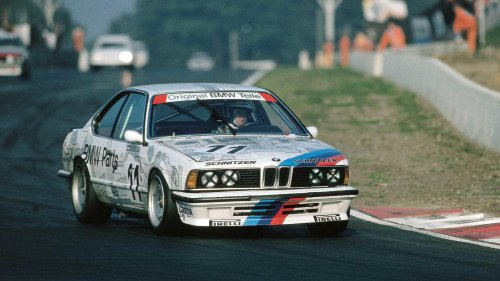
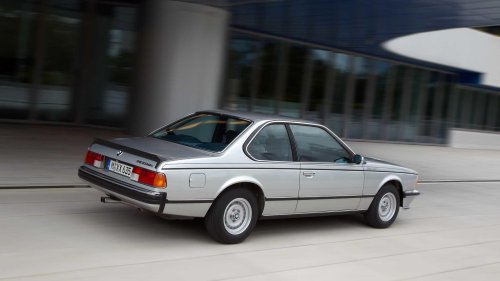
Earlier this month, BMW celebrated several milestone moments at the 2026 Amelia Concours d’Elegance. Not only did the vaunted 3 Series hit its 40th birthday, Amelia Concours also celebrated six decades of Bovensiepen-led Alpina independence.On top of all that, BMW also commemorated 50 years since the debut of one of its most famous models. A luxury performance coupe so successful, both on-road and on-track, that it was revived 16 years later, ironically, to replace its own successor. But if you’re looking to buy your own second-hand example, you may want to get a move on. Because prices will start going up… BMW Launches The E24 6 Series BMWThe story goes that BMW board members in the late 1970s – buoyed by the success of the E9 coupe after years spent teetering on the edge of financial ruin – were keen to produce a follow-up. Nothing too dramatic or daring, though. And, ideally, something with larger rear seats and wider-opening doors. Bob Lutz, however, BMW’s then-board member for sales, suggested, repeatedly, that the Bavarian brand instead lean heavily into its new "Ultimate Driving Machines" tagline, and introduce a more dynamic model.The result – eventually – was the "E24" 6 Series, the silks for which were pulled in early 1976 to enormous acclaim. Designer Paul Bracq’s timeless "Shark Nose", after all, was a notable step away from the E9, and, deservedly, remains among the most distinctive BMWs of them all. Indeed, the 635 CSi was chosen as the canvas for two of the first six BMW Art Cars, which completed a World Tour last year, thanks largely to its bold design.BMWThe BMW board’s call for a "safe" vehicle, however, had still been placated. Unlike the two-seater 3.0 CS it replaced, for example, the E24 “GT coupe” had a rear bench, ample cargo space, and, as a direct rival to Jaguar’s XJS coupe, was luxuriously built and equipped. Constructed by Karmann during the first year, the 6 Series was also built on the chassis of the established 5 Series. The front-mounted engine that drove the rear wheels, meanwhile, was BMW’s established "M30" straight-six, which had powered the brand’s compact E3 sedan since 1968.North America’s launch model for 1977 was the now-largely disregarded 630CSi, with the marginally feistier 633 CSi following the next year. It’s the successor to both these models, however – the 635 CSi – that really got under people’s skin, and continues to do so nearly 50 years later. The 635 CSi Debuts A Complex Engine Range BMWEngine and power specs for BMW's E24 6 Series are so complicated, they’ll make your teeth itch. The 3.0-liter M30 in Europe’s initial 630CS, for example – plucked, incidentally, from the outgoing 3.0 CS, hence the name – produced a solid, if slightly hamstrung, 182 hp. The US-spec 630 CSi, meanwhile, featured fuel injection (note that subtle name change …), and thus, you might expect, would be more powerful. But no. Heavy emissions regulations in the US, plus the fuel-starved fallout from the 1974 Oil Crisis, meant power in the North American model was shackled at 176 hp.Things were similarly complicated with the 3.2-liter capacity 633 CSi, which, in Europe, had its 197 hp throttled back to 194 hp between 1976 and 1979, while the US-spec 330 CSi never broached 181 hp. The European-only 628 CSi? Well, that was introduced three years after the 330 CS, had a 2.8-liter capacity to the latter’s 3.0-liter, and produced 1 hp less. Yep. One.BMWOddly, BMW pulled the same trick when it introduced its then-range-topping 635 CSi to North America for 1985, seven years after it debuted in Europe.To appease nationwide emissions regulations, Europe’s four-speed Getrag manual gearbox was swapped out for a more fuel-conscious five-speed example, or, more often than not, a lifeless three-speed automatic at the heart of the ‘CSiA’ range (a ZF four-speed automatic was available later on). Capacity also stayed the same, with the 633 CSi’s 3.2-liter M30 bored out to 3.4-liters in the 635 CSi.And while torque was punched out from 195-pound-feet to 214 lb ft, the 635 CSi’s power rating in the US was only 182 hp. Just 1 hp more than in the outgoing 633, and 33 hp down on its European alter-ego. The 6 Series The US Had Been Waiting For Finally Arrived In 1985 BMWDespite all this, 1985 was the first time North American customers experienced BMW’s E24 as it was originally intended. The "down on power" M30 was now fed by Bosch Motronic fuel injection, was higher revving than its 633 CSi predecessor, and offered more spirited mid-range response as a result. A midlife facelift for 1988 eventually pushed power up to 208 hp.Even the Getrag manual transmission featured shorter ratios for snappier acceleration, meaning 0–60 mph was now possible in a more representative 8.2 seconds. That, admittedly, is around a second slower than a GMC Yukon can manage today, but was pretty good when you consider Jaguar’s V12-powered XJS was around two-10ths of a second slower. The Handling Was So Good, BMW Took It Racing BMWTo pigeonhole the 635 CSi on pure grunt alone, however, would do this well-composed coupe a massive disservice. Indeed, despite being wider, larger and heavier, the E24’s monocoque was far stiffer than the supposedly nimbler E9 coupe it replaced. MacPherson struts had been prized off the first-generation 5 Series, and, to appease evolving US crash safety regulations, both the A and B-pillars were thicker, and thus more structurally sound. To hide their bulk, designer Paul Bracq leaned heavily into the fastback look.Ahead of its US debut, the 635 CSi had been fitted with newer MacPherson suspension at the front, while the independent rear geometry was lowered to quell the coupe’s predilection for lift-off oversteer. Perhaps most significantly, BMW also kitted the 6 Series out with anti-lock brakes for the first time in the US. Admittedly, these adjustments meant the 635 CSi was 95 lbs heavier than the 633 it replaced. But, critically, this GT Coupe could accelerate, brake, and steer as an Ultimate Driving Machine should.BMWNot that this came as too much of a surprise to European customers, who’d already received this "true" 635 CSi three years earlier. And on which BMW had already based a race-spec model with which it entered the 1983 European Touring Car Championship (the 5,000 homologated examples the brand was obliged to sell were quickly snapped up). The "Group A 635 CSi" would end up being 500-plus lbs lighter than its road-going counterpart, featuring as it did bespoke suspension, brakes, and lightweight alloys, a lower ride height, and a mandated roll cage, as well as flared-out wheel arches and a new front bumper. The slightly smaller 3.5-liter straight-six now pumped out close to 290 hp, and, somewhat fittingly, was developed by Alpina.The Group A 635 CSi would go on to be one of the most crushing touring cars of its era, taking the European Touring Car Championship crown three times, as well as touring car crowns in Germany and Australia once apiece. Most notably, 24-hour victories were secured at Spa (3) and the Nürburgring (2). Examples You Can Buy Today The Price Range BMWPerhaps unsurprisingly, examples of the previously range-topping 635 CSi are more exclusive on the second-hand market than the more powerful, more dynamic M635 CSi that landed in 1984 (or 1987 in the US as the M6). Indeed, of the 86,216 E24 coupes produced between 1976 and 1989, less than 6,000 of them were M6s.That may explain why we found more than 20 examples of the lauded M6 via Classic.com with prices ranging from $17,500 to just shy of $100,000. By contrast, only three pre-owned versions of the "less exclusive" 635 CSi came up. None of which cost more than $16,635, or less than $7,700. Throw modified and "project" models into the mix, and, intriguingly, that starting price drops to just $1,700.Admittedly, these numbers improve when you consider similar, and considerably lower mileage, examples that have sold via Hemmings. But even then, the highest asking price for a clean 635 CSi is still a little under $40,000, or less than half the price of the less exclusive M6.When you consider that the MSRP for a 635 CSi was just over $41,300 in 1985 (the equivalent of more than $120,000 today), there’s arguably never been a better time to pull the trigger on a pre-owned model. Especially since, with BMW very publicly celebrating the 6 Series’ 60th birthday, values must surely start to go up. What To Consider If You Do Go Pre-Owned BMWThere are some potential issues to consider, however. As with any classic car, rust and corrosion can be prevalent, particularly around the front wings and wheel arches, and particularly on imported, pre-1981 models. Restoring a badly worn cabin authentically could also prove difficult, with period leather and upholstery no longer available through BMW. Alongside electrical niggles – the power-assisted Recaro seats have apparently proved problematic – and reported issues with the cooling system, ironically, that game-changing ABS system could end up causing you headaches.The good news, though, is that well-serviced and maintained examples of that dependable straight-six are often bulletproof up to 300,000 miles and beyond, ditto the robust manual gearbox, provided the clutch has been similarly well cared for. Just don’t ask us how much power the engine produces. Turns out that can get quite complicated...Source: BMW



















 +17 others