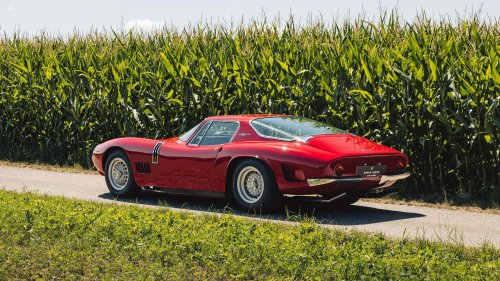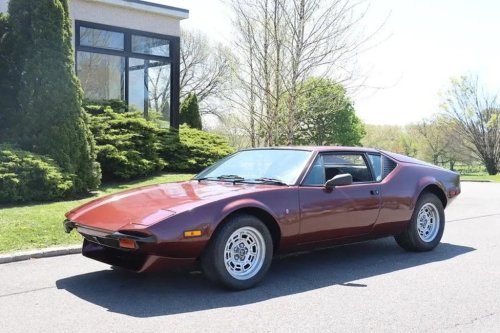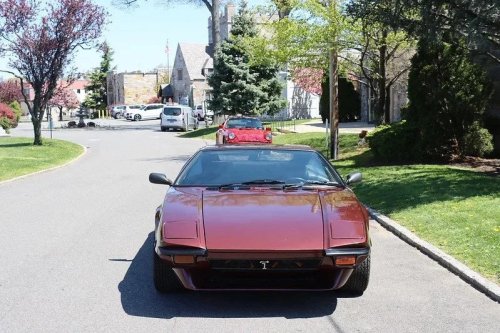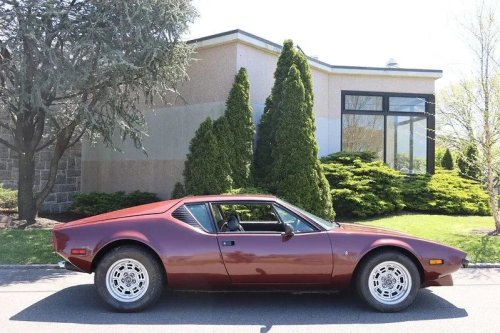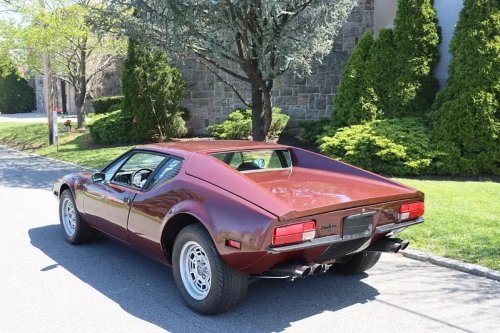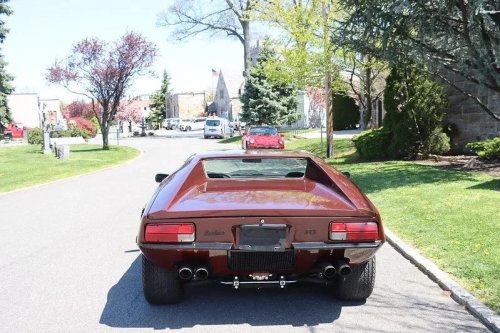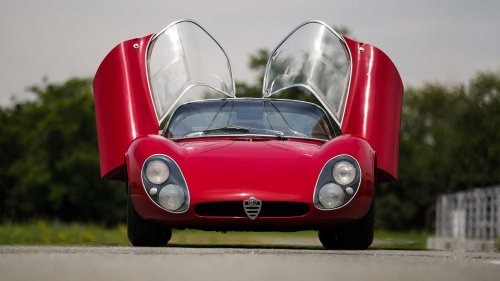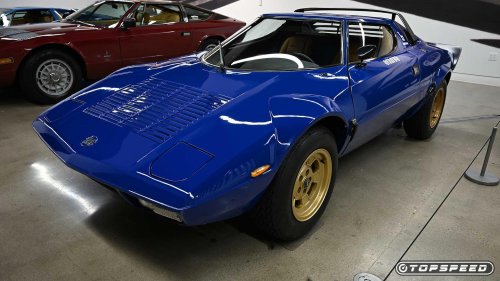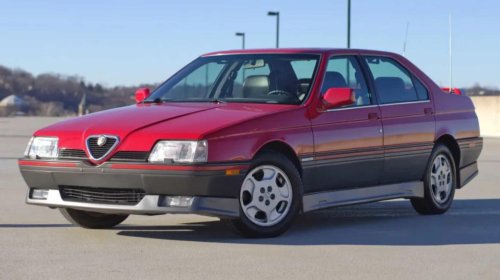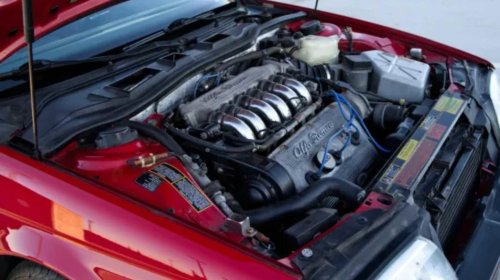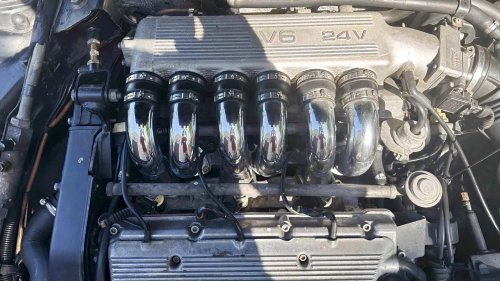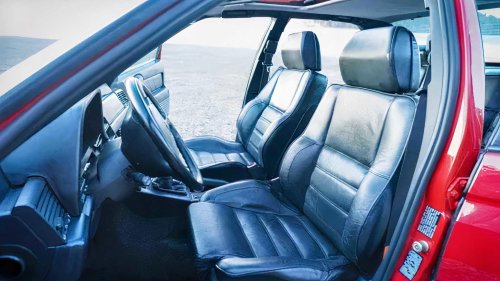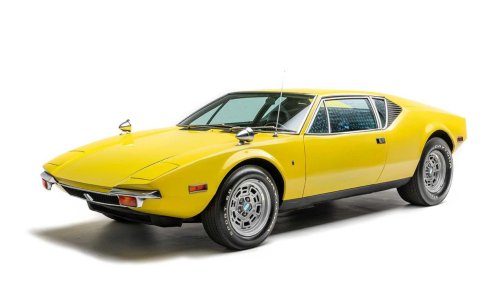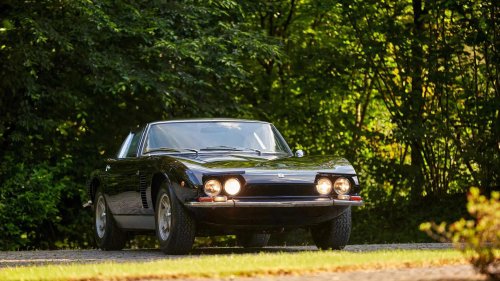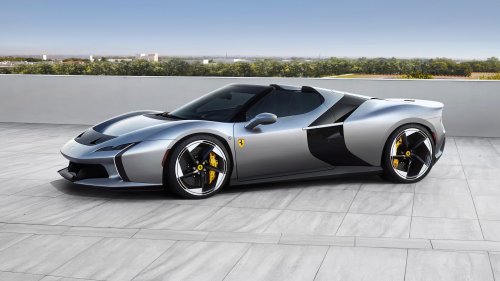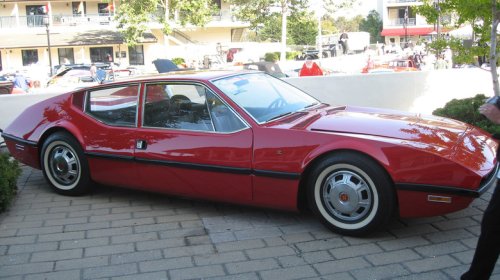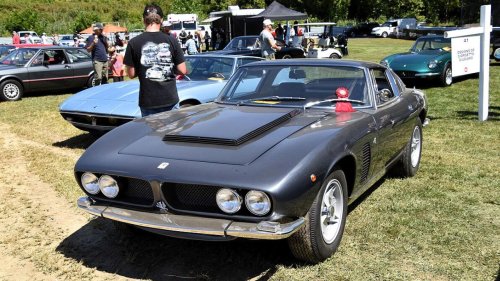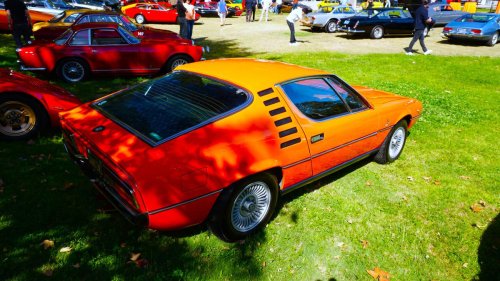
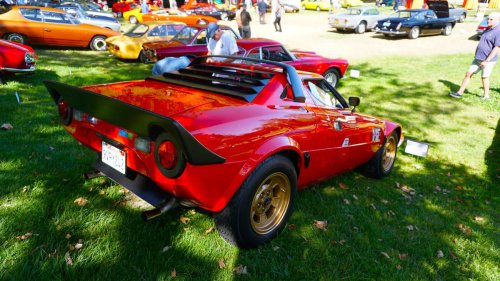
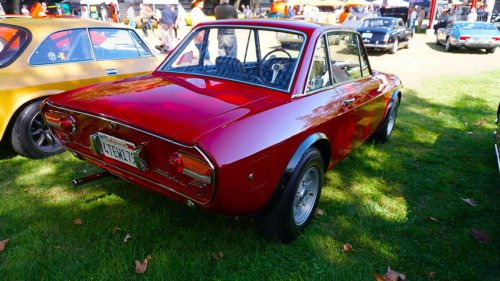
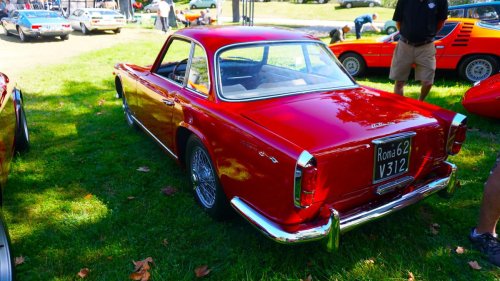
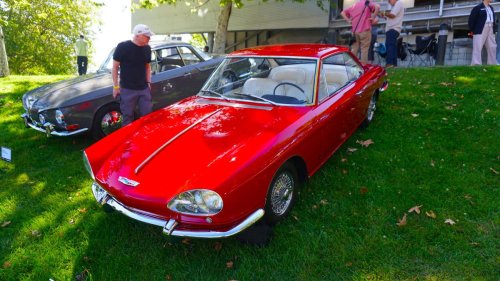
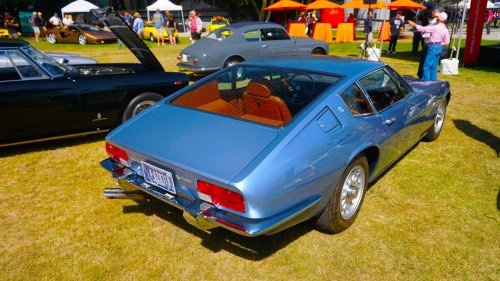
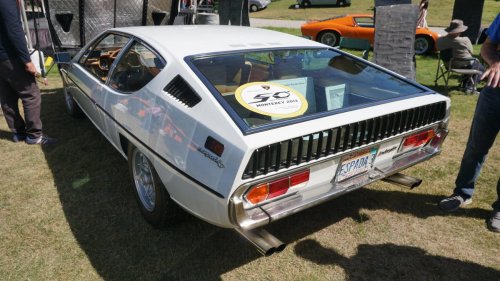
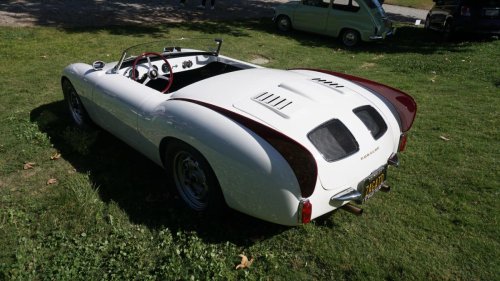
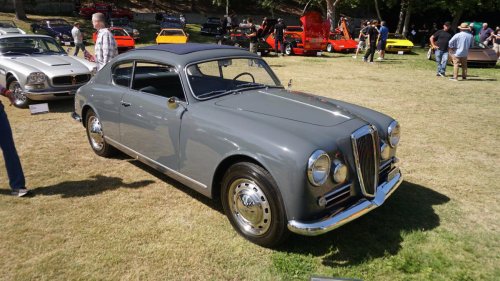
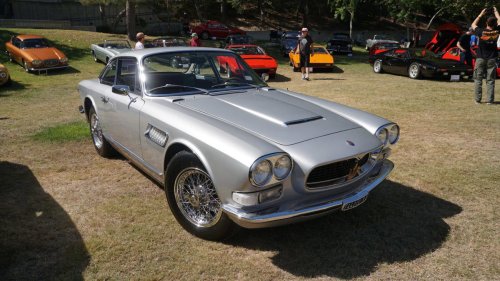
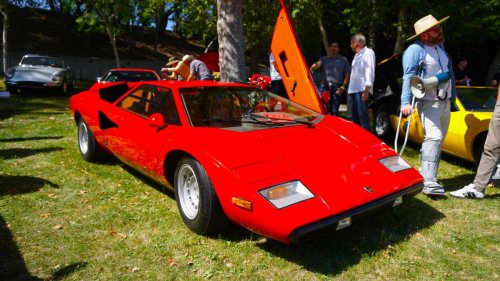
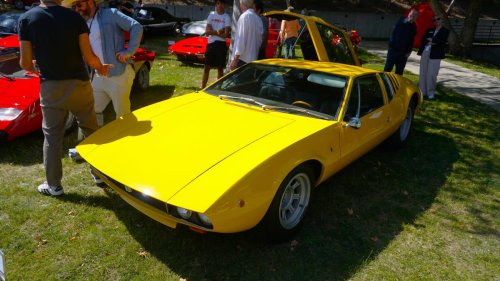
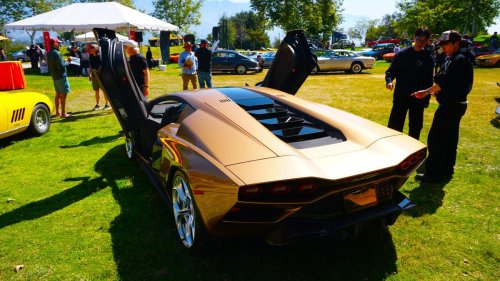
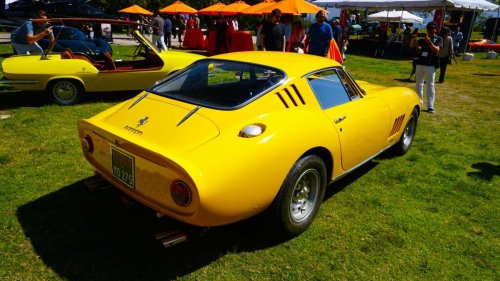
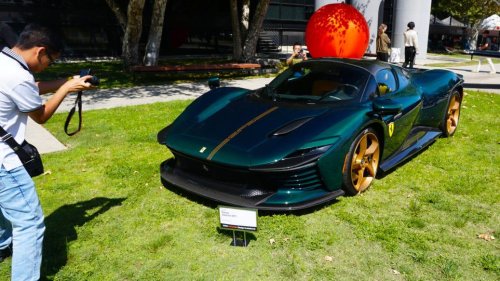
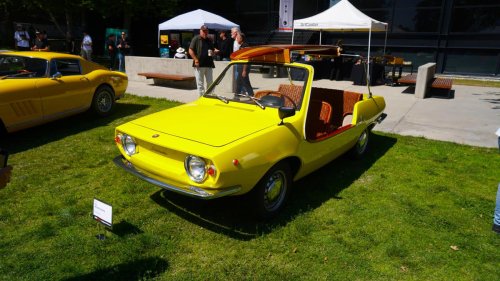
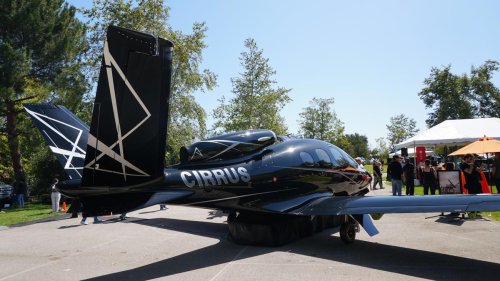
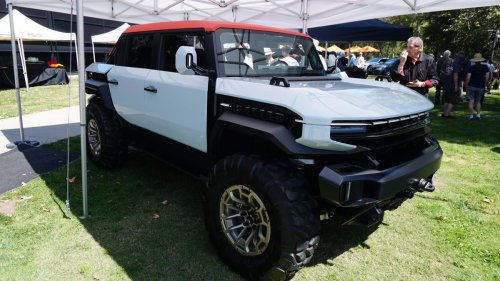
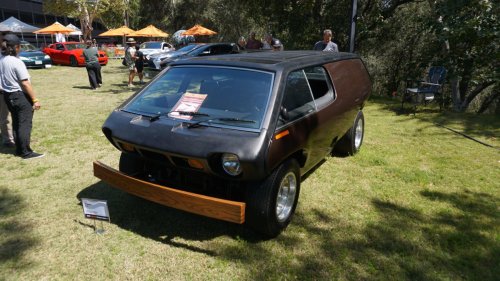
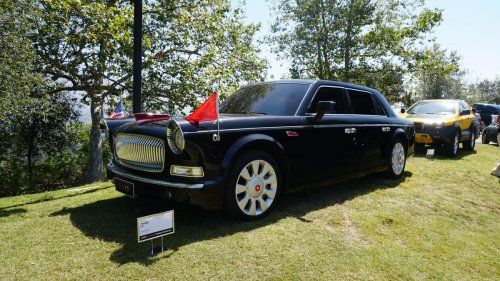
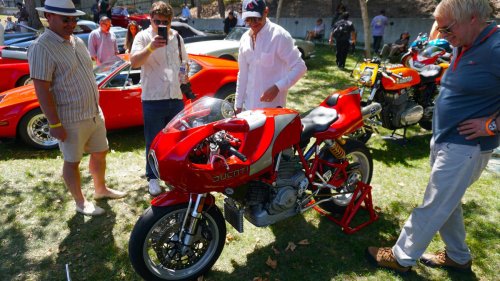
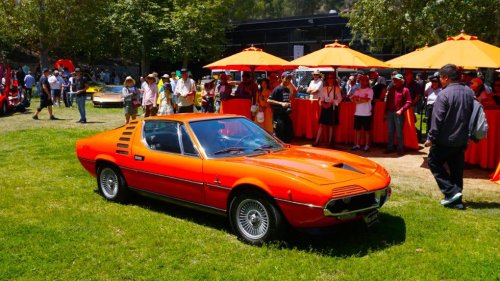
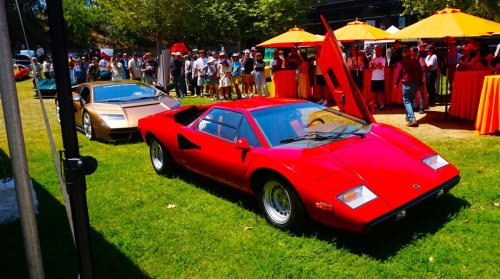
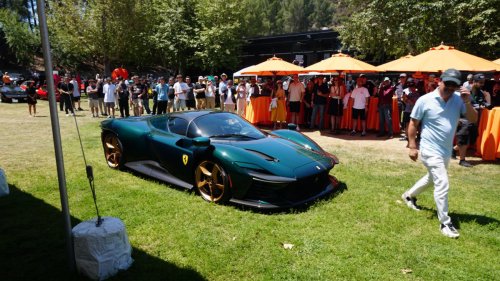
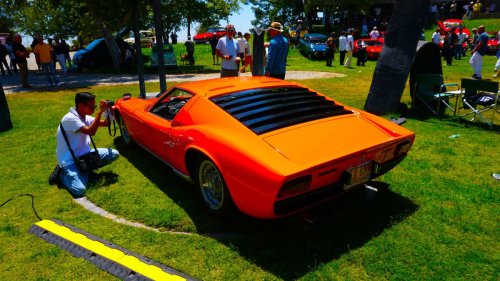
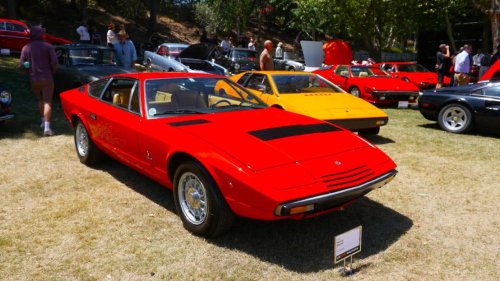

















The Art Center College of Design in Pasadena was founded in 1930, and added Transportation Design as a major in 1948. Guided by the great Strother “Mac” MacMinn for many years, then by a cavalcade of talented successors, it has produced more great automotive designers than any other institution in the world. Every year those alumni gather at the Art Center Design Invitational. This year’s theme was Italian cars, with great examples scattered across the lawn of the school’s hillside campus.1974 Alfa Romeo Montreal“This has been my dream car for the past 20 years," Ian Cartabiano, president of Toyota’s California-based Calty Design Research, told South OC Cars and Coffee at one of the many shows he's exhibited his Montreal. Cartabiano even got his hero, Marcello Gandini, to autograph the dashboard. The personalized plate reads, “Gandini.”He has cited the Montreal as a major personal design inspiration, bridging classic Italian wedge styling with modern automotive design concepts. Will we see something like this in the next Celica?1974 Lancia StratosThe 1974 Lancia Stratos HF (Tipo 829) is a mid-engined sports car built specifically for rallying. Featuring a wedge-shaped Bertone design, it is powered by a Ferrari Dino 2.4-liter V6. It dominated the World Rally Championship, securing Constructors' titles from 1974 to 1976.The Stratos is widely regarded as the first car designed entirely from the ground up for rally racing. To homologate the car for Group 4 racing, Lancia had to produce 500 road-legal versions. Ultimately, fewer than 500 road-going models (known as the Stradale) were built between 1973 and 1975.19676 Lancia Fulvia HFSince its introduction at the Geneva Motorshow in 1963, Lancia’s delightful Fulvia has been a favorite among those who like their driving con brio, and it’s easy to see why, wrote Hemmings in a buyer’s guide two years ago. Lancia’s name had been built on ground-breaking engineering, and the Fulvia proudly carried that tradition forward. Who but Lancia would design a mid-priced, mass-production car with a rev-happy, narrow-angle V4 engine, make so many of its parts from lightweight alloy, and fasten it all together with corrosion-resistant, copper-plated fasteners?The Fulvia succeeded, believe it or not, the humble Appia. The Fulvia was equipped with its own newly designed engine, one that could trace its lineage back to the innovative Lambda of the 1920s: A 13-degree V4. A single, crossflow, aluminum-alloy cylinder head with hemispherical combustion chambers and twin, chain-driven overhead camshafts topped an iron cylinder block, below which was mounted an alloy crankcase. The engine was mounted longitudinally and canted over at 45 degrees to the right, as seen from the front, to allow for a low hood. Although the Fulvia’s predecessor, the Appia, had also had a V4 engine, the two had nothing in common.1962 Triumph TR3 Italia 2000The Triumph Italia 2000 Coupé was built between 1959 and 1962, during which time 330 cars were produced. Designed by Giovanni Michelotti, the TR3 chassis and mechanical components were supplied by the Triumph Motor Company in the United Kingdom, and built in Turin, Italy.1963 Chevrolet Pininfarina Corvair ConceptThis was a one-off design concept for Chevrolet by Pinin Farina unveiled with its current details at the Geneva Motor Show in 1963, according to Gooding & Co. (now Gooding Christie’s), which auctioned it off at Pebble Beach four years ago for $315,000.It was a pivotal design, the auction catalog said, influencing a generation of automotive stylists. Held for over 35 years in Pinin Farina’s private collection, it represented a fascinating chapter in General Motors history.Technical Specs: 2,376-cc flat-six air-cooled engine making 80 hp at 4,400 rpm; twin single-throat downdraft Rochester carburetors; four-speed manual transaxle; four-wheel hydraulic drum brakes; front independent suspension with coil springs; rear swing-axle suspension with coil springs.1971 Maserati Ghibli SSWith the Ghibli, Giorgetto Giugiaro sharpened the lines he drew for the Iso Grifo in 1963, foreshadowing wedgelike GTs from Ferrari, Lamborghini, and Monteverdi, we wrote in 2010. The car debuted at the 1966 Turin show. Its steel Ghia-built body rested on a tubular chassis adapted from Maserati’s 3500 GT and Mexico. Enclosing a rich leather interior, the sleek Giugiaro design so impressed showgoers that Maserati put it into production the next year.1969 Lamborghini EspadaThe Espada debuted at the 1968 Geneva Motor Show with a Marcello Gandini-designed body built by Bertone, our sister outlet BaT wrote. There were only 176 Espadas built between 1968 and 1970. It was powered by a 3,929-cc quad-cam V12 and five-speed manual transmission in 2001 and 2012. The cars rode on 15-inch Campagnolo magnesium wheels coupled with Koni shocks and disc brakes at all four corners. The V12 is equipped with six Weber 40DCOE carburetors as well as dual NACA hood vents, a fixed glass tail panel, and 2+2 seating. 1960 Porsche 356 Zagato SpeedWhen approached in 1957 by Porsche racing driver, Claude Storez, Italian carrozzeria Zagato agreed to build a special aerodynamic body for his 1957 Porsche 356 Carrera Speedster. Leaving Zagato’s Milan workshops in the latter half of 1958, the body was finished in white, featuring a single-piece curved windshield with red longitudinal fins on the rear wings. Once the body was complete, Zagato shipped this car back to Stuttgart, where Porsche fine-tuned the mechanics and then delivered the car to Storez.1956 Lancia Aurelia B20 GTRichard Plavetich was general manager of design at Nissan Design America, is now retired and focusing on his own cars, including this B20 GT, which he has driven on many great rallies. 1968 Maserati Sebring IIDon Clem’s 1968 Maserati Sebring II was designed by Michelotti and built byVignale. No less an authority than Bronson Page of the Macchinissima shows called it “one of the finest GT cars ever.” Only 247 were made between ‘64 and ‘68. We’ve seen this one everywhere from Macchinissima to the Benedict Castle Concours to here at Art Center. 1976 Lamborghini Countach LP400 PeriscopioThe Countach started life under the code name LP112, according to RM Sotheby’s, which was selling another LP400 two years ago in Miami. Paolo Stanzani, working alongside Massimo Parenti and test driver Bob Wallace, spearheaded the project, while the styling brief was handed to Marcello Gandini of the famous Bertone design house. A prototype was shown at the 1971 Geneva International Motor Show before engineers took an extended return to the drawing board, redesigning the car’s tubular chassis frame for greater strength and incorporating vertically mounted radiators in the cooling system, which funneled air through a pair of distinctive scoops and ducts. It would be another three years before the first customer cars were produced, with deliveries finally commencing in 1974.The earliest examples of the Countach were known as the LP400 and featured a mid-rear mounted 3.9-liter V12 rated at 375 horsepower. An evolution of the revered engine famously designed by Giotto Bizzarrini for the 350 GT, this V12 featured in some form across the Lamborghini lineup until 2010. It was the innovative way in which the driveline was packaged—with the gearbox in front of the mid-mounted V-12—that centralized mass, making the car forgiving at high speeds. Built around a complex spaceframe and wrapped in a mixture of aluminum and steel panels, the Countach would become known for its outrageous scissor-opening doors. Although the idea never made it to production, these early cars were initially intended to be built with a periscope-style rearview mirror. The stylish channel in the roof panel and corresponding small window remained and can be found on these early examples.While subsequent versions of the Countach would grow ever more flamboyant over the model’s 16-year production, the purity of Gandini’s original wedge design is best shown in the LP400, nicknamed the “Periscopio” for its unique roof design. As the earliest and rarest iteration, it is no surprise that the LP 400 “Periscopio” is the most desirable Countach, its design nearly unchanged from that of the original concept that created such a commotion at the 1971 Geneva Motor Show.1969 DeTomaso MangustaHere’s what Car and Driver wrote in November 1969:You sit low in the Mangusta, almost on the floor, in a bucket seat that allows no choices of posture. You stretch out for the tiny wood-and-leather steering wheel, while pale luminescent needles waver across seven black dials. The vast windshield sweeps back from the cowl to almost touch your forehead, and just behind your neck is a flat bulkhead, to block out the sound from the engine compartment but not rear vision. You are aware of heat, partly emotional and partly mechanical, and a murmur of the exhaust filters into the tightly sealed cockpit as the Mangusta skims nervously over the pavement. That is the visual and tactile Mangusta—but only a few can drive it, and only those few will ever know that the driver’s nerve endings do not contact absolute automotive perfection.Lamborghini CountachThe new Lamborghini Countach, the LPI 800-4, is a limited-production homage to the iconic 1970s supercar. Only 112 units were ever made—all of which sold out quickly at a base price of roughly $2.6 million to $3 million prior to their release.This beautiful bronze body was brought to Art Center by an actual Italian, Pietro Frigerio, dealer principal at Lamborghini Newport Beach, and also McLaren Newport Beach, Bugatti Newport Beach, Koenigsegg Newport Beach, and Automobili Pininfarina Newport Beach. What a job title. And yet he was the most pleasant guy to talk to all day. Ciao!1967 Ferrari GTB/4Art Center alum, former Mazda and now Tesla designer Franz von Holzhausen brought this gorgeous Scaglietti Berlinetta. Ferrari Daytona SP3Ferrari Collector David S.K. Lee brought this beauty.The Daytona SP3 is an ultra-exclusive, limited-edition supercar in Ferrari’s “Icona” series, says Ferrari. It pays homage to the brand’s 1-2-3 finish at the 1967 24 Hours of Daytona. Only 599 units were produced, initially priced around $2.25 million each, making it a highly sought-after collectible today.Fiat 1969 Fiat Michelotti ShellettePat Quilter brought this. He has shown it at other car gatherings in SoCal, including Macchinissima. One of only 10 known to exist today, the Shellette is based off the Fiat 850 but sports coachwork by Torino-based Michelotti, we wrote when one came up for auction 13 years ago. Note the wicker seats (though this one is missing the canvas canopy) found on other beach cruisers. Its sleek lines are perfect for anyone convinced it is possible to look stylish while riding in a vehicle with a dashboard made of picnic baskets.According to the guy selling that other example 13 years ago, Shellettes “were originally purchased by the Italian Elite who carried them on their Yachts” and that “Jackie and Aristotle Onassis used one on the Island of Scorpious[sic].”2025 Cirrus SF50 Vision Jet Generation 3This was a mockup, not a flyable plane, but that made it a lot easier to remove the wings and truck it here. The mockup has appeared at air shows around the world, and will be at the EAA AirVenture Oshkosh air show July 20-26 at the Wittman Regional Airport in Oshkosh, Wisconsin. It was there last year, too, and a Cirrus rep said they sold 80 planes. GMC Hummer ConceptBoth the 2026 GMC Hummer X concepts, the SUV and SUT, were on hand, designed by Art Center alum Bryan Nesbitt, now senior vice president of Global Design for General Motors.1972 Brubaker BoxNot Italian but always cool. This is the prototype, designed by Art Center alum Curt Brubaker. 2015 Hongqi L5Also, not Italian, but very intriguing.The Hongqi L5 is aimed at billionaire businessmen and super stars who want to show off their being-Chinese credentials, Forbes wrote 10 years ago. More than any other local brand, Hongqi is closely connected with China as a country, and many Hongqi owners are sincerely proud of that.The Hongqi L5 is part of the Hongqi L-Series. The first car was the gigantic Hongqi L9 parade car which debuted in 2009. It was followed by the Hongqi L7 in 2012 and finally by the Hongqi L5 in 2013. There are three variants of the L5: one for the government, a parade car, and the civilian version.2001 Ducati MH900eFamous car and motorcycle writer Basem Wasef’s delightful Duc.“The 2001 Ducati MH900e, also known as the Mike Hailwood Evolution, was designed by Pierre Terblanche as a tribute to Mike Hailwood’s 1978 win at the Isle of Man TT, which was considered one of motorsports’ greatest comebacks since he was 38 years old and returning from an 11-year retirement,” Wasef wrote of his beloved bike. “A total of 2,000 MH900e motorcycles were built and launched Ducati’s so-called Sport Classic series of bikes that pay homage to historical models.”Alfa Romeo MontrealHere’s another shot of Ian Cartabiano’s magnificent Montreal.1976 Lamborghini Countach LP400 Periscopio...and another shot of the Periscopio.2025 Ferrari Daytona SP3You can see more of David S.K. Lee’s Ferrari collection at his next Cars and Chronos gathering, likely in Walnut, California. Keep an eye on the Cars and Chronos Instagram page. Say hi, he’s happy to talk to you. 1969 Lamborghini Miura P400S“The Miura P400 was a revolutionary sports car in every sense,” wrote RM Sotheby’s in a catalog description of a P400S, “from its transversely positioned mid-rear-mounted V12 engine, to the sinewy and voluptuous coachwork by Bertone’s Marcello Gandini. For a short time, the Miura proudly claimed to be the fastest production sports car in the world.“At the Geneva Salon in March 1970 Lamborghini introduced an updated version of the Miura, the P400S. It featured minor cosmetic updates, including exterior chrome trim, and revised interior switch gear with a new ceiling-mounted center console, as well as power windows. An enlarged intake manifold added 20 horsepower over the standard Miura, making the new car both aesthetically superior and more powerful than the original.“Among a combined output of approximately 753 total examples produced across all Miura variants, the P400S was built in a relatively modest quantity of 338 examples. To this day the model remains prized by discerning collectors for its uprated performance and elevated cosmetics, making it one of the more desirable versions of Lamborghini’s legendary bull.”1975 Maserati Khamsin“The Maserati Khamsin is easily one of the most underrated grand tourers of the 1970s,” wrote Classic Driver last year. “Offering a glorious V8 soundtrack and Marcello Gandini’s signature arresting good looks, it was both a triumphant sequel to the Giugiaro-designed Ghibli and a more traditional alternative to the mid-engined Bora. In other words, it was the perfect car to cruise up and down the Californian coastline, and this particular five-speed manual 1977 example was one of only seven US-delivered examples to wear Giallo Fly paintwork over a Nero interior.”