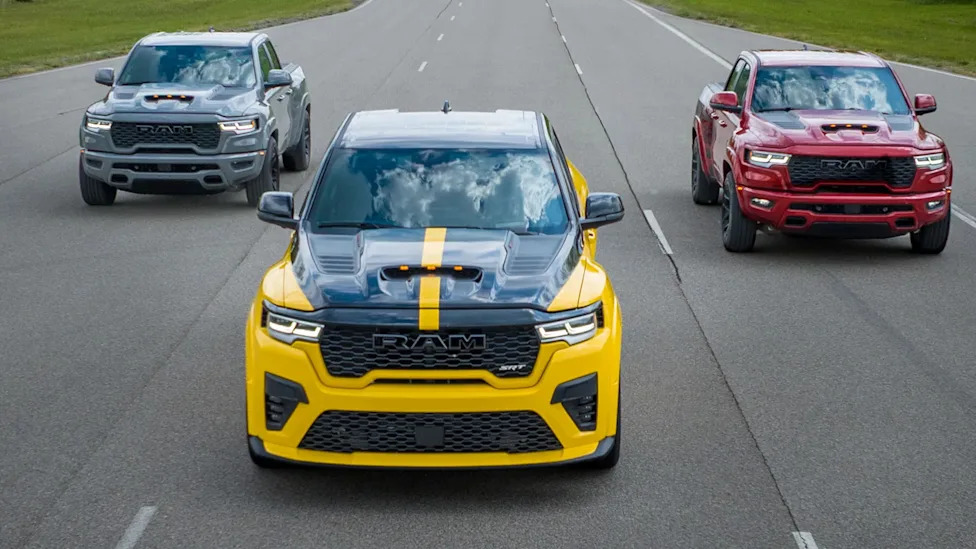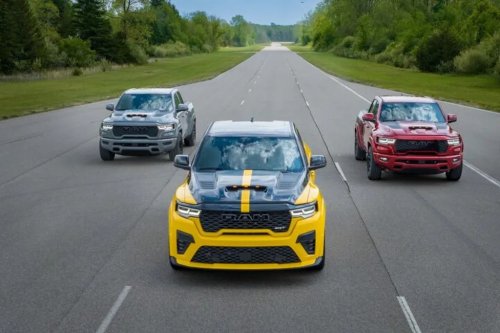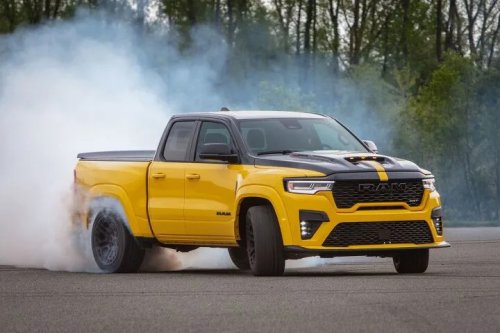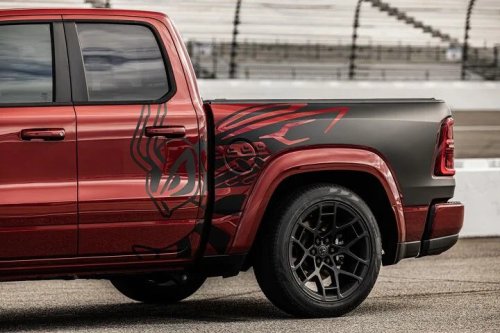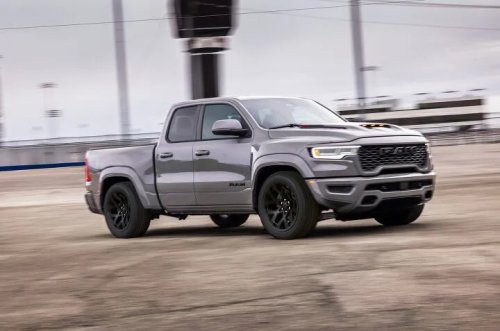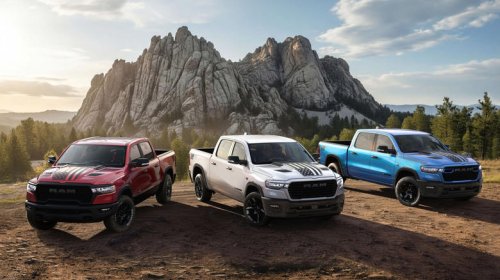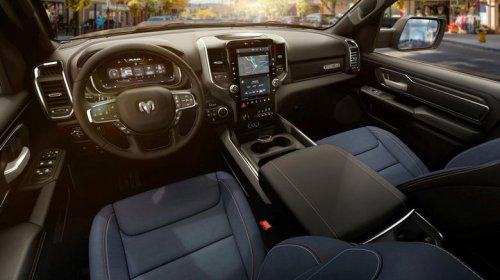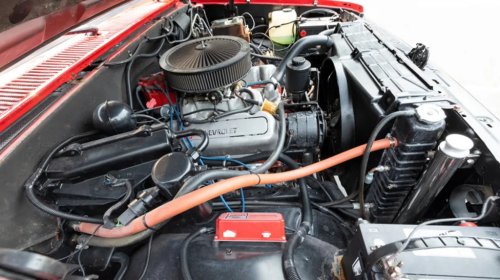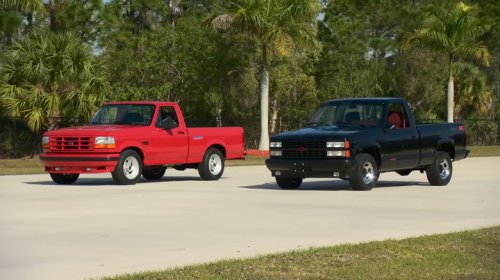
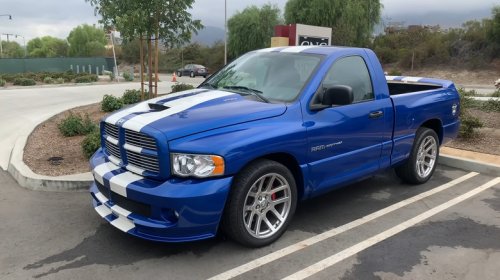
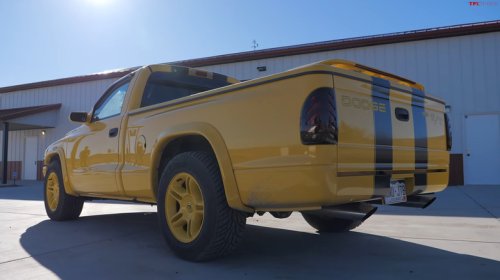
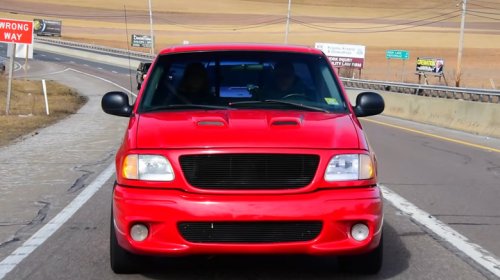
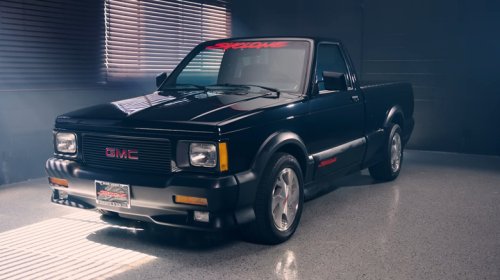
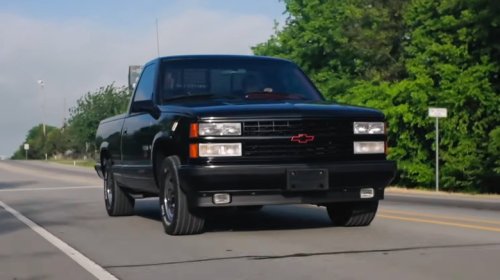
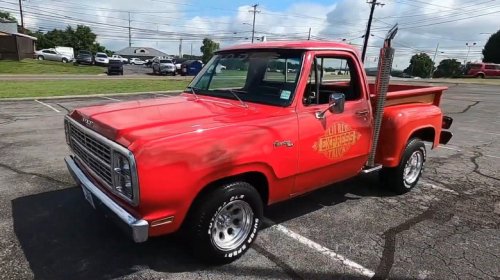


















MyClassicCarTV/YouTube Add Jalopnik on Google: Google Discover Before there were hemi and Viper-powered Rams, there were the modern muscle truck pioneers who saw the unrepentant utility of American pickups and said "that's cool, but what if it needs to win a drag race?" Dodge's adorably named menace, the Li'l Red Express, helped lay the foundation, but the segment we'd recognize today really began to take shape with early efforts like the Chevrolet 454 SS and the OG Ford F-150 SVT Lightning. As time went on, manufacturers continued finding ways to pack more excitement into platforms that were originally designed to be long on power but short on fizz. Interestingly, the muscle truck arms race played out largely on pavement for decades, with today's stupid-fast-off-road-truck segment lying largely dormant until Ford showed up with the F-150 Raptor in 2010. That largely closed the book on street-focused performance trucks, and if you're shopping for such a thing today, you're pretty much limited to the Hellcat-powered 2027 Ram 1500 Rumble Bee, which is more for smoking tires on asphalt than flying through the air in the dunes. Which brings us to our list of the pickup-bed-laden asphalt-smokers of yore, from the li'l Dodge to the GMC Syclone to the SRT-10. In addition to discussing the trucks themselves, we're also going to get into their present-day value while we're at it. That Ram 1500 Rumble Bee starts under $63,000, but the one you really want is nearly $100,000. So, do some of its legendary predecessors sitting in the historical rear-view mirror offer a more reasonable backdoor into the muscle truck experience, or have scarcity and nostalgia done their thing and priced us out of a segment once again? Let's find out! Dodge Ram SRT-10 (2004 to 2006) Doug DeMuro/YouTube The Dodge Ram SRT-10 left the factory with the biggest displacement engine offered in a new truck, and it got there with some genuine sports car provenance. Before there was an SRT-10, there was the Dodge Viper — itself an answer to the question of what happens when you take a big V10 designed for big trucks and stick it into a little sports car. From there, the Viper grew into a legend in its own right, sort of heading off to sports-car finishing school to be refined into an 8.3-liter, 500-horsepower monster that apparently had Dodge engineers raising an eyebrow and saying "what if we put that back into the pickup truck?" It's delightfully stupid when you think about it, and the result was a truck that could go from zero to sixty in 5.2 seconds, fast by modern standards and preposterous in the early 2000s when it was born. In its second model year, Dodge looked at all that and decided that what people really needed was to be able to enjoy all 500 horsepower from a quad cab, because why not. So how is the used market treating the sports truck inspired by a truck-inspired sports car? Cars & Bids sold one for $30,000 in June and another for $27,250 in August. So even though the CLASSIC.com Market Benchmark sits closer to $41,000, it appears that you can absolutely snag one of these for quite a bit less than that. Collectible? Sure. This isn't used truck depreciation. But unattainable? No. At least not yet. Dodge Dakota R/T (1998 to 2003) TFC Classics/YouTube Today, as the market is still trying to decide whether there's room for smaller-sized trucks in major OEM lineups, the second-generation Dodge Dakota deserves your attention even before you drop a 5.9-liter Magnum V8 under the hood. The R/T variant that gets that beefy V8 and some other performance bits represents Dodge's approach to muscle trucks before they landed on the Viper-related solution we just talked about above. Instead, they simply looked at their compact truck and became the only manufacturer at the time to offer one with a V8. The result was a not-huge truck with 250 horsepower and 345 pound-feet of torque, and Hot Rod managed to break 15 seconds in the quarter mile with it. Still, they also reported a distinct feeling that a good bit of the engine's power wasn't making its way to the rubber on the ground, a suggestion that perhaps the simplistic "big engine in a little truck" formula had its limitations in real-world use. This brings us to market value, where maybe coming up a little short in the driving experience department has contributed to more reasonable auction results. Last year, Bring a Trailer sold one at $15,250 and another at just $8,800, with CLASSIC.com estimates telling a similar story. So it isn't an outrageous halo truck or a performance monster, but it does have the chops to go fast enough to impress while still looking like something you borrowed from your uncle to haul drywall. Ford F-150 SVT Lightning (1993 to 1995; 1999 to 2004) Regular Car Reviews/YouTube Even though the Ford F-150 Lightning was a shockingly good electric pickup, for some enthusiasts seeing the Lightning badge on an electric truck was the biggest nameplate revival disappointment since the Eclipse Cross. That's because before the Lightning was defining a vehicle segment and further dividing a tribalized nation, it was helping Brian O'Conner deliver parts in style for The Racer's Edge with some prominent appearances in the first "Fast and the Furious" movie. But we're getting ahead of ourselves. Before Brian was curbing a second-gen Lightning outside the parts store, the first generation was making its bold debut, with Ford's Special Vehicle Team (did you know "SVT" stood for something?) building on the F-150 platform by adding a 240-horsepower Windsor V8, upgraded anti-roll bars, and performance Firestones. It was also lowered, because there was a time when making the truck flex meant going down, not up. After a little break, the SVT Lightning returned for its second generation in 1999, mostly taking the same formula as its predecessor and turning the dials up. The next one had a supercharged 5.4-liter V8 making 360 horsepower at the beginning of its run and 380 by the end. Values are kind of all over the place on this one, though few are dirt cheap and fewer are pulling extraordinary sums. Earlier this year, Bring a Trailer sold a low-mile gen-one for $68,000, with a second generation going for just $36,000. Still, there's plenty of room to get in the game on the lower end, with higher-mile examples transacting below $20,000. If you're torn between the two, just remember that only the second generation got the upgraded dual-piston front brakes and vented rear discs, so consider how fast you need to pull into parking spots, Brian. GMC Syclone (1991) Hagerty/YouTube For 1991, GMC built a truck that could outrun sports cars but not haul cargo, and we're glad they did. The Syclone, in addition to the fact that it would have absolutely owned its Google search results if only Google existed, was also yet another approach to solving the muscle truck equation. It wasn't a sports car engine in a pickup chassis and it wasn't a small truck powered by a big truck motor. Instead, the Syclone started with the compact GMC Sonoma and paired it with a turbocharged 4.3-liter V6 making 280 horsepower and 350 pound-feet of torque. With help from its full-time four-wheel-drive system, it could go from zero to sixty in 5.3 seconds. Just for some in-period context, that's fast enough to get people asking questions about what it could do, such as when Car and Driver decided to line one up against that year's Ferrari 348ts. The Syclone won in the quarter mile before eventually succumbing to the limitations of truck speed as the Ferrari continued accelerating well past the Syclone's top speed of 126 miles per hour. That's quite a performance bargain considering that the Syclone started at $25,970 while the Ferrari was $122,000. But does the smiles-per-dollar math hold up in 2026? With under 3,000 Syclones built (including a handful in 1992), the CLASSIC.com Market Benchmark is $42,953 and even that seems optimistic when you look at recent transactions, including a couple on Bring a Trailer that went for $24,500 and $34,600 earlier this year. That's potentially a lot of money for a 35-year-old used pickup, but not bad for a truck that could embarrass flashy supercars in its day. Chevrolet 454 SS (1990 to 1993) PC Classic Cars/YouTube A few Chevy trucks came with the 454 V8, and this is the one that was executed in a way that was worthy of going toe-to-toe with the F-150 SVT Lightning of its day. A 454-cubic-inch big-block delivering 230 horsepower and 385 pound-feet of torque was a good start by early-'90s performance standards, but the SS also got suspension upgrades (including Bilsteins) and different tires that amounted to something pretty menacing when it all came together within a full-size-but-still-not-huge truck. That was 1990. In 1991, they raised the bar further, adding a gear to the transmission and sailing the 454 up to 255 horsepower and 405 pound-feet of torque. If you're into Fords, you might not like it. If you're into Ford logos being peed on by unauthorized Calvin & Hobbes stickers, you maybe do. If we're letting the market decide, results are vaguely on par with the Lightning(s) we already covered. A 94,000-mile example sold on Bring a Trailer for $25,300, and on the pristine extreme there was a borderline bubble-wrapped one that went for $91,500. CLASSIC.com benchmarks them at $43,949. So, such is life when it comes to things like this: the spendiest examples probably don't make any rational sense, but a more typical one could be a cool buy. Just note that those Calvin stickers started showing up in the '90s, so a lewd window sticker desecrating a Lightning would be totally period-correct. Dodge Li'l Red Express (1978 to 1979) Maple Motors Muscle Cars Nick Southgate/YouTube There are cars our readers are always excited to see, and the Dodge Li'l Red Express is one of them. As the Malaise Era dragged on and the American performance car industry suffered deeply, Chrysler engineers found a li'l emissions loophole just big enough to drive a li'l red truck through. Light trucks over 6,000 pounds were exempt from catalytic converter requirements and were allowed to use leaded fuel. Freed from these performance-crushing burdens and with the help of a different loophole that allowed OEMs to make slight design modifications without being recertified, Dodge could take an existing high-performance motor, upgrade it for more power, and drop it into the truck that would become the Li'l Red Express. The result was a 360-cubic-inch V8 that made 225 horsepower and the fastest American vehicle to 100 miles per hour, full stop. And so the muscle truck was born. You could have any color you wanted as long as it was bright freaking red, and its distinctive exhaust stacks towered upwards from behind the driver. Only the '78 benefited from the perfect confluence of regulatory loopholes that allowed for the best possible version of the truck, and by '79 it was rocking a power-tempering catalytic converter just like everything else. The Li'l Red Express remains surprisingly attainable despite its textbook-worthy place in America's automotive past. It existed right at the intersection of creative engineering and even more creative regulatory navigation, and yet you can still grab one for around the price of buying a well-equipped Camry, with a quite clean one recently selling for just $34,000 on Bring a Trailer. It won't approach the modern performance fizz that some of these others still deliver, but it's definitely a piece of history.