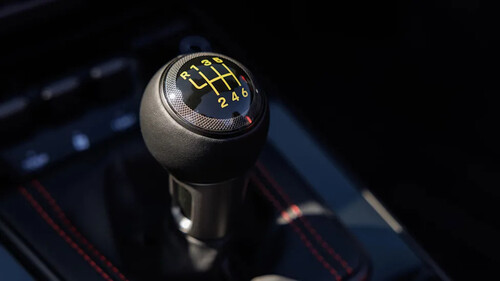
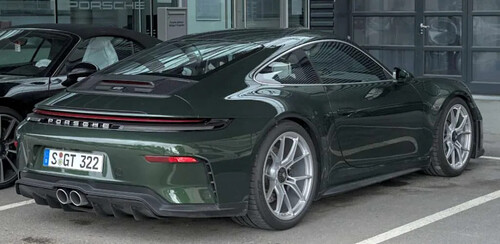
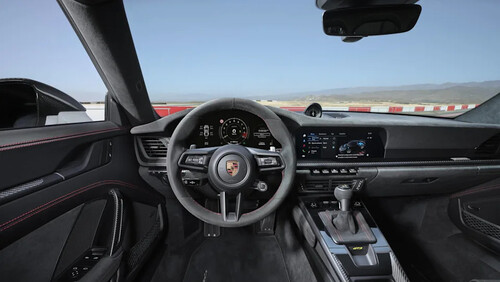
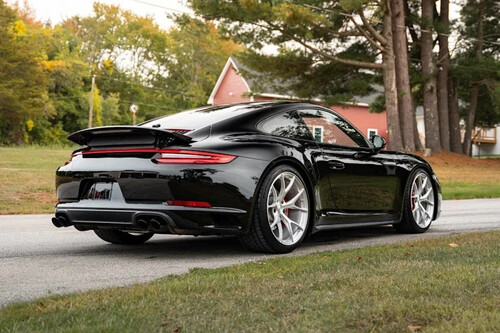
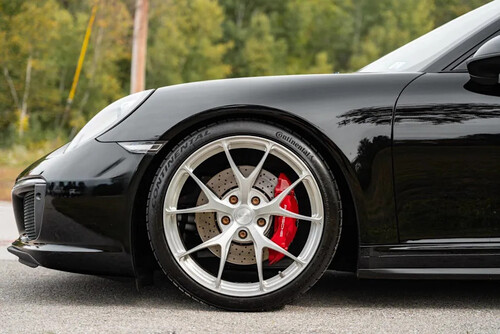
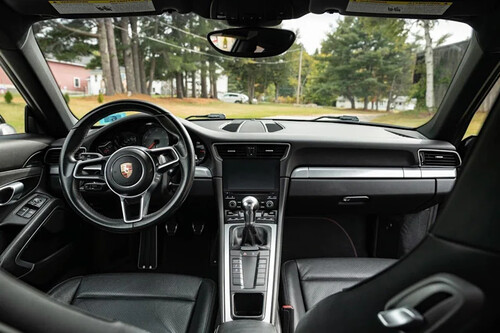
2027 Porsche 911 GT3 S/C Is a True EscapePorscheIt's getting more and more difficult to truly unplug. Expected response times by everyone from your boss to your family continue to trend downward thanks to ever-expanding cell coverage and ubiquitous Wi-Fi. It used to be that flying at 500 mph or so six miles above the Earth's surface was enough to shake it, but connectedness has caught up there too.But we just experienced a fantastic new tool to get you alone with your thoughts: the 2027 Porsche 911 GT3 S/C. As with the GT3 Touring, which now makes up half of GT3 sales, the S/C is meant to be a street machine. There was a time when this vehicle scrutinizer would have scoffed at a convertible Porsche GT car—with more weight and less stiffness and sharpness—but it's just what the therapist ordered in these overly connected times. Good luck calling into a meeting while blitzing twisty tarmac with the top down, wind rushing through the cabin, and a 9000-rpm flat-six wailing behind you.Part of the S/C's magic is that Porsche threw every lightweight bit in its parts bin at it, leading to a claimed curb weight of 3322 pounds. That's 349 pounds lighter than the last base-model 911 Cabriolet we tested and lighter even than the last droptop 911 GT3, the 2019 911 Speedster. The S/C includes standard carbon-ceramic brake rotors (which Porsche claims save approximately 44 pounds); magnesium wheels (about 20 pounds); a carbon-fiber rear shear plate, anti-roll bar, and drop links; and carbon-fiber doors and front fenders from the 911 S/T. Also, Porsche deleted the rear seat on the S/C, and the company made it manual-only, ruling out the PDK automatic, which is 37 pounds heavier. Buyers seem to want the manual anyway, with an 80 percent take rate on the Touring. While making these expensive pieces standard on the S/C certainly helps to purify the driving experience, there's an ulterior motive at play here as well—to get the curb weight close enough to that of the GT3 Touring that the company didn't have to go through the lengthy emissions-certification process again with this latest GT3 variant. Project manager Jörg Jünger said that would have added another six months to a year to the development process, as well as substantial cost.AdvertisementAdvertisementUsing the standard 86-pound power convertible top from other 911 Cabriolets might seem like a cop-out compared to the previous 911 Speedster with its complex and lightweight bespoke lid. But Porsche says its GT customers keep telling them they'd much rather have a power-operated solution they can raise or lower at the push of a button. Jünger explains that, typically, when you cut the roof off of a car, you lose two-thirds of the structural rigidity. (We had to ask him to clarify that he meant that it was only one-third as stiff as a coupe, not two-thirds, which he did.) But, among convertibles, the GT3 S/C is plenty rigid enough not to distract from the driving experience.PorscheAs proof, the S/C doesn't get any additional structural bracing. That's because today's 992-generation 911 Cabriolet is 25 percent stiffer torsionally than the 991 Speedster. To give a sense of just how sharp the S/C is, its spring and damping rates aren't softened even a smidge; they're identical to the GT3 Touring coupe's.Due to all of the lightweight standard equipment, it's no surprise that the price of the S/C, which arrives this fall and starts at $275,350, is more than the typical convertible premium over the $238,150 GT3 Touring. But—look on the bright side—that's an inflation-busting $400 less than the 2019 Speedster. The S/C also isn't a limited-edition model.The engine is the same 4.0-liter flat-six from the GT3: 502 horsepower, 331 pound-feet of torque, individual throttle bodies, titanium connecting rods. But this is a totally different experience from today's turbocharged and hybridized superspeed machines with lightning-quick torque available at any time. In the GT3 S/C, you have to work the whole tachometer to unlock the power. And that work is the joy of the experience.PorscheThe shift lever comes alive when going hard. The efforts feel on the high side when parked, but when grabbing a redline upshift, backing off the throttle seems to cause the lever to effortlessly migrate to its next destination. And you need to be quick with the shifts because the revs soar quickly, and the limiter steps in pronto. Damping changes among the modes are subtle—it's fantastic all the time without trying to make over-the-top changes in character.AdvertisementAdvertisementWe spent more time with the top up—where the S/C is reasonably quiet—than expected in order to escape from the heat wave and record-high temperatures sweeping through Europe. But top-down is the way it's meant to be experienced. Oh, the urgency of this engine. The linearity. The responsiveness. It's a treasure, and we hope Porsche continues building a wailing naturally aspirated flat-six as long as possible. We can't think of a better way to unwind.Porsche➡️ Skip the lot. Let Car and Driver help you find your next car.Shop New Cars Shop Used CarsYou Might Also LikeGift Guide: Best Ride-On Electric Cars for KidsFuture Cars Worth Waiting For: 2025–2029