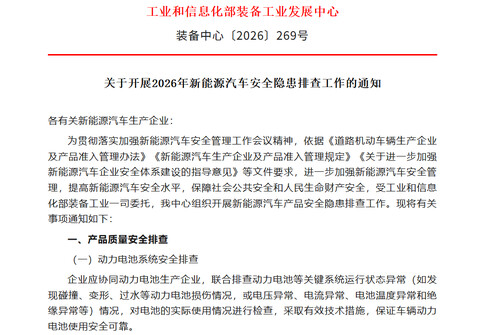
Owen Hill · 6 months ago@owenhill701300°C battery “firewall” unveiled as China accelerates EV safety push, report says Liked by+54 othersPost commentRelated PostsZEEKR Brand Cumulative Deliveries Surpass 800,000 Units; Reports Reveal Two New EV Safety National Standards to Take Effect on July 1 58 · Annabelle Girard · 4 months agoDrivers shouldn't swerve to avoid deer, road safety experts say 73 · Caleb Brown · 25 days agoHyundai Motor Group Expands Pan-India Network to Accelerate Battery & Electrification Research 27 · Oliver Leblanc · 5 months agoC Talk | Thomas Irawan from ETAS: China will play a more significant role in the future 62 · Mia Pelletier · 2 months agoToyota gets the green light for a new EV built to take on ChinaCharlotte Gagnon · 21 days agoScout Denies Delay Report Pushing Truck To 2030, SUV Back Six Months 69 · Annabelle Clark · 6 months agoUS senators ask for review of Tesla's 'Full Self-Driving' safety data, citing Reuters report 43 · Amélie Fortin · 4 months agoNHTSA Says 102 Cars Meet Its New Pedestrian Safety Standard, But There’s a Catch 82 · Henry Lewis · 1 months agoC Talk Highlights | Gasgoo CEO talks with Mr. Gerard Roose, President & CEO of Inteva Products, and Richard Zheng, Vice President and Managing Director, Inteva Products China 23 · Ethan Turner · 2 months agoChery’s iCaur V27 EREV with 300 km EV range launched in China, starting at 28,300 USD 32 · Liam Labelle · 26 days agoTesla (TSLA) reportedly in talks to buy $2.9B in Chinese solar equipment for 100 GW US push 82 · Chloé Smith · 6 months agoChina Launches 2026 NEV Safety Hazard Inspections, Clarifies Accident Reporting Deadlines 58 · Mason Roy · 5 months agoHonda Won the World's First Five-Star Road Safety Rating. It Says Nothing About How Safe Your Honda Actually Is. 22 · Amélie Anderson · 1 months agoC Talk | Henkel: Leveraging Inspiration Center Shanghai to Drive a Smarter Future for China's Automotive Industry 56 · Isabelle Moreau · 2 months agoBentley Goes Electric As China's EV Charging War Gets Ridiculous 99 · Abigail Campbell · 1 months agoChina Tightens EV Safety Oversight With New Fire-Reporting Rules 93 · Audrey Clark · 5 months agoBMW Says Its Safety Tech Prevented 243,977 Potential Collisions 42 · Amélie King · 1 months agoC Talk | Pirelli CEO Andrea Casaluci: How a global tire leader is responding to China's auto industry transformation 59 · Adam Pelletier · 2 months agoNissan Taps China JV To Power Philippine EV Push 69 · Mason Fortin · 1 months agoFord Buried a Timing Belt in Motor Oil to Save Gas — Now the Feds Say 135,000 Cars Are a Safety Risk 18 · Chloé Rogers · 2 months ago




 +54 others