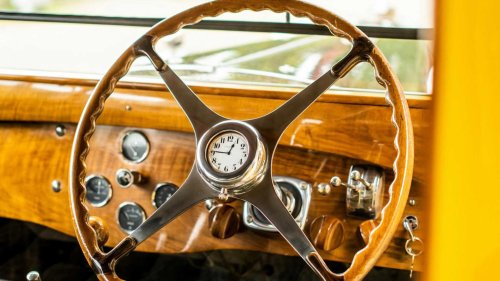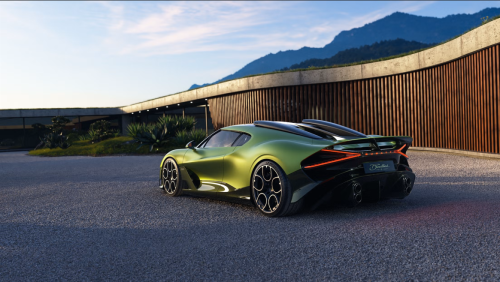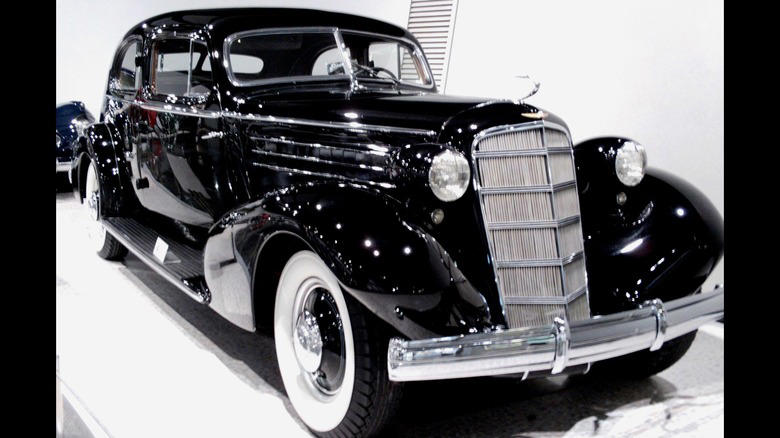
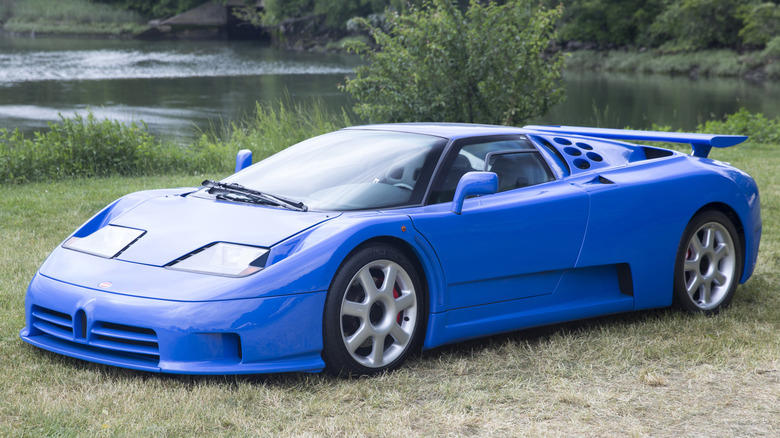



















1930-1937 Cadillac V12The Cadillac V12 went into production against the headwinds of the Great Depression in 1930. It was a derivative of Cadillac's V16, a spectacular powerplant that featured groundbreaking technology, including the first hydraulic lifters on a car engine. The cylinder banks were set at a 45-degree angle to one another, and the engine had been carefully styled to be as aesthetically appealing as it was powerful. Having built a V16, Cadillac then lopped off the two cylinders at each end and increased the bore slightly on the remaining cylinders to produce the V12.The result was 135 horsepower and 284 lb-ft of torque in an engine that idles softly and pulls strongly to 50 mph and beyond. While the V12 was essentially its own model designation, it found its way into a number of Cadillac bodies. Two of these were revealed in one of the most spectacular barn finds of modern times, in Texas: a 1932 Cadillac 370B V-12 Victoria Convertible and a 1933 Cadillac Model 370C V-12 Town Coupe. There was also a 1938 Fleetwood V16 limousine in the collection. Another V12 model was the 1934 Cadillac 370-D V-12 Five-Passenger Sedan. The V12 would remain in production until 1937, despite the travails of the Depression.1991-1995 Bugatti EB110The Diablo's reign as the world's fastest car would last only a year until the reborn Bugatti company took the title with the EB110, giving birth to the age of the hypercar. The EB110's 3.5-liter V12 had no fewer than five valves per cylinder, along with four turbochargers delivering between 1.05 and 1.2 bar of boost pressure. This engine was housed in a car with a carbon monocoque exterior that weighed only 275 pounds — a car so light that even the screws were made of titanium to further reduce weight.The EB110 featured all-wheel drive, a rear limited-slip differential, and an all-wheel viscous locking differential. This helped to translate the V12's power into otherworldly straight-line acceleration, while active aerodynamics kept the Bugatti pinned to the road at high speeds. All of this technology helped the V12 propel the EB110 from 0-62 mph in 3.26 seconds, with a top speed of 218 mph. Both of these performance numbers were world records for a production car.As if that weren't enough, in 1992, Bugatti released the EB 110 Super Sport, which had even less weight and a top speed of 221 mph. Unfortunately, shifting global financial winds led Bugatti to close its Italian factory in 1995 after just 139 EB 110s were built. The brand would later resume production in France under different owners.