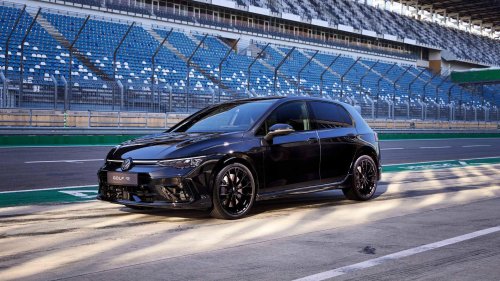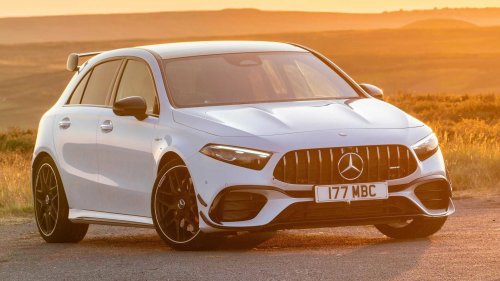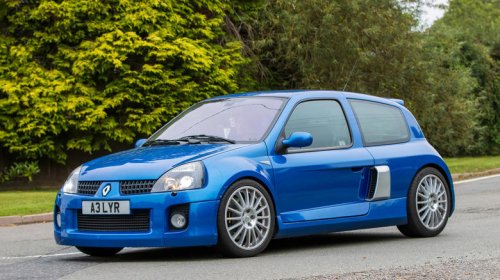
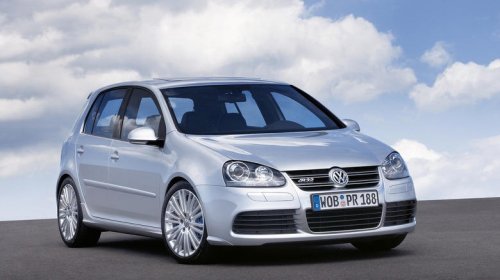
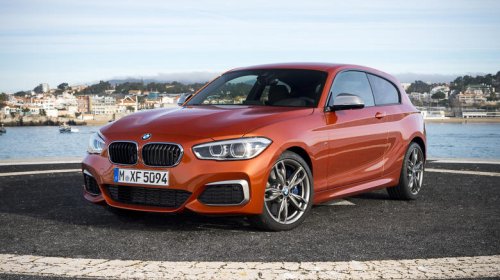
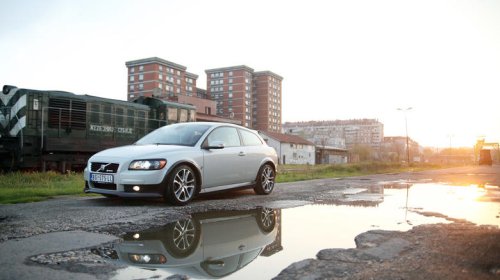



















Renault Clio V6 Renault SportA little over 15 years after the Renault 5 Turbo, the French automaker decided to give it another shot. The Clio, the Renault 5's direct descendant, became the guinea pig for this idea. The result was the Clio V6 Renault Sport, or as most people know it, the Clio V6. In many ways, it was the same idea as the Renault 5. A custom body resembling the Clio, when the two had very little in common, and a powerful engine in place of the rear seats driving the rear wheels.But while the 5 Turbo had to make do with a turbocharged I4 with around 160 horsepower, the Clio V6 upped the ante with a full 2.9-liter naturally-aspirated V6. The engine in question was the ES/L V6, jointly built by Peugeot/Citroen and Renault. The Clio V6 put out 227 horsepower in the initial Phase 1 run, but when Phase 2 came along in 2003, that rose to 247 horsepower, more than even the most powerful hot hatches of the time. Like the 5 Turbo, the Clio V6 was also co-engineered with TWR and was partially built in Sweden. While electric car platforms allow for mid-engine, RWD hatchbacks like this to return in theory, there likely won't be another with a massive V6.Volkswagen Golf R32Volkswagen started experimenting with six-cylinder power in their ubiquitous Golf in the 90s. The Mk3 generation brought along the Golf VR6 and VR6 Syncro. When the Mk4 generation came along, VW decided to leverage a top-of-the-line performance model using their innovative VR6 powertrain, and that was the Golf R32, known in North America simply as the R32.At the heart of both generations of the R32 lay a 3.2-liter version of the VR6 engine. This was a very unconventional engine design, but it was genius in many ways: it was technically a V6, but there's only a 15-degree angle between the cylinder banks, which meant the engine didn't need two heads like every other V6, thus making it more compact and able to be mounted in a transverse layout vehicle with FWD, like the Golf.In the Mk4, the VR6 put out 240 horsepower, whereas the Mk5 bumped that up to 250 horsepower. It wasn't the fastest, but it produced one of the most unique engine notes out there, and that's in the best sense of the word. It also had very different characteristics to, say, the GTI, thanks to being naturally aspirated and a little heavier at the nose. The R32 didn't sell in huge numbers, which has worked wonders for the car's value on the used market.BMW M135i (F21)After the original Golf GTI kickstarted the hot hatchback craze, most automakers collectively agreed that the hot hatch should be front-engine and front-wheel drive. With only a handful of small exceptions, pretty much every modern hot hatchback followed and continues to follow this formula, and no one attempted a front-engine, rear-driven small performance car for quite a while. Not until BMW had something to say about it.BMW took their smallest 1 Series, which only existed in North America as a Coupe, and turned it into a proper hot hatch. The resulting M135i was RWD, and it was powered by a 3.0-liter turbocharged six-cylinder engine putting out 315 horsepower. It may have been a hatchback, but it was a true BMW at heart, with six-cylinder power and Sheer Driving Pleasure thanks to that platform.The rear-driven one proved to be quite a handful, which is why BMW eventually started offering xDrive AWD as well. With the move to a transverse FWD platform for the most recent 1 Series, and relegating the six-cylinder engines to the majority of the M lineup, the F2x generation M135i and M140i would be the last ever six-cylinder hot hatchbacks.Volvo C30 T5 R-DesignPreviewed by the SSC concept, the Volvo C30 was the Swedish answer to the BMW 1 Series and Mercedes A-Class. Aside from the spectacular design hearkening back to the original P1800ES, the C30 was also a practical and usable hatchback. It may have only had three doors, but it was plenty spacious and offered a more interesting, more understated alternative to the German competitors.This was also true of the T5 R-Design, Volvo's idea of a hot hatchback. There was never a proper C30 Polestar or C30 R, but the T5 R-Design was as close as Volvo got, and it was the only one offered in the United States. Powered by a 2.5-liter turbocharged five-cylinder engine putting out 220 horsepower to the front wheels through a six-speed manual or a five-speed automatic transmission, the C30 T5 R-Design was good-looking, safe, and dependable.It's also the last of a different breed: the understated hot hatchback. With all the Civic Type Rs and Mercedes-AMG A45s of the world, making a hot hatchback understated became pretty unfashionable for nearly every automaker. The C30, meanwhile, hid the five-cylinder lump and its tuned chassis very well under the simple, but very eye-catching bodywork. It's easy to see why the C30 has climbed in value.