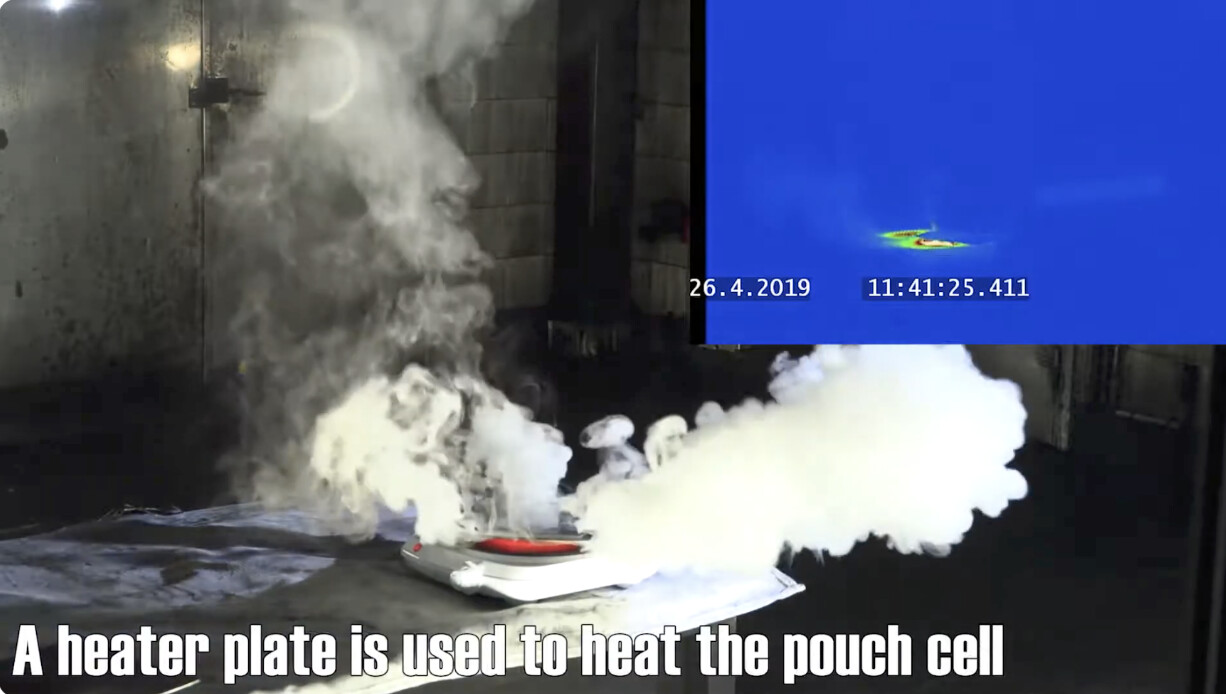
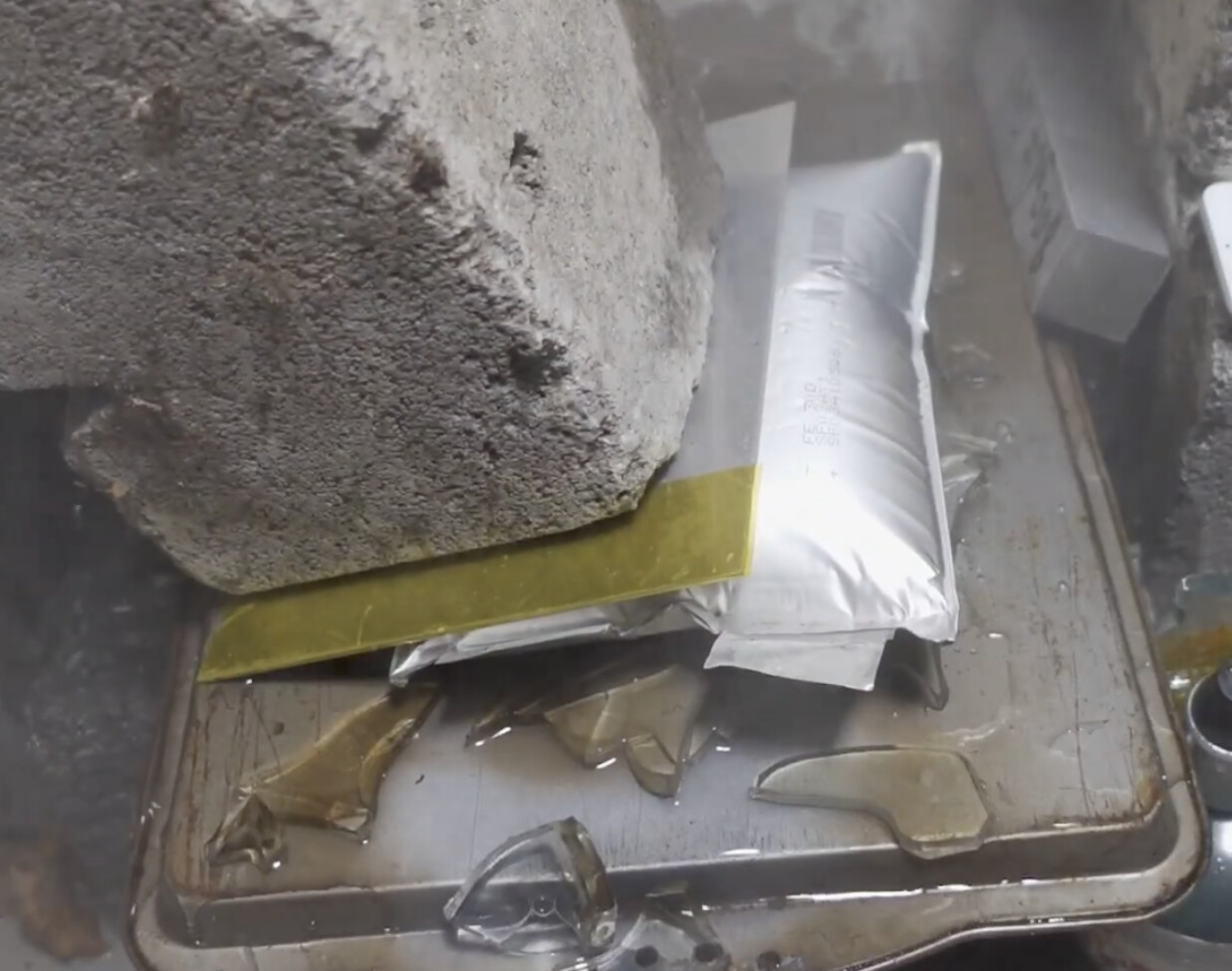
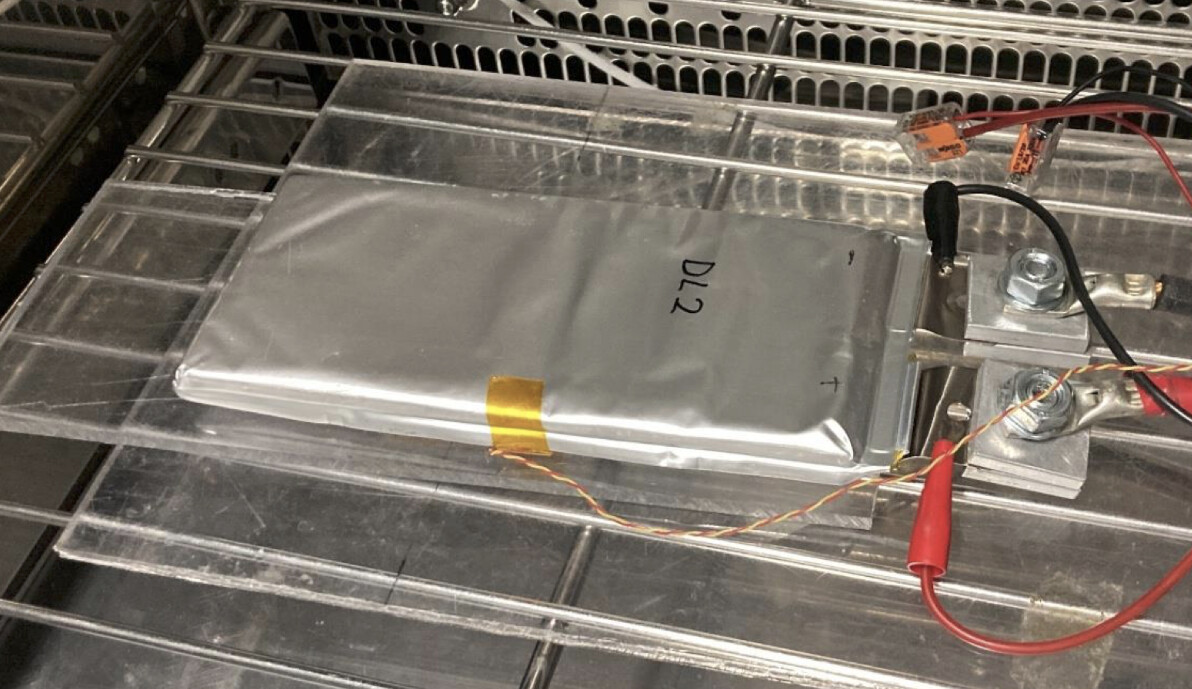
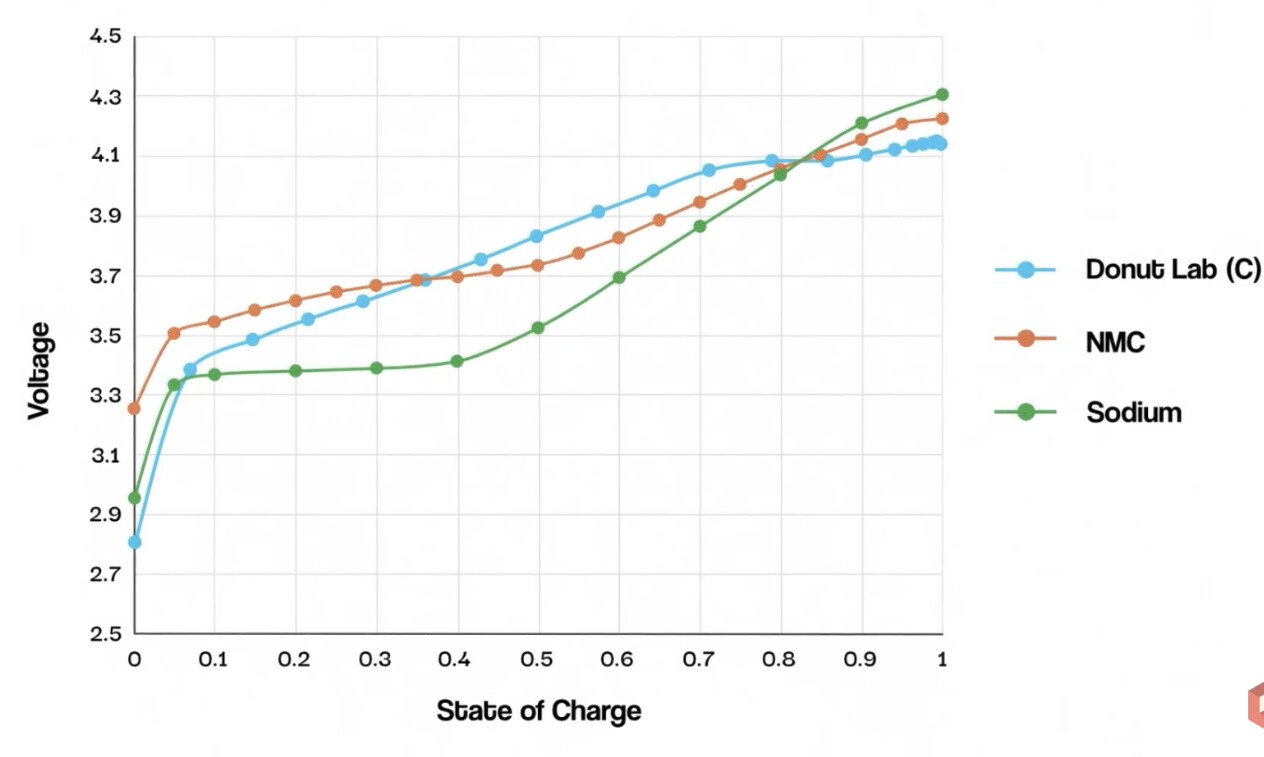
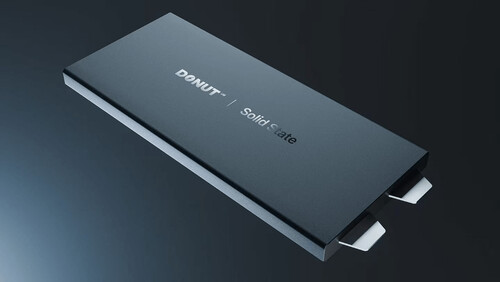
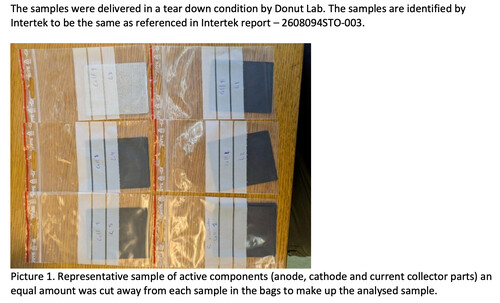
Can you spot which battery is NMC? Image: screenshot from John Sullivan YouTube video. Image from Donut Lab The one that looks like a pillow is NMC. The one that looks like a Pop-Tart is not. How do we know this? Because the puffed up battery came from a video made of an NMC battery. It was placed in a bath of boiling water at 100 degrees Celsius (212 degrees Fahrenheit). If you guessed the battery that looked like a pillow is NMC, you win a prize! Have yourself a tasty plain donut. Which one of these shows a picture of an experiment done by a prestigious, recognized independent laboratory battery tester? If you guessed the one done in a stainless steel laboratory temperature chamber, you win a prize. The hint is: the amateur test was outdoors using a heavy cinderblock brick on top of the billowing battery. Have yourself a donut with your choice of glazing. If you figured the Pop-Tart-looking battery is Donut Lab’s DL2 battery and that Ziroth claimed that battery was NMC, but it is not, you are correct. An NMC battery’s liquid electrolyte decomposes at 100 degrees C, generating high internal pressures. The pouch package billows up like a balloon. A heated NMC pouch could either contain the gases and turn into a pillow, or it could breach the pouch and produce smoke or fire. This amateur experiment was under an hour. DL2 was at 100 degrees C for four hours. Neither ballooning nor smoke happened to DL2. If it did, it would have been impossible to miss. DL2 looked like a Pop-Tart, not an excited puffer fish. If you figured DL2 is not NMC, you win a prize. Enjoy your choice of pastry, with any glaze, topping, or stuffing you like, or even a chocolate eclair if you wish. Do not worry if you guessed wrong, there is a consolation prize — you get an aluminum foil hat. Image: screenshot from Marko Hassinen YouTube video Foil hat. Photo by Christopher Arcus. Levity aside, astute observers will recognize the battery that looks like a Pop-Tart after exposure to hours of 100 degree Celsius testing is Donut Lab’s DL2 battery, tested months ago. The battery that looks like it is about to explode is an NMC battery that is being tested at 100 degrees C by someone who wanted to show what an NMC pouch would do. Same temperature, distinctly different results. DL2 was subjected for much longer. This is a teachable moment. Avoid danger. Lithium batteries exposed to high temperatures or damage may catch fire, explode, or emit smoke and toxic gases. Battery safety tests should be done by professionals. Ships and Sealing Wax, Fingerprint Theories and Backyard Testing The NMC battery subjected to high temperature was covered by a large cinderblock brick to keep it in the water bath. The experiment was terminated because the pressure in the pouch package became so great it displaced the heavy brick and destroyed the experiment, bringing the experiment to an abrupt halt. The battery that looked like a pop tart was tested at the same temperature for four hours. When it was discovered that the DL2 battery pouch lost vacuum, the battery was subjected to further tests at room temperature for dozens of cycles without danger or fire. The DL2 battery is not NMC because it would have puffed up like the NMC battery did under the same conditions. There were three Donut Lab batteries tested in parallel at high temperature by VTT — DL1, DL2, and DL3. DL3 was previously subjected to high temperatures undergoing fast charge testing. Donut Lab later tested other cells, subjecting them to nail tests. The results were no fire, explosion, or smoke, and no increase in temperature. This proved those cells are not NMC. NMC cells burn furiously in nail tests. Donut Lab tested other cells, proving they were bipolar, thus proving them solid-state. When the dust settled, a critic’s comment was that Ziroth’s NMC claim may be true for the early battery DL2. This is wrong. We know DL2 was not NMC for several reasons, not just because it did not become a puffed up package. A liquid electrolyte battery subjected to high temperatures would begin to decompose, generating heat. DL2 tests showed no evidence of exothermic heat. There are other reasons DL2 is not NMC, expressed by Ricky from Two Bit Da Vinci and others like Marko Manninen, but that is another story. Reaction to Donut Lab’s batteries is not universal and monolithic. The informal “unique fingerprint” theory is incorrect in this case and the “bump” theory for the same reason. Those theories both use DL2 battery curves for proof, but DL2 does not show the high temperature behavior expected of NMC seen in the backyard experiment at the same temperature. Theories that say DL1, DL2, and DL3 are NMC are incorrect. I independently provided an alternate curve that looked like NMC for voltage curve end points. I showed there are means like doping that alter voltage end points. A theory of uniqueness only requires one exception to fail uniqueness. If so, what reason is there that dopants cannot mimic ‘bumps’ or that ‘bumps’ are unique? There’s no more proof that bumps are unique than there was that curve end points are unique. In truth, the Donut Lab voltage curve does not exactly match an NMC curve any more than the exception I provided. None of them match exactly, so why shoehorn them into a pre-conceived notion that they are NMC? They cannot be a fingerprint match if they do not all match exactly. If these curves are fingerprints, would any of them be a match? On the contrary, there is proof DL1, DL2, and DL3 are not NMC. The proof that DL2 is not an NMC battery was there all along. Few were paying attention. It took a reddit commenter with a backyard experiment to expose the truth. An NMC battery subjected to four hours of 100 degrees Centigrade would expand like a balloon. An NMC battery will decompose, become exothermic, and evolve gas. That gas at high temperature creates pressure. DL2 did not expand like the NMC battery. Critics are wrong. There is no conspiracy where a later battery was proven not NMC with a nail test but an earlier battery was NMC. The battery curves from DL1, DL2, and DL3 that Ziroth used as proof were not NMC. The evidence is piling up that none of the batteries are NMC. YouTube Channels Are Not Scientific Journals YouTube channels and news organizations that picked up Ziroth’s claims and rebroadcast them as “scientists say” were wrong. It was a rush to judgement that ignored other voices. The controversial claims were indiscriminately disseminated without vetting those claims. Those were not scientists doing science. Those were people doing YouTube videos and biased competitor employees giving opinions. Science uses every effort to eliminate bias. That was not science. Scientific organizations take extreme measures to eradicate and eliminate bias. Worse, it was not journalism. There was no pressing back on a sole source of information. Prestigious scientific journals and professional organizations do not jump to clickbait. They do peer review. They vet their papers before publication. “Scientists say” was not science.