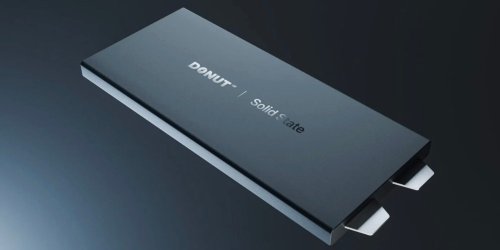
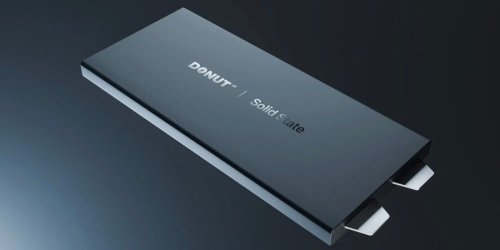
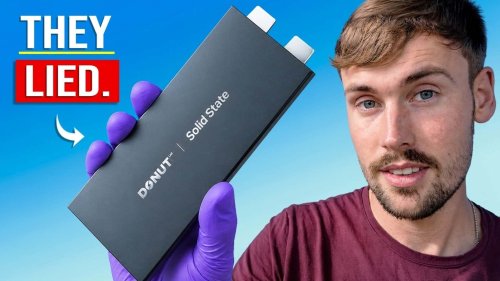
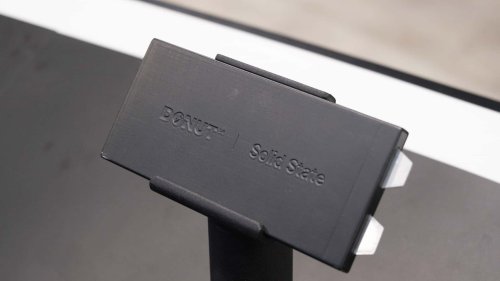
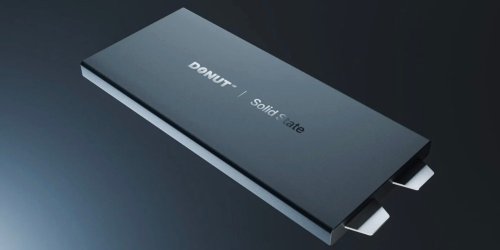
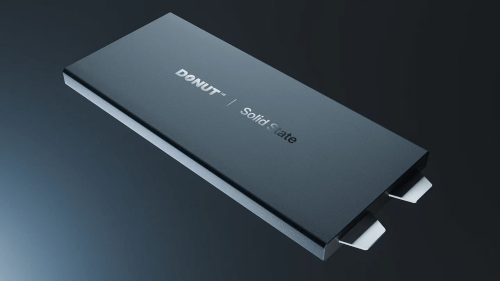
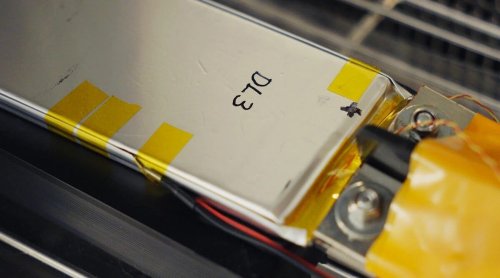
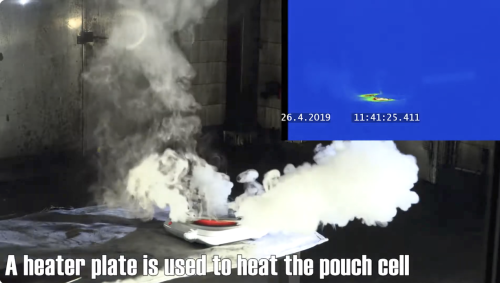
Donut Lab revealed its solid-state battery to the world at CES 2026, to the amazement of many and to the dismay of others shocked by their achievement and performance claims. No other company has a practical fully solid-state battery in production as of this writing. Many, like Quantumscape, have tried for many years, only to find that limitations exist, like the need for extreme mechanical pressures required to maintain contact between cathode and electrode. Such measures require bulky and heavy support, obviating benefits of solid-state operation. Many have resorted to semi-solid-state as a compromise. Semi-solid-state batteries were used by NIO for battery swapping, but they ceased operation since cost and other practical factors proved unsatisfactory. Not long after Donut Lab’s solid-state battery presentation, howls of derision and a cavalcade of insults and skepticism followed. Much of the criticism, unsurprisingly, came from established players in the battery market with vested interests in legacy batteries, companies which failed to produce a practical solid-state battery, proving Upton Sinclair’s dictum: “It is difficult to get a man to understand something, when his salary depends on him not understanding it.” Just because it is new and innovative does not mean it is real and it works, and it is prudent to request data. Some waited for data to decide, while others impatiently jumped to conclusions. In this case, in response to the many critics who said it was impossible and a scam, an unusual amount of proof beyond normal practice in the battery industry was provided. It’s not that large legacy battery makers do not provide proof. They usually provide data sheets carefully constructed to show their products in the best light for intended applications, and the boring engineering details are left in the background that show the limits. Nothing to see here, just the usual. They seldom provide such extended public proof, such as disassembly and extensive tests by independent testers. Nail Tests In particular with batteries, some tests are demonstrated to showcase best performance in a more dramatic way, like nail penetration tests. These are important tests and do show some of the safety attributes specific to different battery chemistries. Nail penetration and other safety tests are now standardized requirements for rechargeable batteries in China, a good development ensuring public safety and aiding battery use. Donut Lab’s battery was tested at 12V terminal voltage and then did nail penetration tests that showed absolutely no fire, smoke, or explosion and very little change in temperature, a very boring and safe result. NMC produces a more exciting display with flame and high temperatures, while LFP is less exciting and produces no fire, but some smoke. Sodium-ion batteries also produce unexciting nail tests. That set of Donut Lab tests also showed that the battery was bipolar, because the terminal voltage was above 12V and batteries with different numbers of layers showed several different voltages. Incontrovertible Solid-State Proof Good things are worth the wait, and Donut Lab has delivered new data. The latest tests prove the battery is solid-state and the measured gravimetric energy density is 409 Wh/kg. The volumetric energy density result is 804 Wh/l. Proof of solid-state was provided in several ways. The batteries can be made in bipolar format. That means the cells are stacked on top of each other within the package, producing a wide variety of external voltages depending on the number of cells within the package. This is impossible with a liquid electrolyte in one package. Liquid electrolytes can flow freely among all cells in the same package and ions can shuttle between multiple cells spoiling desired serial ion flow through each stacked cell. A solid-state electrolyte can stay in place between cell cathode and anode without providing a path for ions between other cells. A liquid electrolyte bipolar battery must provide separate isolated chambers for each cell electrolyte, making practical construction difficult and unwieldy. The advantage of bipolar construction is that current flows through a thin depth and over a large area, providing less resistance and requiring less electrode material than single cells constructed in a pack, increasing the ratio of active material and lowering costs. In pack construction, fewer modules are used and external conductors are reduced. The net effect is higher density at both battery and pack level, even comparing to cell-to-pack technology. In a remarkable demonstration, the cell was disassembled and showed internal construction consisted of repeated layers. There was no internal mechanical isolation between layers within the package. The layers are connected electrically by stacking. This leaves no doubt that the battery is bipolar and solid-state. Social Media Got It Wrong While I already recognized that liquid electrolyte NMC cells could not survive operation at 100°C undamaged, that was not enough proof for some that insisted it was an NMC cell. I debunked the notion that a cell produces a unique fingerprint by showing that other cells produced similar full charge and discharge open circuit voltages. Others have gone on to add to this. The unique fingerprint theory is wrong. It is possible to alter voltage characteristics by doping and other means. Bipolar operation brings into question whether the batteries previously tested were single cell or multiple stacked cells. Bipolar operation and disassembly show the connections create a single-stacked battery, an impossibility for a liquid electrolyte NMC battery. It cannot be assumed the previously packaged battery tested was a single cell. Despite all of this, incredibly, some have mistakenly concluded that there is no proof the battery is solid-state. They are wrong. Their conclusion that Donut Lab has no credibility is equally wrong and exposes their own credibility. An Overlooked Matter and Story — Process While solid-state construction and extraordinary battery performance gain headlines, process methods seem to gain little attention. I explained why the manufacturing process may be more revolutionary than solid-state operation. For those studying the field, it is no secret that printing has been a major focus for the solid-state manufacturing process. There are many studies on that. Investigations have shown that CT-coatings is the source of nano pastes used with silk screen printers. A process using nanopastes and printers may not require machinery in sealed vacuum chambers, removing toxic, flammable solvents like legacy liquid electrolyte lithium batteries do. Donut Lab says its batteries also do not require formation. Formation is a last step in battery manufacture. Batteries undergo first full charge in this step. It forms the solid electrolyte interface (SEI) layer. Cells are warehoused in racks for up to a week, requiring large amounts of storage space. This step is the most expensive part of legacy battery manufacture. Together with the large sealed rooms and toxic vapor recovery, legacy battery manufacturing is achingly capital and operating cost intensive. Vapor recovery also requires large amounts of electricity. A 1 GWh factory can cost a billion dollars. By comparison, printed solid-state battery manufacture without expensive space-consuming formation and containment rooms is estimated to cost an order of magnitude less. Together with cheaper material costs than NMC, and easily sourced and widely available materials, printed battery manufacturing could pose a real threat to vested interests with huge sunk costs that are now in danger of becoming stranded assets. There are now several companies entertaining solid-state processing by the new printing method. Conclusion and What is Next From this, no conclusions can be drawn about what the cell chemistry is, but we can conclude the batteries can achieve over 400 Wh/kg and 800 Wh/l in packaged form, and are indeed solid-state, with other benefits — in all, a stunning performance result. So far, other performance claims have been verified, leaving only two important remaining performance claims unsupported, cycle life and -30°C energy retention. The results seem anticlimactic after the rancorous critics’ responses, but there they are. It is beginning to look like critics that bet money may need to get out their checkbooks or wallets. The hoopla and pressure of social media clicks has subsided for a while. We will see whether critics own up. No doubt, some critics will persist even when shown to be wrong. The battery has proved to be solid-state, not a legacy NMC battery, and bipolar capable. Bipolar operation was not a focus early on. We are awaiting demonstrations of low temperature operation and cycle life, but now that the other claims have been proven, the battery is already remarkable. I don’t think competitors can sleep easy waiting for the final tests. There may be considerable agitation and acrimony in boardroom meetings upon hearing the latest news. I expect the industrial spies will be out in droves after this, if they are not already. It is too late to tamp down interest in this battery with disparaging rumors. Things are getting serious. There is too much proof. The test results matter. There is a real battery with astonishing performance. The ramifications of these test results deserve sober consideration.