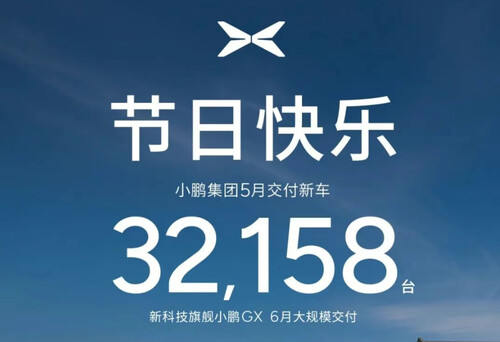
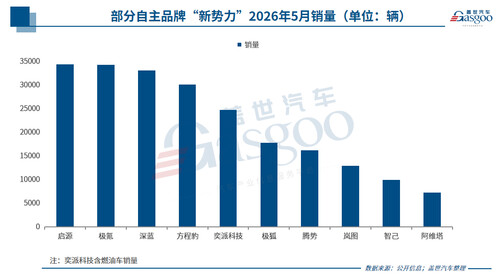
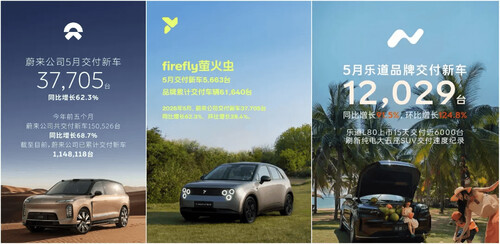
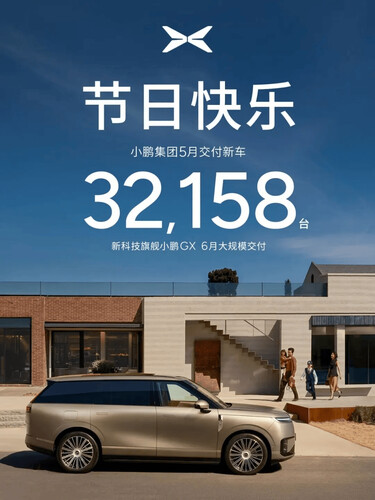
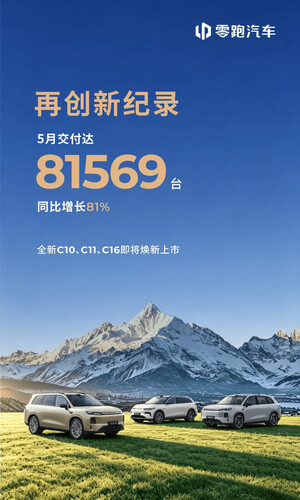
Gasgoo Munich- The battle for China's auto market has quietly shifted from a coexistence of internal combustion and electric power to an all-electric elimination round.With penetration rates breaching the critical 50% threshold, electrification is moving beyond early adopters to become the mainstream choice for the masses.Yet, crossing this milestone raises a new question: Where does electrification go from here?Oil Retreats, Power Advances: An Irreversible TideIn 2025, the penetration rate of new-energy vehicles (NEVs) in China topped 50% for the first time. That means for every two new cars sold, one is powered by new energy.Just as the market hit this milestone, geopolitical tensions in the Strait of Hormuz sent global oil prices oscillating wildly between blockades and reopenings. Those soaring prices accelerated consumers' shift from gasoline to electricity.By May 2026, that rate had climbed to a record 62.9%, completing the leap from "one-half" to "two-thirds" faster than expected.But the story of oil retreating and power advancing is far from over.Image source: NIOThe rapid rise of EV penetration hasn't just accelerated the shrinking of the internal combustion market; it has also triggered a survival crisis within the NEV camp itself.This May, extended-range electric vehicles (EREVs)—once hailed as the ideal transition solution—took a heavy hit. Sales plummeted year-on-year, marking the steepest drop in nearly five years.Growth for plug-in hybrids slowed in tandem, while the market share of pure electric models climbed to 67%, cementing their status as the dominant force.Industry insiders attribute this sudden stall in EREVs to breakthroughs in battery technology and an improved charging network, which are rapidly resolving range and charging anxiety for pure electric drivers.When a pure EV can travel 300 kilometers on a five-minute charge, the "worry-free range" advantage of EREVs loses its exclusive appeal. Instead, their dual systems—requiring both fuel and electricity—have become a burden: higher maintenance costs, more complex vehicle structures, and fuel consumption that isn't exactly low at highway speeds.This isn't an isolated case; it is a microcosm of the entire market structure being reshaped.Pure electrics are gradually becoming the mainstream choice in this elimination round. In the first quarter of 2026, they claimed a 67% share of the NEV market, with cumulative sales from January to April rising 25.3% year-on-year. The trend continued into May, with pure electric models occupying seven of the top ten spots on sales charts.Market feedback has been equally direct. When the XPENG GX launched in May, Chairman He Xiaopeng noted bluntly that pure electric versions accounted for more than half of flagship orders. This suggests that pure electrics are not only the new favorite among NEV users but are also commanding a premium in product value.Electrification has reached a crossroads. The concept is evolving from a simple switch from oil to electricity into a survival-of-the-fittest contest among technological paths.In this process, clarity is essential."China's NEV penetration rate topping 50% is largely the result of long-term policy support," Cao Guangping, a partner at Chefu Consulting, said in an interview. "Globally, most countries sit between 0% and 15%, and even policy pioneer Norway is only around 90%. Such high penetration in China doesn't mean EV performance has comprehensively surpassed internal combustion engines. A significant gap remains between battery technology and the energy characteristics of fuel."Looking at the history of the NEV industry, the first half of electrification was policy-driven, achieving the leap from zero to one. The second half must be technology-driven to scale from one to ten.This elimination round, led by pure electrics, has only just entered the stage where true technical strength is tested.First Half: The Answers on Range and SafetyThroughout the development of the NEV industry, consumer anxiety over range and charging has always been seen as a major hurdle."In the first half of electrification, we solved range and safety; in the second half, we will completely solve charging," BYD Chairman Wang Chuanfu said earlier at the launch of the company's second-generation Blade battery and flash-charging technology.How exactly were these two core problems—range and safety—which plagued the industry for over a decade, finally solved? The answer lies in the collaborative breakthroughs between automakers and battery manufacturers.This April, Xiaomi founder Lei Jun personally conducted a 15-hour livestream of a long-distance drive from Beijing to Shanghai. The trip covered an estimated 1,265 kilometers—ultimately logging 1,313 kilometers—with just a single charge. Around the same time, NIO ran a real-world test in Beijing, driving a Pro model until it was fully depleted; it traveled 892 kilometers, achieving 98.9% of its claimed range.Image source: Xiaomi EVCEOs are stepping into livestreams personally to prove, in the most direct way possible, that electric vehicles can now easily handle long-distance intercity travel.That confidence stems from a generational leap in battery technology.BYD's transition from the first to the second-generation Blade battery involved a shift from lithium iron phosphate to lithium manganese iron phosphate chemistry. System energy density rose to 190–210Wh/kg—a roughly 40% increase over the original. The DENZA Z9GT, equipped with this battery, achieves a range of 1,036 kilometers, while the Yangwang U7 reaches 1,006 kilometers. In terms of low-temperature performance, capacity retention exceeds 85% at -20°C, effectively alleviating the industry-wide pain point of winter range loss.CATL is doubling down as well. In April, it released its third-generation Qilin battery, with a cell mass energy density of 280Wh/kg; a 625-kilogram pack delivers a range of over 1,000 kilometers. For cold weather, the third-generation Shenxing ultra-charging battery takes just 9 minutes to charge from 20% to 98%, even at -30°C.Second- and third-tier battery makers are racing to catch up, with CALB, Gotion High-Tech, Farasis Energy, and SVOLT all making breakthroughs. The entire battery industry is forming a technological matrix of progress across the board, from top players to mid-tier firms.Then there is safety. The second-generation Blade battery retains the core safety trait of "no fire upon nail penetration" and passed three rigorous tests that far exceed national standards. The new standard requires batteries not to catch fire during a short circuit after 300 fast-charge cycles; BYD raised the bar to 500 flash-charge cycles, then performed a "nail penetration while charging" test. The result: no thermal runaway, no smoke, no fire, and no explosion.CATL has taken a different path to safety. Building on the NP (No Propagation) technology in its third-generation Qilin battery, it introduced a new thermal-electric separation design. This physically isolates the high-voltage components of the cell from the explosion-proof valve, giving each cell an independent, sealed exhaust channel that is physically isolated from all high-voltage electrical parts and sampling loops.Years ago, the debate between BYD and CATL over "nail penetration tests" grabbed headlines. But as technology has advanced and consumer understanding deepened, people no longer obsess over the outcome of a single test. Battery safety has become an industry consensus and a baseline, and the market has delivered its verdict."A century of internal combustion development shows that technological innovation shifts from early disruptive breakthroughs to gradual refinement," said Lian Yubo, senior vice president at BYD. "The current evolution of NEV technology is in a similar stage. Innovation is shifting toward the refinement of vehicle functions and performance. Companies must rely on technological innovation to improve user experience and provide emotional value."Consumers are no longer paying for the novelty factor; they expect a more reliable and universally applicable electric mobility experience. For automakers, technological innovation must align deeply with product needs, shifting from a parameter-oriented focus to an experience-oriented one, making technology a tangible and trustworthy reality for consumers.Second Half: Charging Is Becoming as Fast as RefuelingNot long ago, "charging as fast as refueling" was just a lofty vision on slides at EV launches. But in 2026, it is quietly moving from PowerPoint presentations into consumers' daily lives.This March, Wang Chuanfu announced that BYD would open its flash-charging technology to the entire industry.Official data shows the second-generation Blade battery supports a charging rate of up to 10C, whereas mainstream fast-charging batteries currently operate between 3C and 5C. This means a five-minute charge takes the battery from 10% to 70%, with a full charge taking just nine minutes. Even in freezing conditions of -30°C, charging from 20% to 97% takes only 12 minutes—just three minutes longer than at room temperature.The accompanying "FLASH Charging China" strategy plans to build 20,000 flash-charging stations nationwide by the end of 2026, equipped with 1,500kW liquid-cooled ultra-charging piles.Image source: BYDIn June, BYD signed a strategic cooperation framework agreement with Sinopec in Beijing. Sinopec owns over 30,000 comprehensive energy stations and 14,000 charging and swapping stations, providing a ready-made physical infrastructure for the rapid rollout of the flash-charging network.As of the signing date, BYD had already built more than 6,100 flash-charging stations, giving shape to its national network. It expects to work with partners to complete over 20,000 stations nationwide by the end of 2026.CATL has taken a different path: a "dual insurance" route of ultra-charging plus battery swapping. Its ultra-charging battery can achieve a full charge in six minutes at room temperature, and it plans to build 4,000 integrated ultra-charging and swapping stations by the end of 2026.Currently, as automakers push their pure electric models, they are also turning the goal of "charging as fast as refueling" into reality.As of the end of March 2026, Li Auto had launched 4,057 ultra-charging stations with 22,439 piles. NIO's nationwide network reached 9,003 stations—including 3,927 battery swap stations and 5,076 charging stations. XPENG's self-operated stations exceeded 3,200, with a target of 10,000 by 2026. GAC Energy has surpassed 20,000 self-operated ultra-charging piles.Data released by the National Energy Administration on June 24 shows that as of the end of May 2026, the total number of charging points nationwide reached 22.497 million, a year-on-year increase of 44.9%.From BYD's 10C flash charging to CATL's ultra-charging and swapping, and from proprietary networks by top automakers to the conversion of gas stations by oil giants, an era where charging is as convenient as refueling is accelerating toward us.Endgame: Not Just Swapping Cars, But Swapping Energy SystemsAs the electrification revolution unfolds, a fundamental question demands an answer: What is the ultimate goal of all this innovation?The answer is simple: returning to the user.Lian Yubo has noted that electrification still needs to break through bottlenecks in safety, charging, and environmental adaptation. The supply chain continues to innovate around batteries, charging, and thermal management, focusing on solving slow charging and difficulties in cold weather. Technological innovation must continue to drive the adoption of NEVs.For now, different users require different battery solutions.Lithium iron phosphate (LFP) batteries will continue to dominate the mainstream mass market thanks to their cost and safety advantages. BYD's second-generation Blade battery flash-charging technology has resolved the core pain point of charging speed, giving LFP an unshakable competitive edge in the 100,000 to 300,000 yuan price bracket.Image source: ONVOSodium-ion batteries have found their niche in A00-class microcars, two-wheelers, and energy storage—scenarios where cost sensitivity is extreme. Semi-solid batteries, offering higher energy density and safety, are becoming a key differentiator for mid-to-high-end models priced between 200,000 and 300,000 yuan. In the premium market above 300,000 yuan, all-solid-state batteries, though not yet mass-produced, have become a strategic battleground for automakers and battery manufacturers alike.Toyota holds more than 1,300 core patents for solid-state batteries and plans to begin mass production in 2026. BYD is betting on sulfide-based all-solid-state batteries, achieving a laboratory energy density of 400Wh/kg. In this price bracket, consumers are buying not just a product, but a vision of the future and the technological halo of the brand.Various technological routes will leverage their strengths in different market segments and scenarios, creating an industrial ecosystem of differentiated competition and symbiotic complementarity. The ultimate winner won't necessarily be a single technology, but the one that most precisely matches user needs.The endgame of electrification isn't simply swapping gas cars for electric ones; it is building an entirely new energy system.When the EV population reaches tens of millions or even hundreds of millions, these vehicles will no longer be just modes of transport but vital components of the energy network. As V2G (Vehicle-to-Grid) technology matures, every EV will become a mobile energy storage unit—charging during off-peak hours and discharging during peak hours. This stabilizes the grid and generates revenue for users.Realizing this vision depends on batteries having higher cycle life and bidirectional charging capabilities, as well as deep coordination between charging networks and the power grid.BYD opening its flash-charging network and CATL building a shared ultra-charging and swapping alliance are reflections of this ecological thinking. Future competition will no longer be between individual automakers or battery makers, but between ecosystems.Policy support is accelerating as well.Policies like "New Energy Vehicles to the Countryside" are being intensified, vigorously promoting the construction of charging facilities in rural areas and supporting the adoption of NEVs in lower-tier markets. Improving the charging network not only alleviates range anxiety but also paves the way for more advanced energy interaction scenarios like V2G.As Cao Guangping put it, batteries, intelligence, vehicle technology, and infrastructure are four indispensable pillars that form the foundation of user trust. Batteries determine confidence, intelligence defines the experience, vehicles carry quality, and infrastructure provides assurance. These four are interlocked; any single weakness can dismantle user trust. The final competition in electrification will not be about individual breakthroughs, but about systemic coordination.