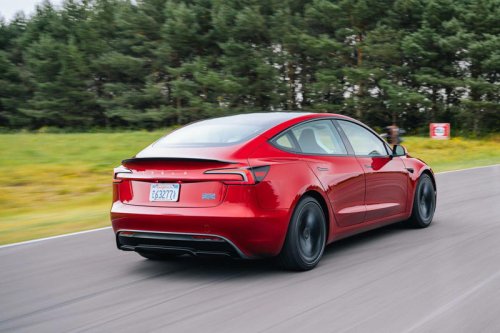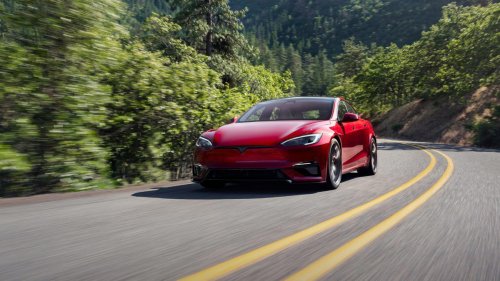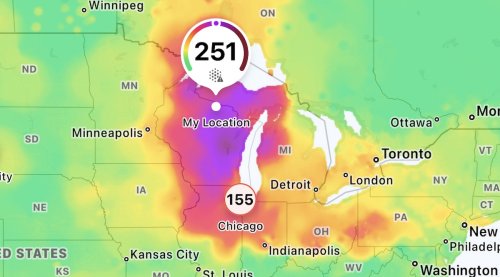
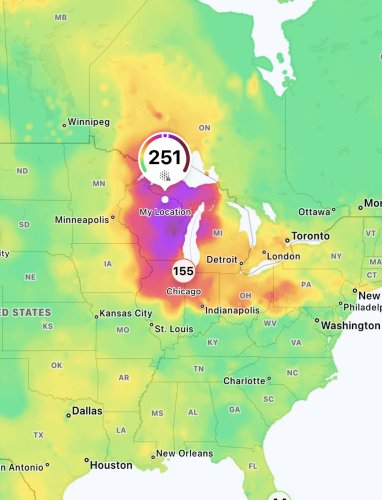
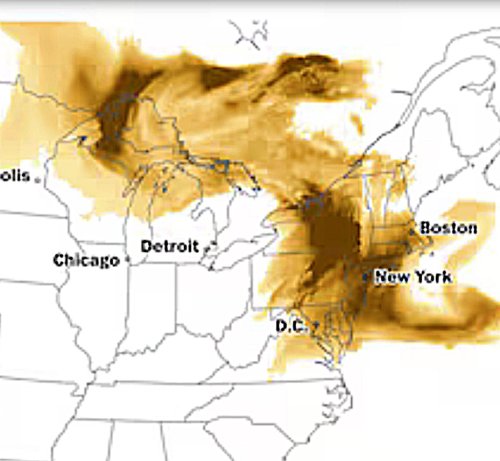
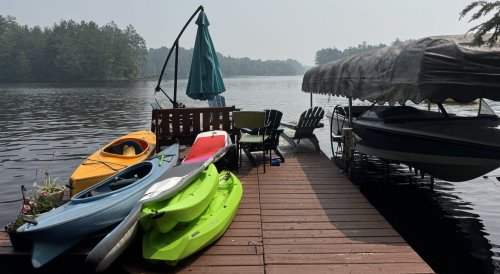
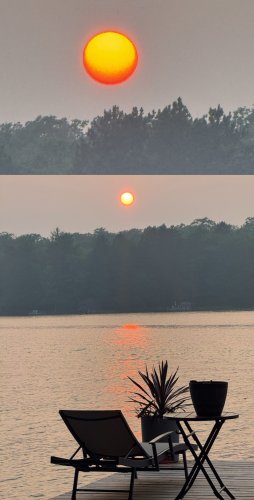
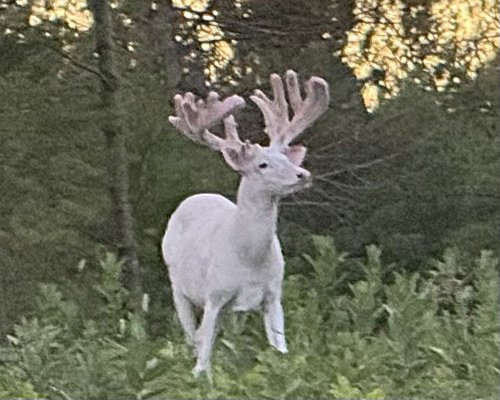
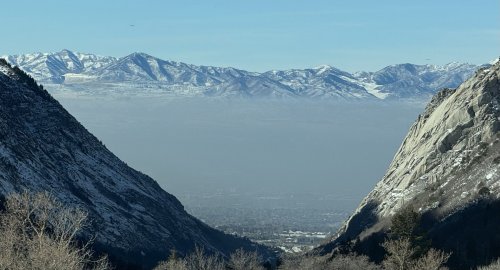
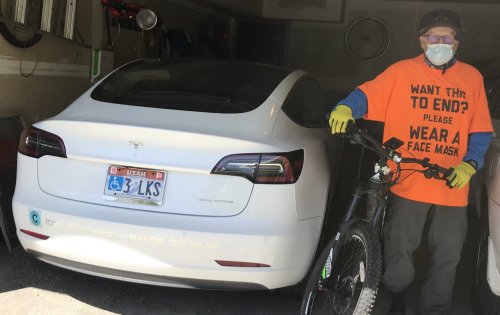
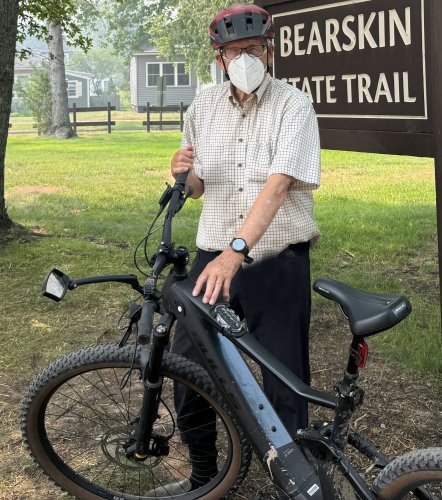
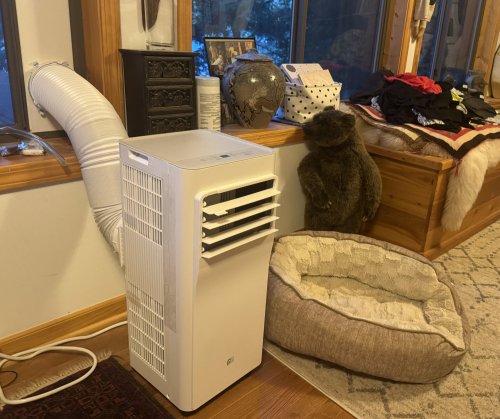
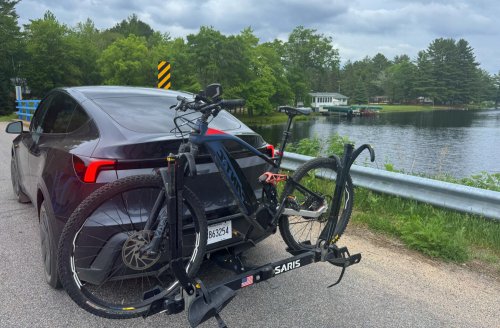
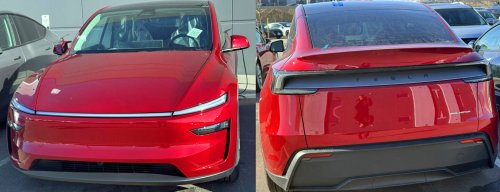
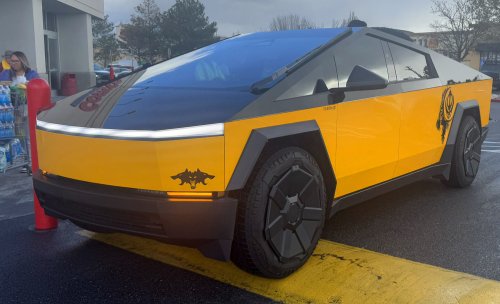
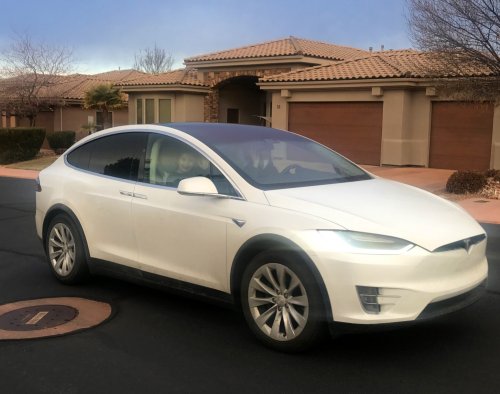
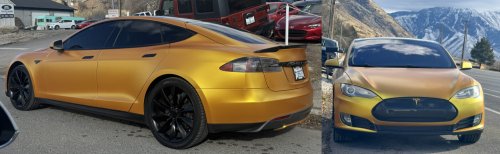





Unhealthy air epicenter over Wisconsin, July 19, 2026. Apple weather app. Plumes of smoke from Canadian wildfires have hung out over Wisconsin and often extended across the upper Eastern US for over a week. The fires have been worsened by the effects of heat and drought resulting from global warming. The photograph above shows the concentration of unhealthy air over Wisconsin on July 19. The following photograph shows the plume also extending all the way to the East Coast on July 19. Unhealthy air plume from Wisconsin to the East Coast, July 19, 2026. Washington Post simulation. The photo below from our pier shows the smoky air over Laurel Lake in Three Lakes, Wisconsin, on July 19, 2026. Sometimes the air has been so smoky that we couldn’t see the far shore. Smoky air on Laurel Lake. Three Lakes, Wisconsin. July 19, 2026. Fritz Hasler photo. The photo below shows the red sun just before sunset over Laurel Lake on July 19, 2026. The fine smoke particles absorb more short-wavelength blue light allowing longer red wavelength to pass through, which gives the red colorization of the sun. Smoke has a significant percentage of particles smaller than 2.5 µm. Red setting sun over Laurel Lake. Three Lakes, Wisconsin. July 19, 2026. Fritz Hasler photos. The air here has been really unhealthy and will probably be this way often in the days and weeks ahead. What can we do about it? The white ghost you see below has been haunting our area for some years as his antler rack has grown. Unfortunately, he can’t do anything to protect us from unhealthy air. Albino buck. Three Lakes, Wisconsin. July 17, 2026. Fritz Hasler photo. The other kind of very unhealthy air that I see comes in the winter as I come down Little Cottonwood Canyon from skiing at Alta Ski Resort in Utah. In meteorology, we call the normal decrease in air temperature with altitude the “normal” lapse rate. In this situation, when the ground is heated by the sun, it heats up the air just above it. This air, which is warmer than the air surrounding it, is also less dense and therefore buoyant, which causes it to rise. You see this situation with typical cumulus clouds. However, sometimes in winter when a high-pressure region moves over the area, we get subsidence or sinking. This causes an “inversion” where the temperature increases with height instead of decreasing. When a warmer buoyant air parcel hits air above it that is even warmer, it stops rising and we get “capping” where the dirty air polluted by vehicles, wood burning stoves, etc. is trapped below as illustrated in the images below. The particle size distribution in this case is also in the range of 2.5 µm, similar to the wildfire smoke that we are seeing in Wisconsin this summer. Salt Lake Valley pollution. From Little Cottonwood Canyon, Salt Lake City, Utah. January 12, 2025. Fritz Hasler photo. In the photo below, you see me wearing a surgical mask during the early days of COVD. At the time, I didn’t understand masks or appreciate how unlikely it was to spread COVID outdoors. Expecting protection from COVID or smoke inhalation using a surgical mask is not much more effective than expecting help from the white ghost (albino buck) above. A surgical mask is only 20–30% effective in filtering out smoke particles or the COVID virus. During COVID, a surgical mask was effective in preventing an infected person from spreading the disease by coughing or sneezing, but it provided little protection for the person wearing the mask. If you see someone wearing a surgical mask on a smoky or winter inversion day, you are seeing someone who has a cold or doesn’t understand the situation. The author’s biking outfit wearing a surgical mask. Lindon, Utah. May 7, 2020 One thing we can do is dig out the N95 masks we still have lying around the house from the COVID epidemic. You can see me wearing one below. Those masks filter at least 95% of airborne particles, including large respiratory droplets and smaller COVID aerosols. They are effective against particles as small as 0.3 microns (µm), which includes many viruses, bacteria, and smoke. The author wearing N95 mask. Bear Skin Trail, Minocqua, Wisconsin, June 16, 2026. Fritz Hasler photo. What can you do when you are in your home? Most people are running MERV 8 filters in their HVAC systems (MERV = Minimum Efficiency Reporting Value). However, if you have 4” filter slots in your HVAC, you can upgrade to a MERV 11 filter. A MERV 11 filter traps roughly 85% of airborne particles in the 3.0 to 10.0-micron range and effectively captures smaller particles (1.0 to 3.0 microns). For those of us who have never previously needed air-conditioning in Northern Wisconsin, a stand-alone unit like the one below is an option. This one has the option for horizontally sliding windows, as shown in the photo, as opposed to a normal in-window unit which requires a vertically hung window. Perfect Air 8500 (BTU) air conditioner with MERV 11 rating. Three Lakes, Wisconsin. July 20, 2026. Fritz Hasler photo. A MERV 13 removes up to 75 % of the .5µm smoke particles. However, a MERV 13 filter will put some strain on your HVAC pump motor. If you want to have higher particle-removing efficiency. it would probably be better to use a stand-alone HEPA filter. What about commercial buildings? Commercial buildings that meet American Society of Heating, Refrigerating, and Air-Conditioning Engineers standards (ASHRAE) are required to have filtration at the MIRV 13 level or better. What about your car? All Teslas have twin box filters in the cabin that are rated at MERV 13. My base Model Y shown below comes with MERV 13 filters. I investigated upgrading my base Model Y to a HEPA filter, but Tesla doesn’t offer the upgrade at this time. Switching out the MERV 13 box filters to ones with higher ratings isn’t recommended, as it might burn out the fan motor. Mountain bike on rack. My base Tesla Model Y. Camp Hasler. Three Lakes, Wisconsin. June 8, 2026. Fritz Hasler photo. All Model S, X, Cybertruck and 2026 Premium Model 3 and Y cars have HEPA filters in the frunk. HEPA or biodefense filters are rated as 99.99% efficient at removing particles as small as .3 µm. If you see a Tesla that looks like the ones below, you know they come with HEPA filters. New front and rear styling on 2026 Tesla Model Y Premium. Pleasant Grove, Utah. January 12, 2025. Fritz Hasler photo. Wrapped Cybertruck. Salt Lake City, Utah. December 30, 2024. Photo by Fritz Hasler. Tesla Model X. Saint George, Utah. January 2. 2021. Photo by Fritz Hasler. Even an older Tesla Model S vehicle like the one below has a HEPA filter. Tesla Model S with gold wrap. Provo, Utah. December 15, 2024. Photo by Fritz Hasler. If you find any of my articles helpful to you, please use my referral link when buying a new Tesla: https://ts.la/arthur73734 (be sure to use it when you make your order). Tesla keeps changing the program but here’s the latest: If you are buying a new Tesla Model 3 or Y and use my link, you will get 2 months of free Full Self Driving (a ~$200 value) on top of the one month that comes free with every new Tesla. For a Cybertruck, you will get $1,000 off your purchase price. At the moment, Tesla is also offering a year of free Supercharging with the purchase of a new Model 3 Premium or Performance.