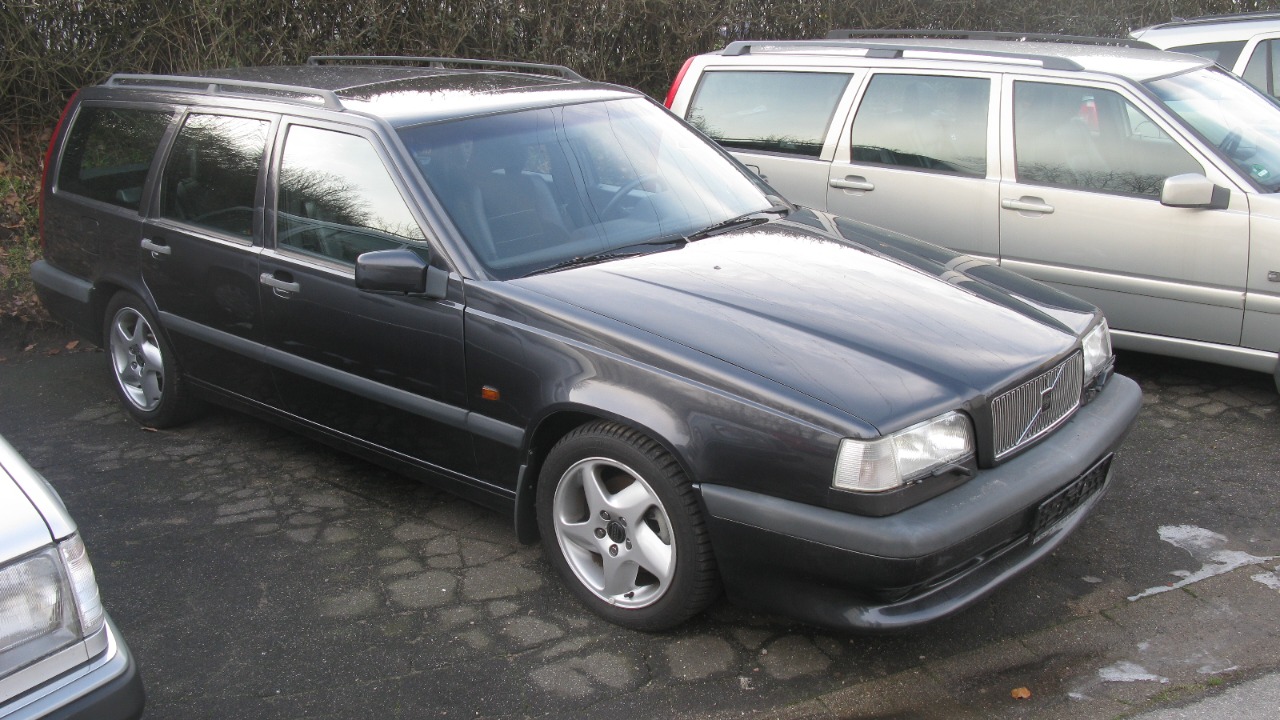
Volvo showed the Volvo 850 in June 1991, and the car changed what the brand’s name meant on the street. Before it, a Volvo was a safe, square, rear-drive box. After it, the same square shape could carry a turbo five-cylinder, a racing number or a coat of bright yellow paint. The 850 also sold in huge numbers. Volvo built 716,903 of them before production ended in 1997, so plenty of people grew up riding in the back of one. That’s exactly why a good one turns heads today. Most of those sedans and wagons worked hard for decades, so a clean survivor looks like a time capsule. These nine are our picks for the 850s that make people stop and stare, from a plain launch sedan to a wagon that went racing. Those opinions are ours. The years, numbers and history come from Volvo and the people who know these cars best. 1. 1993 Volvo 850 GLT sedan The GLT is where the story starts. Volvo launched the 850 as a four-door GLT, and the car reached American showrooms for the 1993 model year. That made it the first front-wheel-drive Volvo sold in the U.S., a big change for a brand known for rear-drive 240s and 740s. On its own heritage page for the 850 sedan, Volvo lists four breakthroughs from the launch. First, a five-cylinder engine sat crosswise and drove the front wheels. Second, a Delta-link rear axle mixed independent-style comfort with the security of a live axle. Then came the SIPS side-impact protection system and a front seat belt that adjusted itself. Early GLTs used a 2.5-liter 20-valve five rated at 170 PS. Volvo also kept a clear family link to the 740 and 940 in the styling. Our take: a tidy GLT in a dark color looks sharper now than it did when new. The thin pillars, flat glass and long hood give it a crisp outline that modern crossovers can’t match. Better yet, Volvo says it built 390,835 sedans, so you can find one if you’re patient. 2. 1994–1995 Volvo 850 T-5R sedan The T-5R began as a marketing idea. According to the Volvo 850 T-5R registry, a team had nine months and a budget of 15 million Swedish kronor to dress up a standard T-5. Volvo showed a Cream Yellow sedan at the Geneva show in March 1994 and called it the “T plus 5.” Production began in Gent, Belgium, during the first week of October 1994. The registry says the first run was 2,500 yellow and 2,500 black cars. That first batch sold out by early January 1995. Porsche had a hand in it, too. Auto Express says Porsche helped develop the seats and assisted with the engine tuning, transmission and suspension. The result was 237 bhp from a 2.3-liter turbocharged five, plus 17-inch wheels and a lowered ride. Italy got a 2.0-liter version instead, because of tax rules there. In our view, the sedan is the purist’s T-5R. It looks like a stern office car until you see the paint and the wheels. Then nobody can look away, which is the whole point of this list. 3. 1995 Volvo 850 T-5R estate Volvo sold the T-5R as a wagon as well, and that’s the version most fans picture. Volvo unveiled the 850 estate in February 1993, less than two years after the sedan. Its tailgate stood almost straight up, so the cargo hold was huge, and the shape won Japan’s 1994 Good Design Grand Prize. The Auto Express icon review calls the estate the cooler T-5R. We agree. Volvo built 6,964 T-5Rs worldwide, and only 876 went to the United States. Color makes some even scarcer. The registry counts 1,582 green estates, the largest single group, yet only 13 of them were sold in the U.S. Norway, for its part, received only yellow cars. Picture a long wagon in Cream Yellow on 17-inch wheels, then park it next to a modern SUV. One looks like every other car in the lot. The other looks like a dare. If you want the 850 that draws the biggest crowd at a show, this is the one we’d chase. 4. 1996 Volvo 850 R estate Demand for the T-5R didn’t fade, so Volvo built a successor. Auto Express says that demand led to the 850 R, which ran from 1996. The R had no special-order paint like Cream Yellow, but it had more muscle under the hood. Italian 850 Rs, by contrast, used a 2.0-liter turbo rated at 211 PS. A Garage Dreams buyer’s guide lists the manual 850 R at 250 hp and 350 Nm. Volvo got there with a larger turbo on manual cars, a new manifold and intercooler and a revised fuel pressure sensor. A limited 1996 run used the heavier M59 manual gearbox with a viscous limited-slip differential, though it never came to the U.S. The R also got bigger 302 mm front brake discs. In our opinion, the R wagon is the best all-rounder of the fast 850s. It hauls a family, pulls hard and looks serious in dark colors. If you like where this road led, our look at Volvo’s R cars follows the badge forward. 5. 1996 Volvo 850 R sedan The 850 R sedan is the quickest way to cover ground in this family. The buyer’s guide puts the manual sedan at 6.7 seconds from 0 to 100 km/h, against 7.5 seconds for the automatic. Manual cars used the B5234T4 version of the 2.3-liter five. Inside, the R added sport seats, Alcantara door cards and a 200-watt amplifier. Color choice tells you a lot about a car like this. American buyers could get only Bright Red, Polar White or Black Stone. Elsewhere, Volvo also offered pearl shades such as Turquoise Pearl and Dark Olive Pearl. A red sedan on R wheels is loud enough to stop conversations on its own. Before you buy, know the weak spots. The guide flags the rear main seal, which is linked to the crankcase ventilation system, and fixing it means pulling the gearbox. As a result, it’s smart to replace the clutch at the same time. Volvo replaced the 850 sedan with the S70 for 1997, and the R badge later moved on to cars like the 1998 Volvo V70 R. 6. Volvo 850 estate in BTCC livery No 850 stops traffic like the racing wagon. In April 1994, Volvo entered two 850 estates in the British Touring Car Championship at Thruxton. The decision stayed secret until shortly before launch, according to Volvo’s own look back at the program. Tom Walkinshaw Racing ran the cars, and Rickard Rydell and Jan Lammers drove them. The rules capped engines at 2 liters and banned turbochargers. So the race car lost its turbo and made around 290 hp, and a six-speed sequential gearbox replaced the road car’s five-speed. Volvo says it was also the first team to fit a catalytic converter, which later became mandatory in the class. Rydell admitted the estate was “by far the largest car in the series.” Its best finish that first year was fifth at Oulton Park. The World of Volvo notes that the wagon weighed about 950 kg, the class minimum. For 1995, Volvo switched to the sedan. Even so, the wagon is the one everybody remembers, and a car in that livery draws a crowd at any meet. 7. 1996 Volvo 850 T5 The regular T5 is the 850 that made the fast versions possible. Volvo sold the turbo model from 1993 to 1997, and its 2.3-liter five made 225 PS. That’s close to the T-5R, but without the loud paint, so most people never suspect what’s under the hood. Garage Dreams puts the T-5 at 1,420 kg. It also lists a 0 to 100 km/h time between 7.3 and 7.7 seconds. You could pair it with a five-speed manual or a four-speed automatic. For a mid-1990s family sedan, that was serious pace, and it made the T5 a favorite among fans of fast, plain cars. Our take: the T5 is the sleeper’s choice, and that’s why we’d put one on this list. In fact, a clean, dark T5 on factory wheels gets a second look from people who know, and a blank stare from those who don’t. Just budget for upkeep. The buyer’s guide says to change the timing belt every 70,000 miles or five years, and to check the water pump while you’re in there. 8. Volvo 850 Turbo estate In the U.S., the turbo wagon wore a simple badge: 850 Turbo. It carried a feature that rivals couldn’t match at the time. On its 850 estate history page, Volvo calls the 850 the first car in the world to offer side-impact airbags. Series production of those airbags began in the autumn of 1994. The Turbo models got them as standard for 1995, while other 850s offered them as a $500 option. Then, for 1997, Volvo renamed the 850 Turbo the T-5. That same year the V70 replaced the 850 estate, so the Turbo badge on a boxy wagon marks a short window. Meanwhile, the 850 AWD arrived in November 1996 as a 1997 model, offered only as an estate. We love this car because it hides so well. To most eyes, it’s a sensible family hauler with a roof rack. However, the turbo five gives it real punch, and the safety story gives owners bragging rights. A clean Turbo wagon at a cars-and-coffee event tends to gather people who once had one, and they always want to talk about it. 9. Volvo 850 estate police car Police work gave the 850 wagon a second reputation. In Britain, Auto Express says Hampshire Constabulary and “many other forces” chose the “fabled 850 estate” for motorway patrol in the early 1990s. The turbocharged T5 versions were especially prized, and the magazine says they could reach nearly 150 mph. That mix of space and speed suited patrol crews. A wagon could carry cones, signs and medical kits, then chase down speeders on the motorway. Volvo lists the estate at 472 cm long on a 267 cm wheelbase. The wagon in our photo is a preserved British police 850 estate, shown with other historic police vehicles at an emergency-services display in Eastleigh, Hampshire. Our take: an ex-police 850 in full livery stops traffic for a different reason. Drivers tap the brakes first and smile second. If you find one, keep the markings legal and the history file complete, because the paperwork is half of the appeal. For the record, Volvo built 326,068 of the 850 estates between 1993 and 1996.

 Liked by Chloé Rogers, Lauren Bouchard





















 Liked by Chloé Rogers, Lauren Bouchard