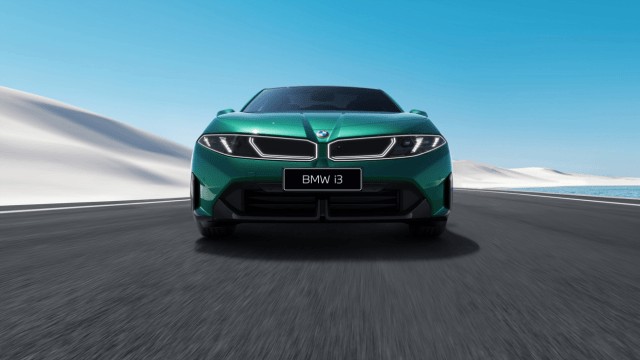
Hyundai Motor Group has proven to be one of the most influential forces in the electric vehicle space. It was one of the first automakers to widely use 800-volt battery packs that made use of much faster 350-kW DC fast chargers, which other automakers began to adopt (and some are exceeding). It also was the first to add simulated gear shifting to its performance EVs. This has been more directly copied by a number of automakers, including Honda and Porsche. BMW is next on that list, but it sounds like the company is trying to put its own spin on the technology. BMW Confirms The Feature For M Performance EVs Australian car news and classifieds site Carsales spoke with one of BMW's senior driving dynamics engineers, Christian Heiss. He told the outlet that BMW has been developing its own take on paddle-shifted simulated gears, and the system will appear on an upcoming i3 M60. It will also appear on the i3 M, but not on anything that isn't M Performance or more aggressive in nature. Furthermore, BMW doesn't call its setup gears or speeds, but rather, stages. Announcing some details of the new electric M3, BMW indeed uses "stages" to refer to its setup. Specifically, there are six stages that act as gears, though Heiss implied that BMW's system won't just provide an accurate simulation of a conventional transmission the way the Hyundai Motor Group system does. "It's thought a bit differently, but everyone hoping for a gear shift simulation will be happy with this — hopefully more than happy" -BMW Senior Driving Dynamics Engineer Christian Heiss He didn't go into any further detail about the system, leaving us to ponder what the differences could be. While extremely convincing, the Hyundai system simulates an eight-speed automatic to a fault. It adjusts power output based on "rpm," and even cuts power to help convey the feeling of a gear change. Honda does a similar thing with its faux shifting in hybrids such as the Prelude. We've seen that obsessive simulation actually results in a slower car, because of the varying power output and cuts. Skipping the fake gears means you get all the power, all the time, and with no interruptions. Knowing what we know about BMW M, it's possible this system could operate without the slower times associated with other systems. How Can Fake Gear Shifts Evolve In An Electric World? The Ferrari Luce also has a sort of simulated gear shifting system, which you may have missed while distracted by its controversial styling. Instead of each paddle controlling either up or down shifts, only the right paddle does any "shifting," while the left paddle manages regenerative braking settings. Also, instead of going through fake gears, the right paddle adjusts the amount of power and torque provided, and apparently, when accelerating, the instrument cluster will prompt the driver on the ideal points to "upshift" to the next level for optimum acceleration. It seems like the system may be a way to get strong performance, more involvement, and to be more unique than other EVs. CarBuzz Insight – Why This Matters: Finding ways to add involvement to EV driving experiences is one of the biggest challenges for automakers, especially when it comes to enthusiast vehicles and automakers. Engines and transmissions have been load-bearing for differentiating vehicles, and electric powertrains remove a lot of that. Simulated transmissions seem to be gaining fans considering how they've proliferated beyond the Hyundai Motor Group, but we're still in the early days of EV development and differentiation. BMW, looking at doing something different, and maybe even better, has us excited both to try it out, and because it might help make the EV market even more interesting, if not better altogether. Source: BMW, Carsales

 Liked by Abigail King, Matthew Johnson














 Liked by Abigail King, Matthew Johnson