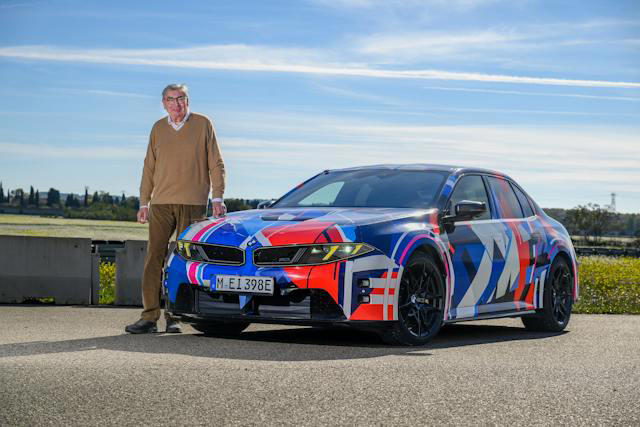
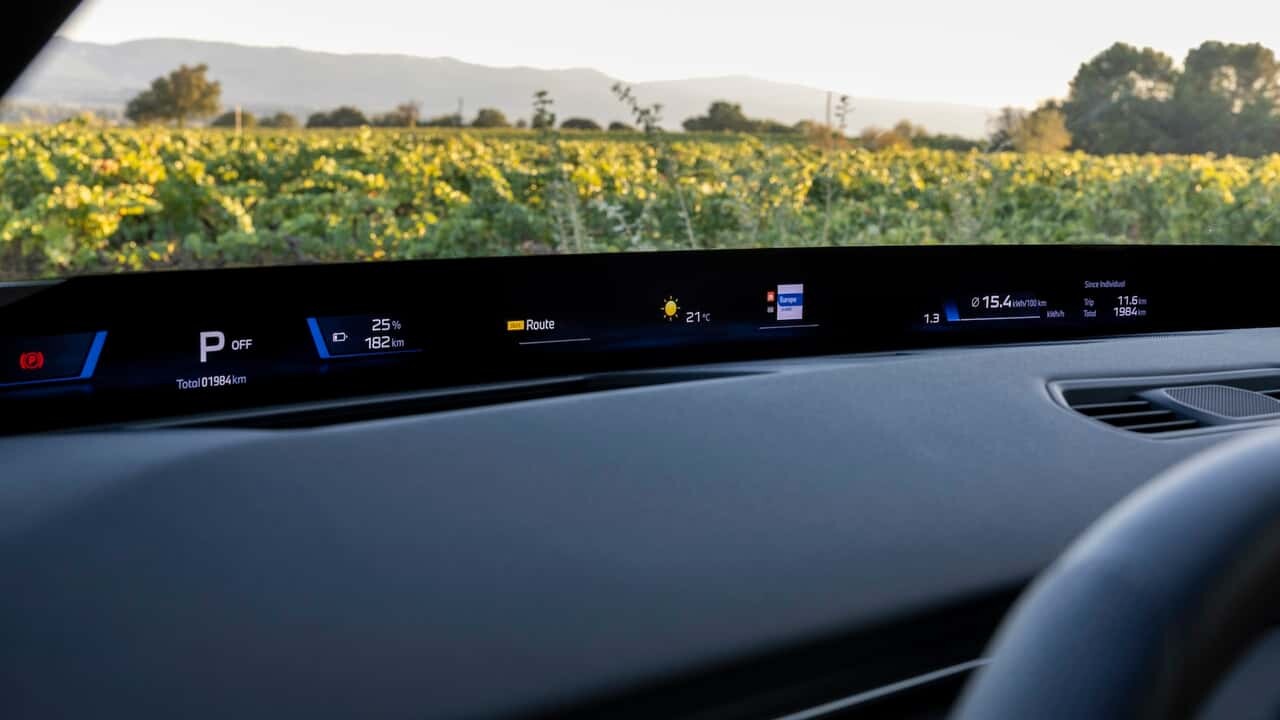
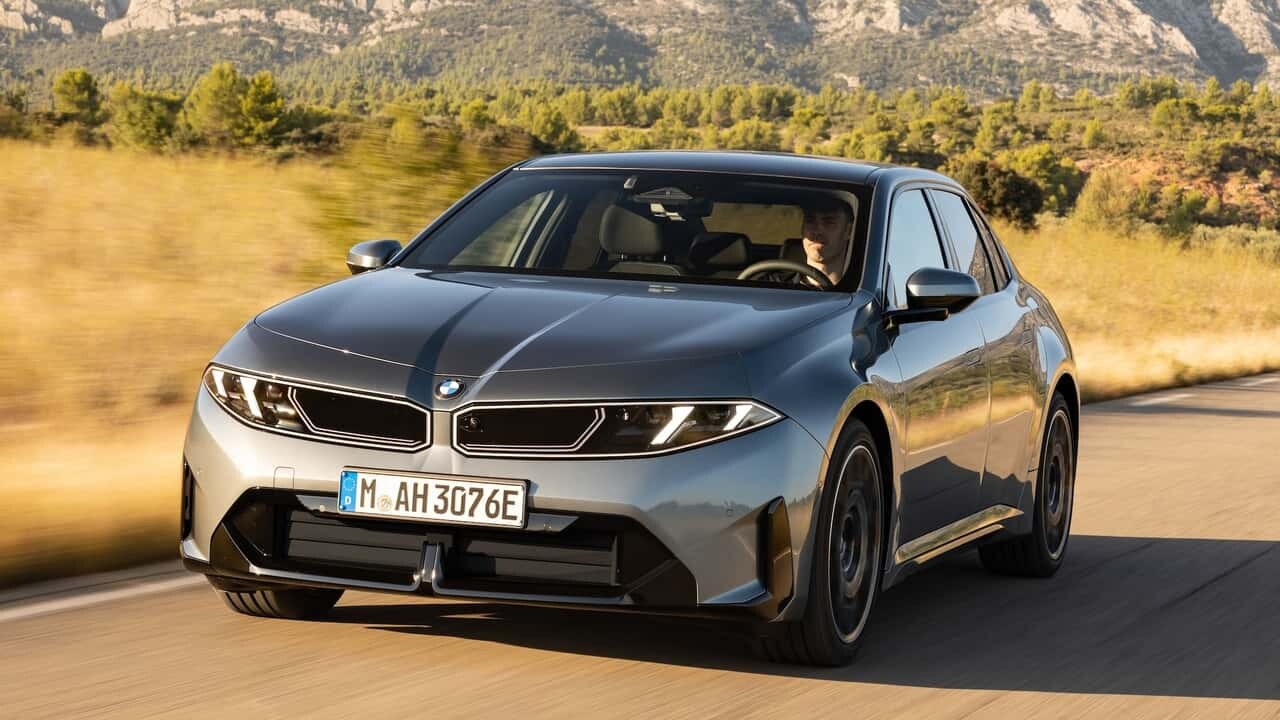
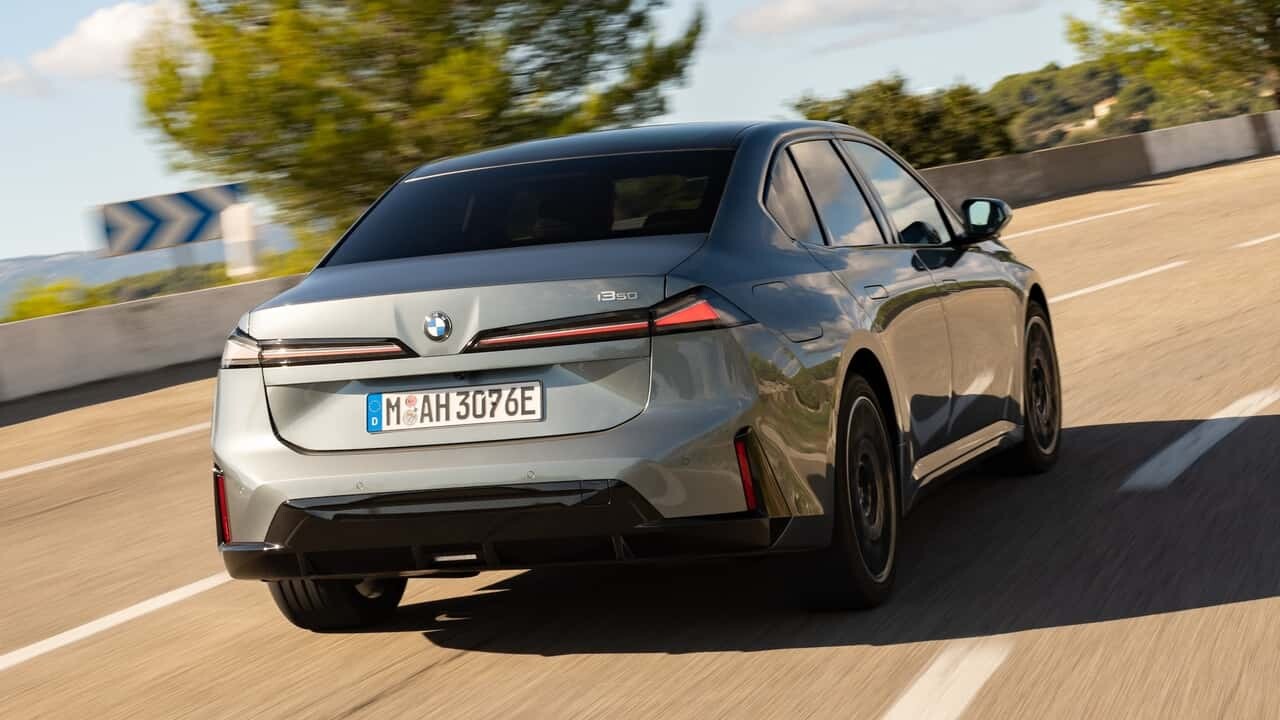
Attend an event organized by BMW's M Division, and you know what you are going to get. Such as plentiful M branding everywhere. It was no surprise when I arrived at BMW's proving ground in Miramar, France, to experience the M3 prototype for the first time to see numerous flags and banners with the famous slant "M" logo. And it felt equally natural for a moment to be listening to the sound of a hard-worked engine on the test track, with what seemed the entirely M-appropriate howl of a straight-six exhaling through a minimally muffled exhaust. But then, as the noise grew louder, the narrative shifted. Because it was an M4 GT4 making the compelling racket. The two M3 prototypes that followed it wearing a vibrant, dazzle pattern disguise, were traveling every bit as quickly but almost entirely silently. BMW We've known for some time that the BMW M3 was going to make the switch to becoming an EV, but the reality of what that entails for those watching from outside the car was still a mild shock. The good news for anyone unsure about such a radical departure for the subbrand is that work on a gasoline-powered M3 is continuing in parallel. The combustion version, with the development code G85, is likely to feature another version of the S58 turbocharged inline-six from the current G80 generation, likely working in conjunction with some level of hybrid assistance. That will be a much more traditional take on the junior M car, but it almost certainly won't be as powerful or as quick as the fully electric version. But is our world ready for this level of different? My first experience at Miramar was a passenger ride around the handling track, sitting in the left seat of one of the four colorfully-wrapped prototypes beside Sven Esch, M's head of vehicle dynamics. I knew the car had a quad-motor powertrain, with one motor driving each wheel, and I could see it was riding on new Michelin Pilot Sport S 6 tires, but that was about all I had to go on when Esch executed a full launch-control start, one brutal enough to leave me confident the finished car will be another member of the two-second club when it comes to 0–60 times. The other disclosure, delivered from the changing tone of the noise coming from the speakers and the sight of Esch's fingers working paddles behind the steering wheel, is that BMW is joining Hyundai, Porsche, and Mercedes in having a simulated gear system. The lap also revealed a handling balance familiar from many generations of M cars, with varying angles of oversteer through most of the corners. UWE FISCHER There are still many unknowns. Although the cars at Miramar were close to production spec, BMW is keeping many details to itself. There are no performance claims yet. And every number given for power, torque, range and charging speed carried an asterisk leading to an "approximately" proviso. The maximum system output was quoted at 838 hp and 885 lb-ft, with the pair of front motors able to deliver up to 643 hp and 398 lb-ft working together, while the larger two in back max out at a claimed 750 hp and 738 lb-ft. Given the way automotive PR typically works, I would be surprised if any of those figures grew any worse before becoming finalized. But they are clearly a way off the 1153-hp AMG GT 63 4-Door, the 1123-hp Lucid Air Sapphire, and the 1019-hp Porsche Taycan Turbo GT. The M3 EV uses a different battery pack from the regular i3, with a new cell design and double-sided cooling to enable huge peak flow rates, with this having approximately 100 kWh of usable energy and operating at up to 800 volts. BMW is predicting an EPA range of 300 miles, and peak DC charging speeds will be around 420 kilowatts—slightly higher than the regular i3 and better than the speediest Taycan, but a way off the 600-kW capability of the AMG. More impressive is the ability of the battery pack to reabsorb energy through regeneration, doing this at rates of up to—approximately again—540 kilowatts. So the equivalent of 724 hp, without having to use the carbon-ceramic discs and pads. Then there are the simulated gears. Although, pedantically, these are not. BMW has decided the mDrive mode allows the selection of what it calls "stages," of which there are six. The default mode on startup is actually Automatic, in which the car changes between the stages by itself while playing a corresponding soundtrack as it does so, like a true automatic transmission in drive. There is also a paddle mode that gives you the ability to select a stage and also a simulated limiter if you fail to change up in time. It also has a normal EV single-speed drive mode. BMW Beneath the surface, the M3 has been given a substantial structural work over compared with the i3, the M version getting additional reinforcement for suspension subframes and also plates that bolt to the underfloor battery pack front and rear to better integrate this into the car's structure. There is also a strut brace between the front suspension towers, eliminating the i3's frunk, plus smaller reinforcement struts within the A-pillars and on the rear towers. While the M3 might be beaten by rivals on power statistics, it turns tables with the complexity of its powertrain. Having individual motors for each wheel is a segment first, in contrast with the two-motor Taycan Turbo GT and the three-motor AMG GT 4-Door and Lucid Air Sapphire. The lack of any physical connection between the different wheels means all the functions normally handled by differentials and clutch packs have to be done electronically, a hugely complex task for the dynamic control system. But it also brings benefits, most obvious is the ability to vary the torque going to each individual wheel almost instantly, without the response delay of even the fastest-acting mechanical systems. And it can also do this with regeneration, changing the braking effect on each wheel with equal dexterity. My chance to experience all this witchcraft was limited to two stints on the Miramar handling track, following the raucous M4 GTS being piloted by works driver Jens Klingmann at a pretty gentle pace, and with Carsten Wolf, vehicle characteristics manager, riding shotgun. Wolf proved to be a pretty laid-back passenger, but I was only able to switch certain dynamic settings. UWE FISCHER While the electric M3's cabin architecture is very similar to that of the i3 and the new 3-series, the prototype wore a dashboard cover to obscure what I'm told were unfinished screen-layout designs. The car did have an M-specific version of BMW's Panoramic Vision extra-long gauge cluster, which features a rendered "rev counter" very similar in design to the one in the new M350 xDrive, two graphic bars moving apart. There was also a small set of color-changing shift lights. It was immediately clear that performance was on another level to the i3 50 I had driven earlier the same day. The M3 felt every bit as quick as the power figures suggested it should, with none of the shortish straights of the handling track being long enough to bring any sense of acceleration beginning to tail off, even as speeds headed well north of 100 mph, and the M4 GT4 was visibly having to work hard to keep a gap. In a straightline fight, I'm certain the EV would have been the faster car, although riding on Pirelli slicks, and having Klingmann at the wheel, gave the car a clear advantage in corners. The M3's steering was heavier than the i3 and M350's and brought a far better sense of connection to the front tires. Unlike some cars with lots of electrical power going through the front axle, the prototype didn't suffer from any steering corruption, albeit over what was generally a smooth track surface. Even in the softest Comfort mode, the car turned into corners with a keenness that was clearly being helped by applying different levels of regen to each wheel, which then kept it locked to a chosen line. BMW Or at least, it stayed locked until I started to try and get early onto the accelerator. At which point a new sensation arrived, unexpected in an M3: mild understeer. The control systems were clearly intervening hard in the background; winding off lock brought full fury back immediately. At Wolf's suggestion, I pressed the steering wheel's M1 button to shift the drivetrain and chassis to their Sport setting, reducing the front-end push. But it required the M2 button, which brought the most aggressive Sport Plus settings, and putting the stability control into its half-off MDM mode to unlock the M3's party spirit and show the side of its personality I'd first experienced from the passenger's seat, with progressive, easily controllable oversteer. Plenty of magic was still going on behind the scenes. I noticed that even if I wasn't quick to apply opposite lock, the prototype would still hold a tidy drift, the dynamic brain carefully metering the torque going to each corner—I was in no doubt that turning the stability management fully off would be a different level of challenge. But, at last, the M3 was feeling like an M3 should. The wheel-by-wheel regeneration was much more subtle. The i3 already blends electrical and friction braking seamlessly, and the M3 is on a different level, able to use regen to the point of ABS intervention. The left pedal was firm and proportionate, and I had no sense of when one side was handing over to the other. But even under track loadings, most slowing was being done electrically. At the end of my first stint, Wolf, smiling, handed me an infrared temperature reader and invited me to measure the brake temperatures. At the front, the carbon disc was at just 100 degrees Celsius (212 degrees Fahrenheit), way less than I would expect after 10 minutes of track driving in an 800-hp car that weighs around 5000 pounds. The other advantage of the ability to harvest so much energy is a significant improvement to track range; Wolf says that for every three laps the car was recuperating enough for another lap at the same pace. Gruppe C Photography What about the virtual gears? Sorry, the "stages." These were less convincing. The sounds being piped over the M3's speakers are loud and engine-like, especially at lower simulated revs, but they grow more otherworldly and sci-fi as the shift lights start to illuminate: I was detecting distinct notes of TIE fighter. M has deliberately taken a different direction from AMG, which has the GT 4-dr doing a full-fledged V-8 impression. BMW's approach is arguably the more honest one; the M3 isn't pretending to be something it isn't. But I noticed that the stages also had much less torque modeling than rivals such as Porsche's E-Shift system in the Taycan, or the pioneering e-Shift in the Hyundai Ioniq 5N, which started this whole game. Beyond the possibility of hitting the M3's artificial limiter, being in the wrong gear didn't bring much obvious penalty on track. After a couple of laps of changing with the paddles, I actually went back to Automatic mode, where the virtual gears shift themselves. Which proved that the rising and falling soundtrack does help orientate corner entry speeds. Driving the slow-down lap with both the stepped gears and the speed sound turned off made the M3 prototype suddenly feel like a sensory deprivation chamber. What was a very limited first drive was clearly aimed at raising anticipation for the finished car more than answering every dynamic question. It was enough to prove that this M3 is a radical shift from its predecessors. But also to validate BMW's claim that it is set to be the fastest and most powerful M car yet. The prototype also felt at home on a racetrack in a way that EVs very rarely do, and it has clearly been designed with circuit work in mind. This is a very, very different M3—and I'm glad there will still be a more traditional one. But the electric version still feels worthy of its famous badge.

 Liked by Adam Côté, Oliver Harris






 Liked by Adam Côté, Oliver Harris