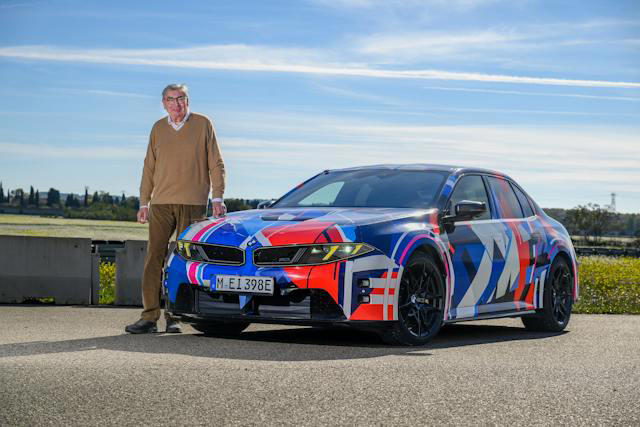
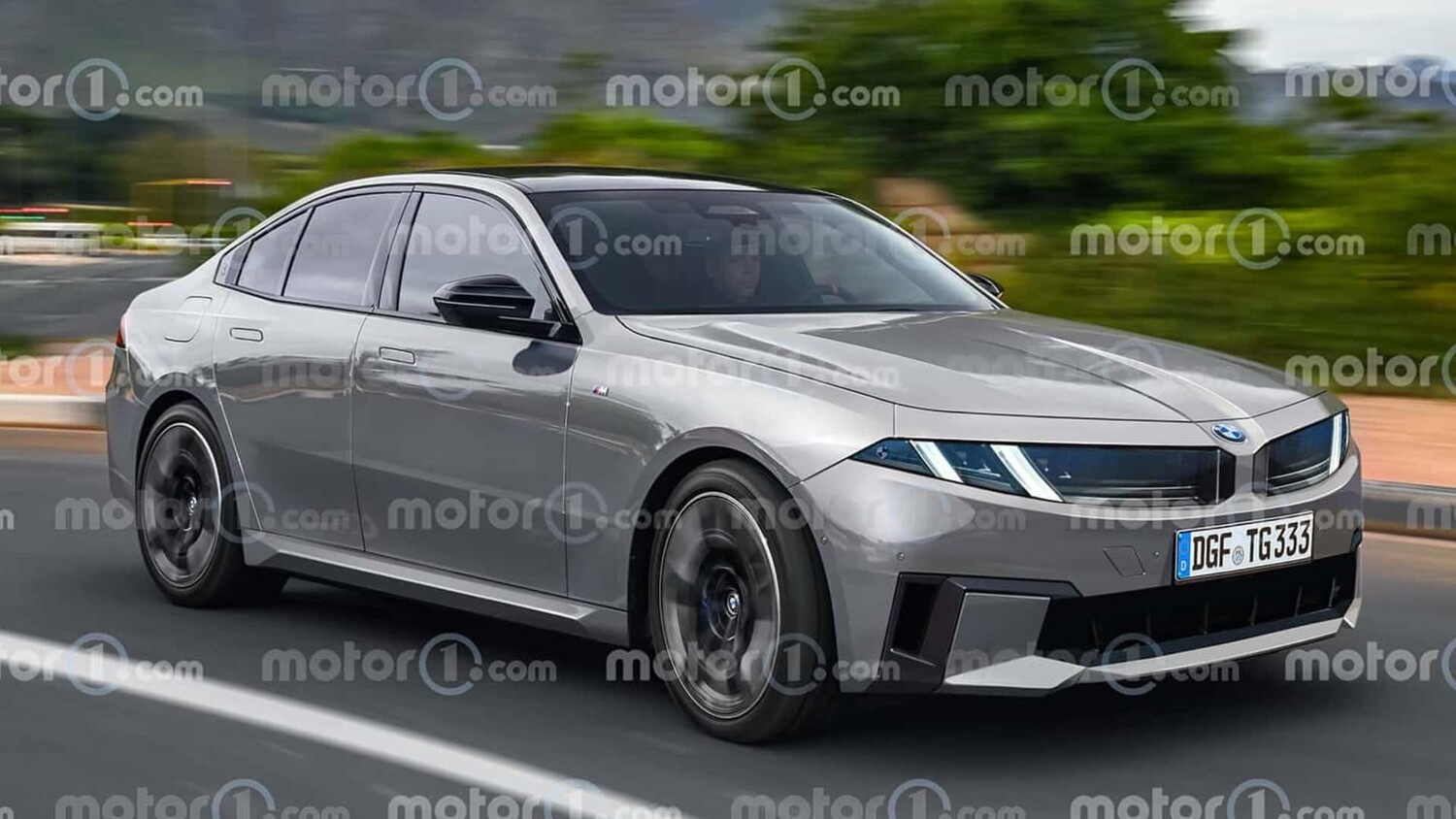
“Hold on tight!” Klaus Huber, Head of Integration for Vehicle Dynamics, floors the throttle with his left foot still on the brake. Then he pulls both shift paddles, glances across to the passenger seat, smiles and—bingo! He lets off the brake and next thing I know we are brutally jolted forward. The first-ever electric M3 launches itself out of the pit lane exit over a crest onto a fast left-hander. Although some data are still to be confirmed, this M3 can allegedly storm from 0-60 mph in 2.5 seconds. The acceleration is very real, but the sounds accompanying it are not. The take-off drama comes with a choice of three different computer-synthesized soundtracks. “Mid” is M-speak for high-mech intense, “Max” fills the cabin with basses and booms until the door sills crack, “Off” plays a surprisingly emotional a capella tune accompanied by some electronic background chatter. But there is no time to lean back, listen, and relax; the man at the wheel continues to play pinball with my guts. “The new M3 is a totally different animal,“ says Huber. “It can unleash a maximum torque 1200 Nm (885 lb-ft) and regenerate energy with up to 540 kW (724 hp). In other words, this is the most potent production car BMW has ever made.” The first M model based on the 3 Series’ fresh Neue Klasse platform has Ultimate Driving Machine written all over its swirly red, blue, and white widebody prototype livery. It is living proof that the BMW M division can not only execute its iconic go-faster combustion-engined and plug-in-powered spin-offs (like in the M5) but also a battery-fed compact super-sedan. According to the grapevine in Garching, home of BMW M, the electric rocket ship will cost about as much as the M3 Competition xDrive when it arrives in dealer showrooms next spring. More importantly, it promises to transfer all the driving pleasure and excitement the coveted six-cylinder crackerjack is known for to a brand-new zero-emission component set. Its head start over any competition is that it will be the only EV to boast four electric motors and a single electronic control unit masterminding the powertrain and the driving dynamics. Aptly named Heart of Joy, the black box expertly orchestrates the car’s handling, ride, and performance. The M3 is much more than an i3 on steroids. It packs two gearboxes and two motors per axle, which produce a combined 643 hp/398 lb-ft up front and 750hp/737 lb-ft in the rear. Also new are separate water and oil cooling systems as well as the three-level inverter. The 100-kWh underfloor battery pack can be charged with up to 420 kW for a maximum WLTP range of 406 miles. The provisional EPA rating is a more realistic 300 miles. In real life, however, a hard-charging M3 is unlikely to cover more than 225 miles in dry warm weather and about 175 miles in winter. That alone might be a dealbreaker for many buyers, particularly in the United States. Hook it up for ten minutes and the battery (developed and made in-house) will restore energy for up to 215 more miles. For weight, packaging, and thermodynamic reasons, BMW chose M-specific round cells over the previously used prismatic pouches. The front axle can be decoupled for improved range and efficiency, although the handling is already defined by a clear rear-drive bias. An even sharper-edged 2WD-only model is apparently in the works, and it may be badged GT, CS, or CSL. Specs: 2028 BMW M3 Prototype Price: $90,000 (est.) Powertrain: Quad electric motors, 100-kWh battery pack, direct-drive transmission Output: 850 total system hp; 885 lb-ft Layout: Four-door, five-passenger, all-wheel-drive sedan Weight: 5180 lbs (approx.) 0-60 mph: 2.5 sec EPA Fuel Economy: TBD (est. 300 miles) Competitors: Porsche Taycan, Tesla Model 3 Performance Like the Porsche Taycan and the Mercedes-AMG EVs, the M3 is fitted with an e-shift device dubbed Stages. It lets you choose from six virtual gear ratios and three different shift speeds named Moderate, Dynamic, and Extreme. Complicated? It is, because except for a few buttons on the steering wheel, the underlying dynamic characteristics must be personalized via the busy touchscreen. Mercedes’ AMG Race Engineer, which can be accessed directly by three large knobs on the center console, is a more practical solution that offers an even broader choice of functions and calibrations. The eSounds package composed for the M3 varies from near mute to high-mech intense to blaringly loud. The Heart of Joy ECU can also call up acoustic tricks, such as fake throttle-blip “downshifts” and machine-gun-like rattles on throttle mimicking the virtual limiter. None of this is real, but the software ticks certain subconscious boxes. My turn at the helm now. The Circuit de Provence proving ground is still damp in places, but Kelvin van der Linde—driver of the 590-hp M4 GT3 pace car—doesn’t hold back. Although the gutted lightweight special has a clear advantage through tighter corners, the M3 is all over its rear wing on the faster sections where the 368 lb-ft torque bonus and the 260 extra horses make all the difference. As recommended, we drive the first five laps in Sport mode. The preprogrammed setup summoned by tapping the red M1 button on the steering wheel locks eDrive in Auto S, which changes virtual gears automatically. While downshifts support the brake action, “upshifts” are paired with mild kicks in the butt. Want more excitement? Then dial in Manual S, which puts the system in paddle shift mode complete with shift lights, a graphic rev counter, and eventually a limiter. Throttle response, shift strategy, and sound can be adjusted by locking the drivetrain in Comfort, Sport, or Sport Plus. The same parameters allow you to tweak the suspension. With each wheel masterminded by its own motor-transmission unit, the chassis pushes the grip and traction envelope to a new level. At the limit of adhesion, it torque-vectors the perfect line with ultra-cool sharpness and surreal balance. Klaus Huber is obviously happy with what he has seen so far. “I think you’re ready for the M2 button. This is where the real fun begins. From now on, Kelvin in the pace car will have to work even harder for his money.” Composed by the pros, this performance mode increases the energy recovery from Mid to Max, holds the drivetrain and the chassis in Sport Plus, and selects M Dynamic Mode for reduced stability at the breakaway point. Power, torque, and acceleration are unchanged, but I can brake even later now and carry even more momentum past the apex onto the curbs and out to the following straight. Nailing the throttle in M2 has a wild inner explosion effect that is like a fusion of instant overboost, afterburner, and nitrous injection. Downsides? The M buttons are now split and must serve two different tasks. M1 also unlocks the ADAS menu; M2 also opens the M Set-up list—bad news for fat, shaky fingers. Ten laps later it’s back to the pits, where staff check tire pressures and brake temperatures. The carbon-ceramic disc reads a tad over 110 degrees C, which is nothing compared to the 400 C the thermometer would have typically recorded for a combustion-engine M3. “That’s one of the secrets of this car,” states the senior project engineer Philipp Brunn. “Even a sporty driver can regain up to half of the energy spent. On a racetrack like this, the recovered energy effectively powers one in three laps. Even in extreme conditions, degradation and repeatability are not an issue.” Although the 20-inch Michelins looked ragged and worn at the end of the morning session, the combined deceleration and energy regeneration process works wonders for the brake and tire temperatures. As a result, cornering grip is up, and understeer is down, so you can turn in later and plot a straighter, faster exit line. Unlike some rivals, the BMW does without a drift mode activator and multi-stage traction control device, but select DSC Off and the M3 will happily don its slidemeister costume. Track mode has some new features, delivering repeatable power output and the ability to maintain full peak performance depending on the ask. “Hot Lap” is good for a two-minute blast, “Short Run” delivers the goods for eight minutes, “Long Run” maintains constant power and torque for 15 minutes. To access Track, the state of charge must be 80 percent or more. The steering effort and the brakes can be set in Comfort or Sport. I am ordinarily never a fan of different calibrations for critical man-machine interfaces like driving, but here Sport does (for a change) indeed blend a more prompt response along with a shorter pedal travel for what feels like even more instant stopping power. That change encourages you to drop the anchors fractionally later. Sure, these are only nuances, but at the end of the day they help build a degree of confidence and involvement which has been absent so far in almost all high-performance EVs. As mentioned, the new electric 3 Series and iX3 are the first BMWs to feature an integrated powertrain and driving dynamics control unit. The scalable plug-and-play system was designed for fast updates, and it can accommodate different drivetrain topologies and performance levels. After all, there is a lot more to come from the M division’s Neue Klasse witch kitchen. Rumors are that iX3 M/iX4 M will arrive in late 2027, to be followed early next decade by an all-electric M5. The 2028 M4 coupe and convertible will also jump on the high-voltage bandwagon, sources say. While previous M cars went heavy on carbon fiber, the future lightweight materials of choice are sustainable composites made from natural fibers, which reduce the CO2 footprint by about 40 percent. The new multi-contour bucket seats are, for instance, 16.5 pounds lighter than the previous design. The composite roof shown here will be standard on many M models. No, we did not yet drive the new, all-electric M3 on public roads. That’s why we can’t tell you much about ride comfort, high-speed directional stability, noise level on the autobahn, real-life energy economy, maneuverability in town, or the feel-good factor on longer trips. But the stiffer chassis and the beefed-up body should, in combination with the upgraded suspension kinematics and the lower center of gravity, result in nicely balanced driving dynamics even on bumpy back roads and broken-up freeways. On the track, the 850-hp BMW will soon throw down the gauntlet at the upcoming Mercedes AMG C63, tentatively rated at 952 hp. For now, the Bimmer is not only the interim speed master EV sport sedan but also a sweet-handling and commendably holistic piece of kit. Did we spend our time behind the wheel pondering the 530-odd-hp combustion-engined M3 sister model? No, we did not. 2028 BMW M3 Prototype Highs: Outstanding performance for size and price. A truly involving drive with awesome brakes, massive regen power, and virtual gearshifts that are surprisingly close to the real thing. Should cost no more than your dad´s M3 xDrive Competition. Lows: Complicated user-interface ergonomics. Loud and monosyllabic synthetic soundtrack. Short-nose silhouette looks less butch than the lesser M350. Real-world range still doesn’t compare to ICE. Takeaway: If this is the future of EVs, the M3 will retain its legendary status for a long while. Looking to purchase a car? Find your match on the MSN Autos Marketplace

 Liked by Mason Green, Madeleine White













 Liked by Mason Green, Madeleine White


