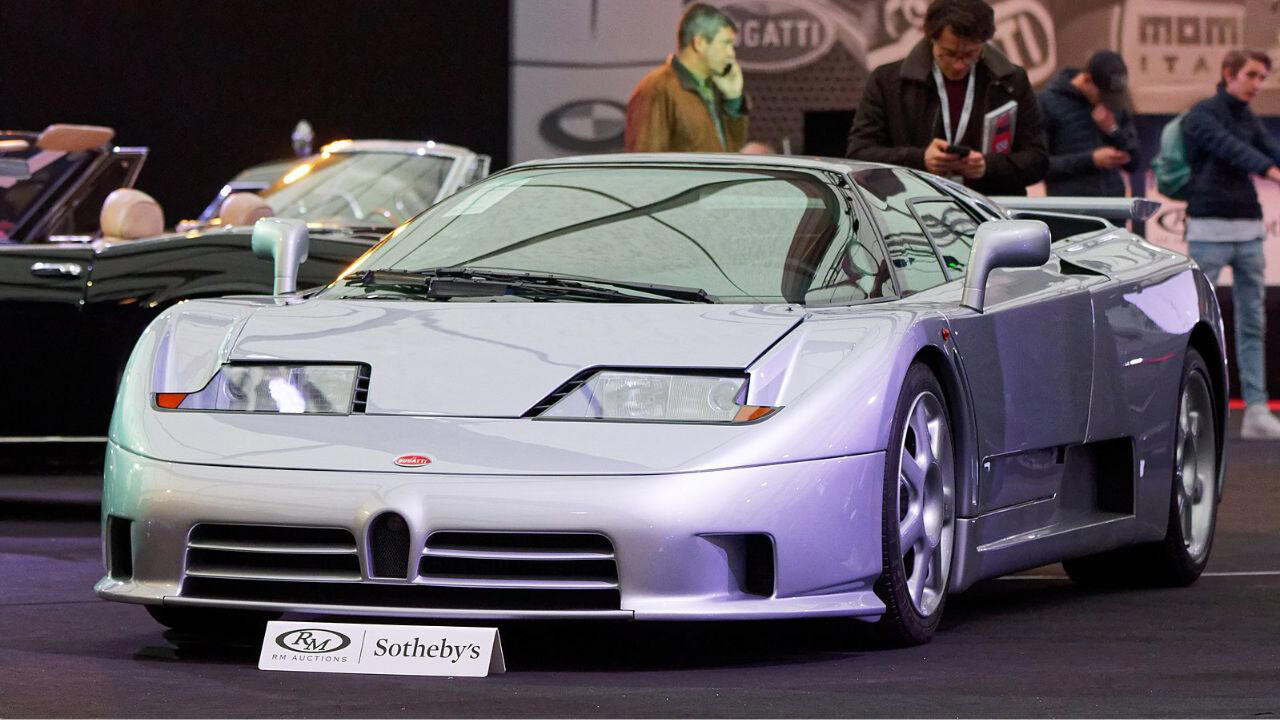
The Alfa Romeo RZ rolled out in 1992 looking like nothing else on the road, all hard angles, a stubby tail and a nose that seemed carved from a single block. It was also a two-seat roadster built in a small batch, and it shared that bold attitude with a whole generation of cars. Between the late 1980s and the early 2000s, carmakers kept reaching for tomorrow with two seats and a clean sheet of paper. First, some of those cars chased speed with turbochargers, carbon fiber and all-wheel drive. Others chased efficiency, with electric motors, aluminum bodies and shapes that sliced through the air. Not all of them sold well, and a few never came close to the numbers their makers hoped for. Yet each one gave drivers a glimpse of what was coming next. These are our picks for 11 two-seaters that looked like the future when they arrived, and in several cases they turned out to be right. 1. 1992–1994 Alfa Romeo RZ The RZ was the open-top version of the SZ coupe, which Alfa Romeo built from 1989 to 1991. Robert Opron of Fiat’s Centro Stile made the first sketches, and Antonio Castellana finished the styling and interior. Zagato, however, only assembled the cars, at its works in Terrazzano di Rho near Alfa’s Arese factory. Underneath, the RZ borrowed its chassis and powertrain from the Alfa 75. As a result, the Alfa Romeo RZ got the 3.0-liter Busso V6, rated at 207 hp, behind its angular nose. Two outside suppliers, Carplast and Stratime Cappelo Systems, made its composite body panels. Production ended in December 1994, and fewer than 300 RZs left the line. In our view, the Alfa Romeo RZ is the boldest shape on this list, and it looks just as strange and wonderful parked next to a modern car today. 2. 2000 Honda Insight Honda beat Toyota to American showrooms with a hybrid that looked ready for a science fair. The first Insight went on sale in North America in December 1999, about seven months ahead of the Prius. It was a three-door, two-seat liftback, built on a lightweight aluminum monocoque. For power, it used a 1.0-liter three-cylinder rated at 67 hp, helped by a 10 kW electric motor. Honda called that system Integrated Motor Assist. Meanwhile, the teardrop body posted a drag coefficient of 0.25. The payoff showed up at the pump. Under the EPA’s revised 2008 method, a 2000 Insight with the manual gearbox rates 53 mpg combined. That is a figure plenty of new cars can’t touch. Our take: the Insight looked odd in 2000, but its gas-electric idea became a template that many cars followed. 3. 1997 GM EV1 General Motors put an electric two-seater on the road long before electric cars were common. The first-generation EV1 arrived for the 1997 model year, and GM built 660 of them. Every one of those cars was leased, and the lease explicitly barred buyers from purchasing it. Even so, the shape was the real headline. Its drag coefficient of just 0.19 is a remarkably slippery figure for a road car. The first cars ran on a 16.5 kWh lead-acid pack, while a later second generation offered nickel-metal hydride batteries. In the end, GM built 1,117 EV1s across both generations, then reclaimed and crushed most of them. About forty went to museums with their powertrains disabled. We told the full story of how the GM EV1 predicted the electric future decades too early. In our view, no car on this list was more right about what was coming. 4. 1990 Panther Solo 2 Britain’s Panther tried to build a mid-engined, all-wheel-drive sports car on a small company’s budget. The Solo 2 made its debut at the 1987 Frankfurt Motor Show. It used the 2.0-liter turbocharged four-cylinder from the Sierra RS Cosworth, rated at 200 bhp, with Panther’s own transfer box sending power to all four wheels. In fact, the construction was pure aerospace thinking. A steel spaceframe carried an aluminum honeycomb core sandwiched in fiberglass, and Kevlar and carbon bodywork was bonded on with aerospace-grade adhesive. Ken Greenley of London’s Royal College of Art penned the shape. Sadly, the ambition outran the factory. According to Hagerty UK, the price climbed from an announced £28,000 to almost £40,000 by 1989. Of 125 people who put down deposits, only 13 received cars before production stopped in early 1991. Our take: it was a brilliant idea at the wrong time, and with so few delivered, you are unlikely ever to see one. 5. Third-generation Mazda RX-7 (FD) Mazda launched the third-generation RX-7 in October 1991, and it made most rivals look boxy overnight. Its flowing design came from Mazda’s Irvine studio in California, drawn by Wu-Huang Chin with help from Tom Matano. There was barely a straight line on it. Better still, the engine was just as forward-looking. Its 13B-REW twin-rotor used sequential twin turbochargers, and it was the first mass-produced sequential twin-turbo system exported from Japan. North American cars made 255 PS, or 252 hp. Even so, Mazda stopped selling the FD in North America after 1995, while Japanese production carried on until 2002. Japan sent it off with the 2002 Spirit R, limited to 1,504 cars. We dug into how the Mazda RX-7 FD made lightweight feel lethal in an earlier piece. In our view, it remains one of the best-looking Japanese cars ever made, and its shape has aged better than almost anything from 1991. 6. Venturi 260 France rarely builds supercars, which makes the Venturi 260 a genuine oddity. The company came from two car designers, Gérard Godfroy and Claude Poiraud, who had worked together at the coachbuilder Heuliez. Fittingly, its mid-mounted turbocharged V6, enlarged to 2,849 cc from Renault’s turbo V6, made 260 bhp, according to PistonHeads’ history of the brand. It replaced the earlier 2.80 SPC, and its low, wedge-shaped body used glassfiber panels. Venturi went racing at Le Mans in 1993 and sold a limited 260 LM edition to mark the occasion. By 2000, though, the company had built no more than 700 cars in total. Our take: a Venturi 260 is a rarer sight than a Ferrari of the same era, and its sharp nose looks every bit as modern. 7. First-generation Smart City-Coupé Not every futuristic two-seater chased speed. The Smart City-Coupé made its debut at the 1998 Paris Motor Show, and it was about 2.5 meters long. That is short enough to make most parking spaces look roomy. The car came from a joint venture between Mercedes-Benz and the watchmaker Swatch, which is where the Smart name came from: Swatch, Mercedes and ART. A steel Tridion safety cell wrapped the cabin, and a 599 cc turbocharged three-cylinder sat at the back, driving the rear wheels. Daimler built it at its Smartville plant in Hambach, France. Smart marketed the car as the City-Coupé until 2002, when a facelift brought the fortwo name. Our take: the tiny two-seater looked like a toy in 1998, but its idea of a city car built around a safety cell has aged remarkably well. 8. BMW Z8 (E52) BMW previewed the Z8 with the Z07 concept at the Tokyo Motor Show in October 1997. The production car kept the concept’s long hood and retro roadster look. Underneath, though, it hid some serious engineering. For example, the body and chassis were all aluminum, built around a MIG-welded space frame. Henrik Fisker designed the exterior, and the Z8 used neon tubes for its taillights and turn signals because they lit up faster than bulbs. Power came from the 4.9-liter S62 V8, rated at 395 hp. BMW built 5,703 Z8s, and the car cost $128,000 new. Moviegoers met it in the 1999 James Bond film The World Is Not Enough, in which a helicopter saws it in half. In our view, the Z8 proves a car can look back and forward at the same time. 9. 1994 Bugatti EB110 GT Romano Artioli bought the Bugatti name in 1987 and set out to revive the brand with an all-new supercar. His company opened a new factory in Campogalliano, near Modena, on Sept. 15, 1990. Exactly a year later, the EB110 made its debut in Paris. After that, the specification read like a wish list. A 3.5-liter V12 with four turbochargers sat in the middle, and permanent all-wheel drive split the power. The carbon monocoque weighed just 125 kg, and the French aerospace firm Aerospatiale built it. According to Bugatti’s own heritage release, the car reached 351 km/h. Only 96 EB110 GTs left the factory by 1995, out of about 128 cars in total. Our take: the EB110 GT introduced the formula of carbon, turbos and all-wheel drive that later supercars made famous. 10. 1992–1994 Jaguar XJ220 Jaguar first showed the XJ220 at the 1988 British International Motor Show as a V12 concept with all-wheel drive. The production car changed course. It used a 3.5-liter twin-turbocharged V6 and drove only the rear wheels, but it made a hefty 542 hp. Meanwhile, its long, low shape looked like a jet fighter with the wings removed. More importantly, the speed matched the looks: the XJ220 hit 212.3 mph in testing in 1991. First deliveries came in June 1992, and the last car left the line in April 1994. The price was as dramatic as the body. The car listed at £290,000 before tax in 1990, and retail reached £470,000 by 1992. We covered the full saga in XJ220: Jaguar’s forgotten supercar. In our view, the XJ220 still looks fast standing still. 11. 1998 Lotus Elise S1 Lotus took a different road to the future, and it started with the chassis. The Elise used bonded, extruded aluminum, a technique Hagerty UK compares to the way aluminum double-glazed windows are made. The car made its debut at the Frankfurt Show in 1995. As a result, that chassis helped the S1 weigh just 725 kg. A 1,796 cc Rover K-series four-cylinder made 118 bhp, so the Elise never needed big power to feel quick. It even had a Bugatti connection: Romano Artioli, then the Lotus chairman, named it after his granddaughter Elisa. The price was the other surprise. It cost £18,950 in 1996, and Lotus sold more than 10,000 S1 Elises from 1996 to 2000, according to Hagerty UK.

 Liked by Emma Gagnon, Ava Tremblay














 Liked by Emma Gagnon, Ava Tremblay