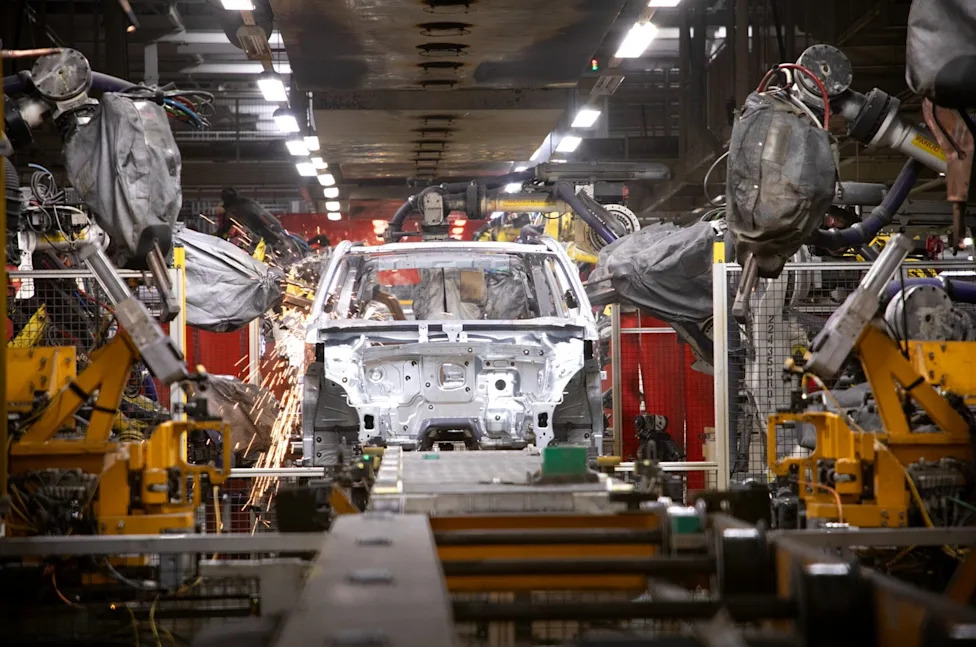
In June, Germany’s Manager Magazin reported that Volkswagen Group CEO Oliver Blume had a plan to close four factories in Germany and eliminate 100,000 workers, both in Germany and around the world, by 2030. It said the plan would be made public at a company board meeting on July 9. The Volkswagen factories affected were said to be those in Hanover, Zwickau, and Emden, as well as the Audi factory in Neckarsulm. July 9 came and went, and it now appears that plan did not get the approval from the board of directors that Blume expected, which is no surprise since a majority of the 19 member board is composed of those who represent the interests of workers or the state of Lower Saxony. The vote was 12 against and only 7 in favor of Blume’s vision. What happens now is anyone’s guess. Volkswagen is producing more cars than it can sell, a situation that cannot go on indefinitely. It has seen its annual sales fall from around 12 million vehicles to just 9 million. That is still a lot of cars and trucks, but the profit margins on them have fallen as well, putting the squeeze on investors. Deliveries Are Down Vehicle deliveries in the second quarter of this year dropped 8.6 percent to 2.07 million, the sharpest quarterly decline in four years, bringing first-half global deliveries to 4.12 million, which was down 6.3 percent compared to the first half of 2025. According to Yahoo! Finance, the company’s profit margins are now only half of what they were five years ago, mostly as a result of a weaker sales in China, the costs of converting to electrification, and higher tariffs imposed by the US. IG Metall, Germany’s biggest industrial union, which represents most of the assembly line workers employed by Volkswagen Group, organized demonstrations by workers at Volkswagen factories all across the country, calling on management to put forward a strategy that protects production. That’s to be expected, but if customers are not buying your products, that’s a problem. The company’s existing labor agreements ban strikes, but IG Metall and other unions have warned they could intensify industrial action should management attempt to undermine job security commitments. According to sources familiar with the discussions, the state of Lower Saxony sought to negotiate a compromise during the supervisory board’s talks. Volkswagen’s primary factory is located in Wolfsburg, a city in Lower Saxony, and that state is a major stockholder in the company, with representation on the board of directors. One source said Lower Saxony had considered submitting its own proposal, but ultimately abandoned the plan without giving further detail. Reducing Overhead According to The Guardian, Blume told the board the company “must continue on this path” of reducing overhead by 20 percent at its factories, including cutting half of its model lineup — especially the variants of different brands. The company is also exploring alternative options for factories to secure jobs. He said it was still in advanced discussions about the transformation of its factory in Osnabrück from automotive to defense production. Over the weekend, it was reported that Volkswagen had planned to make vehicles for Rafael, an Israeli defense contractor, to protect jobs at Osnabrück. That plan was blocked by the Qatar sovereign wealth fund, which has a 10 percent stake in Volkswagen AG. Christiane Benner, the chair of IG Metall, said the proposals were unacceptable, particularly since the union had already made concessions. “Instead of taking this achievement as a model, the board is confronting employees with new downsizing plans. Understandably, the resulting anger and uncertainty are immense. We need new ideas and concepts for utilizing plant capacity, sensible considerations from the company,” she said. Up until the board meeting last week, the plan on the table was to shutter four Volkswagen factories in Germany. In his most detailed explanation of the management blueprint for the future, Blume told his staff that “despite some decidedly controversial decisions” on the table, he had perceived “broad support on the supervisory board” of his analysis of the group’s future and the need for action. Worker Protests Last Thursday, the board spent hours hearing Blume’s proposals while workers staged protests at several Volkswagen, Audi, and Porsche locations across Germany. Asked about staff concerns about jobs, Blume — who positions himself as a Volkswagen insider, having started in the paint shop at Porsche at age 28 — said he was “doing everything in his power” to keep the company competitive enough to survive and promised to enter into “constructive discussions” with the staff and the production workers. But where once he was seen as a trustworthy “company man,” trust in his leadership has eroded significantly. On July 11, 2026, the works council distributed a special edition of its newspaper to the workforce, saying that Blume would have to answer to staff at meetings during the summer break. This is a huge fall from grace for Blume, wrote Autoblog editor Earl Lee. When he was appointed CEO, after Herbert Diess — who came from BMW! — was fired moved aside, he was initially viewed as being “for the people” by the members of the work council. They no longer see him as a friend to labor. Fewer Workers But Slower Cuts Before the July 9 meeting, he said the company would shed 100,000 workers over the next 5 to 6 years. After the meeting, that number was trimmed to 50,000 — an initiative he claims is already taking place in a “socially responsible manner” involving some voluntary redundancy packages and partial retirement arrangements. The company has already cut 37,000 jobs from the workforce this way, but a second phase of cuts aimed at reducing overhead even more was now necessary, he added. “Since half of our overhead costs result from personnel costs, a theoretical calculation — assuming no change in labor costs — would result in the elimination of approximately 50,000 positions worldwide,” Blume said. He confirmed there was still a question mark over those four factories mentioned above — Volkswagen plants in Emden, Hanover, and Zwickau and the Audi factory in Neckarsulm. That last location is scheduled to keep building cars until at least 2031 and possibly as late as 2034. But whether it would continue operating once production of current models ends is an open question. Blume said “smart solutions are always better than closing a plant” but that “Germany cannot turn a blind eye” after the car market was flooded with cars that are not needed, both from China and Europe. What’s Next? So what will happen at Volkswagen? Your guess is as good as ours. The company seems to have no real answer to its sharp decline in sales in China, which means that gravy train has come to an end. Sales of new cars all across Europe — especially combustion-powered cars — are down significantly. Where Volkswagen manufactured 12 million cars a few years ago, last year it manufactured 9 million. Something’s got to give, and a reduction in the number of workers is the obvious solution, as painful as that may be to all concerned. For the moment, slow attrition of the workforce seems the only strategy that is minimally palatable to all concerned. So in the absence of any more grand plans from Oliver Blume, that is probably what will happen. Students of capitalism may actually cheer the travails of Volkswagen as proof that the system is working as intended. Creative destruction is a necessary part of the capitalist manifesto. But that ignores the financial and psychic pain visited on those who lent their backs and their brawn to making Volkswagen one of the most successful car companies in history. Stay tuned. The end of this story has yet to be written.




















 +38 others




![Volkswagen, Volkswagen ID.4, Volkswagen ID.5, Volkswagen's best-seller is going electric in 2027 to replace the ID.4 and ID.5 [Images]](https://cdn.topcarnews.net/thumb/id/aHR0cHM6Ly9pMC53cC5jb20vZWxlY3Ry-ZWsuY28vd3AtY29udGVudC91cGxvYWRz-L3NpdGVzLzMvMjAyNi8wOS9Wb2xrc3dh-Z2VuLUlELVRpZ3Vhbi1JRC00LmpwZWc_-dz0xNTAwJmFtcDtxdWFsaXR5PTgyJmFt-cDtzdHJpcD1hbGwmYW1wO3NzbD0x/aed2aa2870791850c8e69c5fc3a0ed85.jpeg?t=20261006&post_id=66267)
![Volkswagen, Volkswagen ID.4, Volkswagen ID.5, Volkswagen's best-seller is going electric in 2027 to replace the ID.4 and ID.5 [Images]](https://cdn.topcarnews.net/thumb/id/aHR0cHM6Ly9lbGVjdHJlay5jby93cC1j-b250ZW50L3VwbG9hZHMvc2l0ZXMvMy8y-MDI2LzA5L1ZvbGtzd2FnZW4tSUQtVGln-dWFuLUlELTQtZnJvbnQtcXVhcnRlci5q-cGc_c3RyaXA9aW5mbyZhbXA7dz0xMDI0/97fb00cd3919b8d0dc36440715039e6e.jpg?t=20261006&post_id=66267)
![Volkswagen, Volkswagen ID.4, Volkswagen ID.5, Volkswagen's best-seller is going electric in 2027 to replace the ID.4 and ID.5 [Images]](https://cdn.topcarnews.net/thumb/id/aHR0cHM6Ly9lbGVjdHJlay5jby93cC1j-b250ZW50L3VwbG9hZHMvc2l0ZXMvMy8y-MDI2LzA5L1ZvbGtzd2FnZW4tSUQtVGln-dWFuLUlELTQtc2lkZS5qcGc_c3RyaXA9-aW5mbyZhbXA7dz0xMDI0/ed240b20e8275f3af4b904f46ebb5fb3.jpg?t=20261006&post_id=66267)
![Volkswagen, Volkswagen ID.4, Volkswagen ID.5, Volkswagen's best-seller is going electric in 2027 to replace the ID.4 and ID.5 [Images]](https://cdn.topcarnews.net/thumb/id/aHR0cHM6Ly9lbGVjdHJlay5jby93cC1j-b250ZW50L3VwbG9hZHMvc2l0ZXMvMy8y-MDI2LzA5L1ZvbGtzd2FnZW4tSUQtVGln-dWFuLUlELTQtcmVhci1xdWFydGVyLmpw-Zz9zdHJpcD1pbmZvJmFtcDt3PTEwMjQ/436c7979cf5b947053f7f0bf39ff94bc.jpg?t=20261006&post_id=66267)
![Volkswagen, Volkswagen ID.4, Volkswagen ID.5, Volkswagen's best-seller is going electric in 2027 to replace the ID.4 and ID.5 [Images]](https://cdn.topcarnews.net/thumb/id/aHR0cHM6Ly9lbGVjdHJlay5jby93cC1j-b250ZW50L3VwbG9hZHMvc2l0ZXMvMy8y-MDI2LzA5L1ZvbGtzd2FnZW4tSUQtVGln-dWFuLUlELTQtZnJvbnQuanBnP3N0cmlw-PWluZm8mYW1wO3c9MTAyNA/ec2e4ca027ccbfb42942abe523f3acf7.jpg?t=20261006&post_id=66267)
![Volkswagen, Volkswagen ID.4, Volkswagen ID.5, Volkswagen's best-seller is going electric in 2027 to replace the ID.4 and ID.5 [Images]](https://cdn.topcarnews.net/thumb/id/aHR0cHM6Ly9lbGVjdHJlay5jby93cC1j-b250ZW50L3VwbG9hZHMvc2l0ZXMvMy8y-MDI2LzA5L1ZvbGtzd2FnZW4tSUQtVGln-dWFuLUlELTQtcmVhci5qcGc_c3RyaXA9-aW5mbyZhbXA7dz0xMDI0/668525889dc433b0fd0e166fd5bd8366.jpg?t=20261006&post_id=66267)