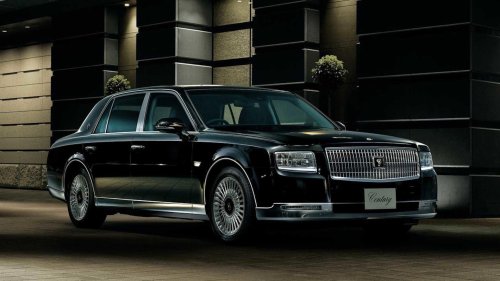
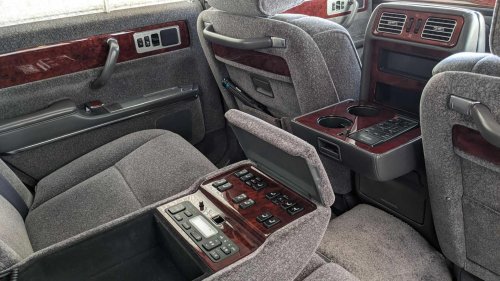
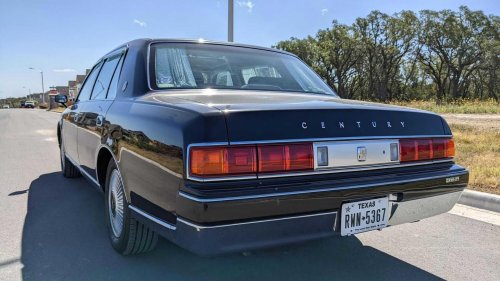
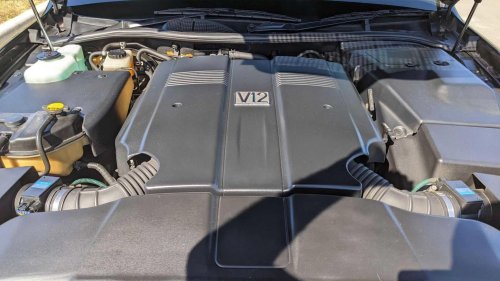
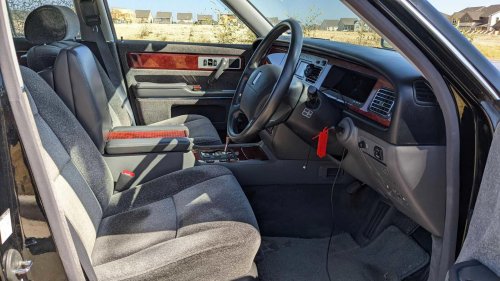
Many unusual and interesting cars have crossed the Pacific because of America’s 25-year import rule, and some of them were luxury vehicles that once lived a storied life in the land of the rising sun. One vehicle in particular is now finding its niche in American enthusiast circles, but is now performing far outside its original comfort zone, for a completely different market. This second-generation Toyota Century, which Toyota built from 1997 to 2017, is a very formal car, and perfect for someone who expects to be driven rather than merely transported.Even though this black-suited, soft-spoken flagship features Toyota’s first V12 passenger-car engine and many other tricks, it’s attainable in the US today for ordinary used-car money. The Black-Suited Toyota That Never Needed To Shout ToyotaThe Toyota Century in question is one of a long line of vehicles in this lineage, tracing back to 1967. The “Century” name marked the 100th anniversary of the Toyota Group founder Sakichi Toyoda's birth, and the model replaced the outgoing Crown Eight. The original car hung around for almost three decades and became something of an institution in its homeland. But when the second-generation G50 came out in April 1997, this was more evolutionary than revolutionary. Toyota clearly wanted to keep the majestic styling that was an integral part of the car's identity, while it radically updated the mechanical package underneath for the modern times.On the outside, the Century’s proportions were very formal and almost ceremonial, measuring 207.5 inches long and 74.4 inches wide, and with a 119.1-inch wheelbase. It earned the nickname "Yakuza limousine," with the kind of intimidating presence you might associate with some kind of silent assassin, but without any unnecessary flash.The Century would become the country's distinguished flagship, and it found its way into the hands of many executives, leaders, and those who wanted to aspire to be them. It was often a chauffeur-driven automobile for important people, and Toyota leaned into the car's reputation for providing status, privacy, smoothness, and rear-seat command. Japan's Flagship Is Built Around The Rear Seat Cars and Bids A typical luxury sedan begins with the driver, but the Century had it the other way around. It emphasized features like rear-seat quietness, rear passenger amenities, and as you entered the rear cabin, you became truly isolated from the outside world. Toyota designers also added separate climate control, rear seat heaters, a seat massager, and adjustable reading lights, with an available Dual Electro Multivision TV package and GPS voice navigation in the rear.Those pampered passengers could also access a CD player and an FM multiplex text broadcasting system if they wanted to. And the rear doors would secure themselves automatically with a satisfying click, so the incoming passenger didn't have to mess around with such trivialities. The interior materials were equally telling, with available leather, jacquard wool fabric, crystal glass for the dashboard clock, and wood paneling that always came from the same piece of timber to preserve the continuity of the grain. On the outside, the car had a phoenix emblem crafted with a hand-carved mold, and its sheet metal received up to seven coats of paint.Mechanically, the Century also lived up to its mission and featured Toyota's renowned 1GZ-FE engine, a 5.0-liter DOHC V12 rated at 276 hp and 354 lb-ft of torque. It had VVT-i, electronic throttle control, and a 10.5:1 compression ratio, with an unusual fail-safe design that allowed the engine to operate on only one bank of cylinders in an emergency. The intake components, electronic throttles, sensors, EFI computers, and fuel pumps were all installed independently on each cylinder bank.When you take all this upmarket packaging into account, it's difficult to see how this Century could make sense as a used-car value proposition. After all, this was Toyota's only V12-era limousine and a truly formal flagship, with a level of rear seat detail that was surely better suited to diplomatic transportation than a normal executive sedan. But today’s US market doesn't care and clearly doesn't want to price the Century as if it were some type of forbidden exotic. Imported Centuries Are Shockingly Cheap Cars and Bids While this Century was impressive inside and beneath, it was still visually conservative from the outside, and that might help explain why the US market is valuing it rather differently than you might expect. It certainly doesn’t have the same type of enthusiast mythology as a Skyline GT-R, NSX, Supra Turbo, or rotary Mazda, and to many, it just looks like an anonymous black sedan.Recent auction data suggests that drivers grade 1997 or 1998 Centuries live in the $10,000 to $16,000 range. There are some examples floating around above $20,000, with one selling on a leading auction site for $39,000 in April 2026, with evidence of other similar outliers. Those numbers appear to be especially striking when you look at what you actually had to pay for a Century when it was new. In 1997, the G50 sold for about ¥9.25 million (which equates to around $59,000 at today's exchange rates). Prices gradually rose until the third-generation Century sedan launched in 2018 at ¥19.6 million ($124,000). A V12 Toyota Still Comes With Real Ownership Caveats Cars and Bids Before rushing out and buying an imported Century, it’s still important to assess the cost of ownership. After all, this is a complex, low-volume Japanese market limousine with a V12, air suspension, and all those trick electronics to account for. Toyota durability can be part of this car’s appeal, but the condition of the target car matters a lot more than the badge.As standard, the Century’s official specifications are impressive, with items like double wishbone suspension with skyhook air suspension at both ends, ventilated disc brakes, rack-and-pinion power steering, and a 95-liter (25 gallon) fuel tank. The original cars had a smooth four-speed automatic, although the later G50s featured a six-speed automatic, even though those versions are not yet eligible for import.Potential buyers should look closely for some identified problems before buying their Century. For example, they should watch for air suspension leaks, corrosion, tired rear seat electronics, inoperative accessories, or aging soft-close door mechanisms. Ideally, they’ll find a vehicle with a good service history, intact rear amenities, a corrosion-free underside, and a functional air suspension system. The Affordable Century May Not Stay A Secret Forever Cars and Bids Today, the G50 Century is old enough to import and unusual enough to intrigue JDM collectors, while also being luxurious enough to tempt some buyers away from predictable German sedans. But it has a very special form of appeal and story that most luxury cars can’t match. After all, this was a former Japanese flagship with a bespoke V12 engine and a rear-passenger-first cabin that had a very clear and prominent position in Japanese car culture.Toyota still sells the Century in Japan, with the third-generation sedan arriving in 2018 and the newer model in 2023, pushing the idea of chauffeur-driven mobility even further. In 2025, Toyota spun Century off as a distinct brand, to even compete with the likes of Rolls-Royce. And that may position the older V12 sedan as an affordable doorway into a nameplate that Toyota now treats as something very special indeed.The Century represents a uniquely Japanese take on ultra-luxury. It’s understated rather than flashy, quiet rather than loud, and engineered to prioritize its rear passengers. When it was new, it was expensive across the board in Japan, but the US market views it quite differently right now and suggests prices are surprisingly low. But as Toyota elevates the Century and gives it an even broader luxury identity, those G50 prices may not stay low forever. And now may be the perfect time to sample what’s surely one of the strangest and most compelling luxury bargains to come out of Japan.