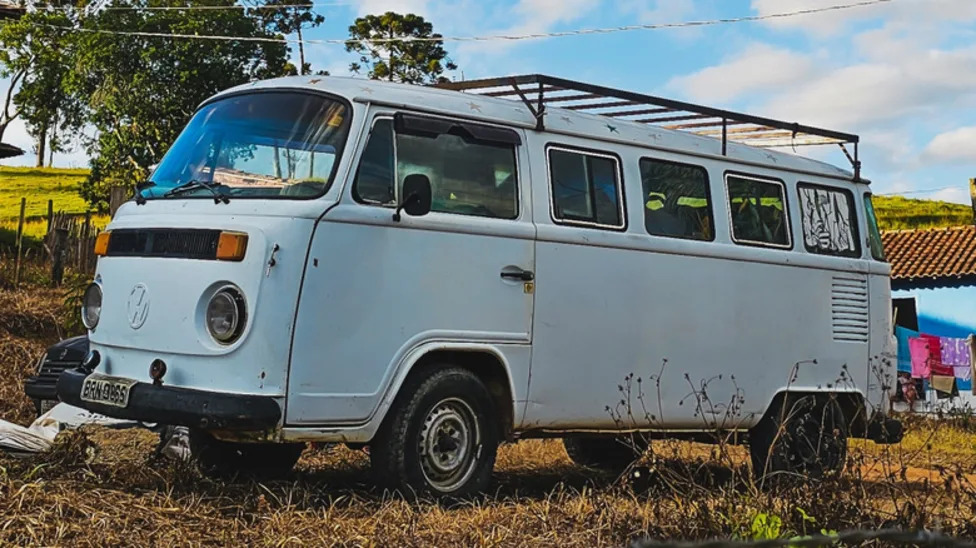
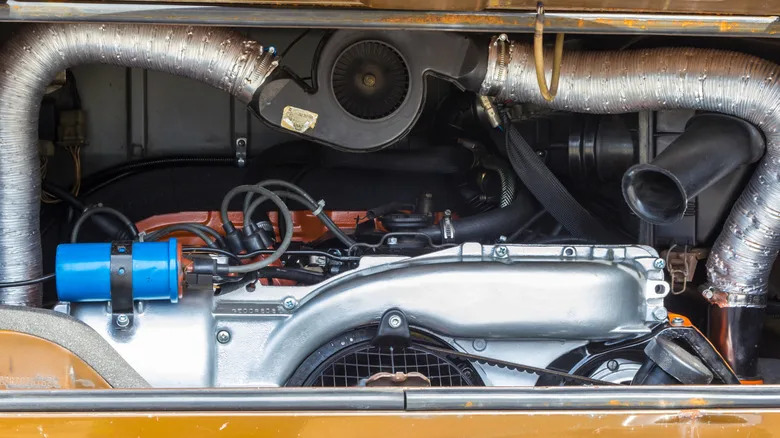
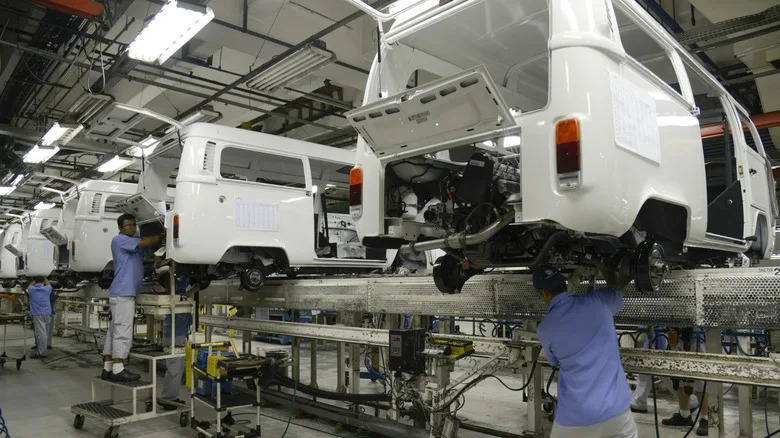



















Paulo Henrique Pigozzi/Shutterstock Volkswagen owes its decades of success to the reliability and versatility of the iconic air-cooled flat-4 engine. From the company's 1930s origins at the behest of the German government, Volkswagen relied on the Type 1 air-cooled engine to power everything from sports cars to family sedans and large forward-control commercial vans. Compared to the big-power turbocharged juggernaut engines of today the humble air-cooled Volkswagen was a puny pipsqueak, typically falling far short of three-digit horsepower numbers, but it was cheap to build, cheap to run, and deservedly developed a dedicated following. The original Type 1 flat-4 engine served well through the end of the 1960s, when Volkswagen developed its Type 4 "Pancake" replacement. While the Type 1 was best known for powering millions of Beetles, Buses, and Karmann Ghias, the larger, more powerful Type 4 would find its way into a wide variety of German, South African, and Brazilian-built Volkswagens and Porsches over the decades, even though I once placed them among the worst engines of all time. These engines weren't only used in cars, either, as many were destined for another life in experimental aircraft, stationary industrial generators, and boats. The Type 4-powered Brazilian-built T2C Kombi van continued delivering low-horsepower air-cooled joy to the world until stricter emissions regulations killed it in 2005, and Volkswagen sold a limited 200-unit run as a way to say auf wiedersehen (or is that a despidida?). That's right, the T2 Volkswagen Van was discontinued for the U.S. and European markets by 1979 (replaced by the T3 Transporter), but some 26 years later it was still in production in its largely original air-cooled van form in South America. In Europe the Transporter had already entered development on its sixth generation by the time Brazil ended production of the T2. The history of the Kombi Andrew Balcombe/Shutterstock The Volkswagen Type 2 was a much-needed update to the Volkswagen van platform, 9 inches longer than the iconic split-window model it replaced. These so-called Bay Window vans began life with a 47-horsepower version of the Beetle's flat-4, upgraded with a 12-volt charging system and new CV-jointed independent rear suspension. These upgrades fixed the unpredictable positive-camber handling of the earlier model's Beetle-based suspension. While the T1 generation gets all the attention for its contributions to hippie culture and the Summer of Love, it was the T2 that became Volkswagen's global workhorse. The first T2 generation was designed with Volkswagen's new pancake engine in mind, but production couldn't meet demand for the first few years, and it finally was introduced for 1972 with a whopping 66 horsepower and considerably more reliable service. By 1974 that engine was punched out to 2 liters and 70 ponies. For most of the world, production of the T2 generation was split between T2a and T2b, with the split happening around 1972 as Volkswagen gradually updated its van. Once the van bowed out of the European and U.S. markets in 1979, however, something interesting happened. The global South adopted the van as its own and production continued unabated in Mexico and Brazil, with a T2c launched in the mid-1990s that introduced a 10mm-taller roof for stacking larger loads and better maneuverability inside. This body style of van was sold largely unchanged from 1967 through 2013. It had dozens of different engines and trim levels throughout the years, but it was always recognizable as an iconic Volkswagen. And it was durable enough for a T2 to survive the 2025 Los Angeles wildfires. Why build in Brazil? Paulo Fridman/Getty Images Volkswagen built its first factory in Brazil, the São Bernardo do Campo facility, in the late 1950s. This plant was employed in building the iconic bread loaf Type 2 van for South America because it was both cheaper than shipping these vans from Europe and because Brazil's high import tariffs all but required locally built vehicles. The van would enjoy uninterrupted production in the factory from 1957 through 2013 — a world record — producing over 1.5 million in those 56 years. It isn't hard to explain its popularity in the Brazilian market. Brazil is the 10th largest economy in the world, but its per-capita gross domestic product remains quite low. The T2 Kombi was popular because, as Top Gear put it as production was winding down, "there's no cheaper way of hauling a tonne of covered cargo." Brazil is a country where sugar-cane-powered cars beat EVs. Why bother innovating when a cheerful van from the 1960s is still plenty to do the job? These vans were so common in South and Central America, and so inexpensive to make, that Volkswagen continued to mildly develop them, fitting an 80-horsepower 1.4-liter watercooled inline-4 engine (cribbed from the Audi A2 and Mk2 Polo) in the rear compartment after discontinuing the air-cooled four in 2005 and building them for another eight years without much change. It's kind of astonishing that a single vehicle could have this kind of longevity. Brazilians loved the van, and kept buying them for decades after the rest of the world had already moved on. Keep it simple.