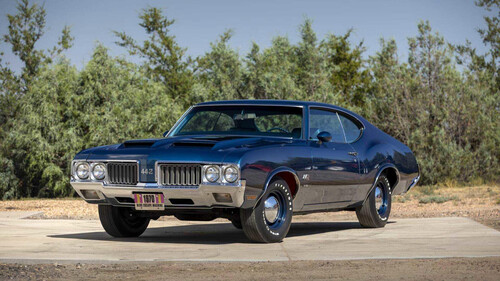
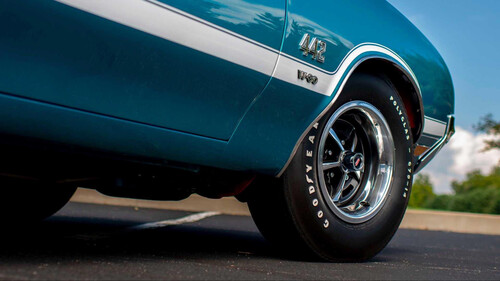
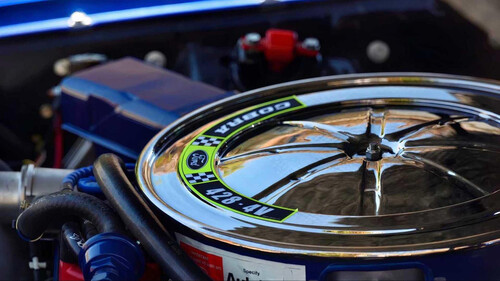
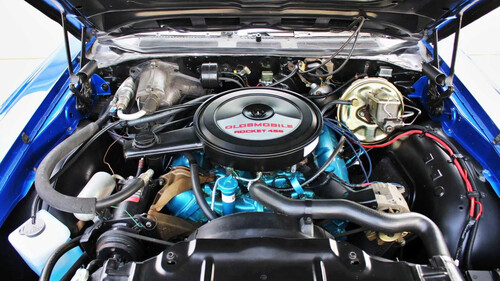
The golden age of muscle cars, often considered the mid-1960s through the very early 1970s, is remembered fondly by those who were around during that time. Even those who came well after the glory days of American muscle hold some of the cars produced during that time in high regard, and for good reason, too. After all, the classic muscle car era was cut quite short by none other than government red tape, as new emissions regulations introduced in 1973 effectively choked the life out of the muscle car boom.During those years, virtually every American automaker was trying to get in on the muscle-bound action. Save for luxury brands like Cadillac or Lincoln, other marques such as Buick, Mercury, and even AMC were deep in the thick of it. Another brand, Oldsmobile, was famous for their muscle car, the 442. However, the 442 didn't get quite as much of the spotlight as, say, models like the Chevrolet Chevelle SS or the Pontiac GTO. Once the 442 was axed in 1987 after being briefly resurrected, Oldsmobile tried to give the 442 namesake one last hurrah. They called it the Quad 442. The Quad 442 Wasn't A Separate Model Hemmings Oldsmobile Quad 442 Key Points Offered as an option on the Oldsmobile Cutlass Calais Given the option code "W40" or "W41" Featured a 2.3-liter inline four-cylinder engine Only offered for two years While the thought of the iconic Oldsmobile 442 conjures up images of the Good Old Days of American muscle, the Oldsmobile Cutlass Calais Quad 442 certainly didn't. However, the American automobile market had moved past the muscle car, as the last bastions of the muscle-bound era petered out in the late 1980s, when models like the 1988 Chevrolet Monte Carlo SS were produced, and even most of those couldn't hold a candle to the pre-1973 muscle cars of yore.HemmingsAs for the Quad 442, it was Oldsmobile's attempt at reigniting some of the excitement surrounding the 442 namesake without having to ask General Motors to cough up enough scratch to finance designing, developing, and producing an entirely new model. The new-age 442 was re-imagined as a sporty two-door, much more European in nature than its predecessors, especially with its 2.3-liter engine, quite a lot smaller than the 455 CID (7.5L) V8 that was featured in the Olds 442s during the 1970s.HemmingsUnfortunately, when Oldsmobile released the Cutlass Calais Quad 442 in 1990, it received a lukewarm reception. Those who knew of the 442 namesake's roots felt it was much too far a stretch to call the little four-banger Calais a 442, no matter how many "442" badges were stuck onto it. In addition, folks who were interested in a sporty, four-cylinder two-door were more interested in other offerings from other automakers, mainly Japanese ones. It Was Almost Mechanically Great... Almost HemmingsAt the heart of the Oldsmobile Cutlass Calais Quad-442 was an engine bearing the same "Quad Four" name. Belonging to the Quad Four family of engines, the mill specifically tasked with powering the Quad 442 was codenamed "LG0", and featured a displacement of 2.3 liters. It also boasted a four-valves-per-cylinder valvetrain, along with a dual-overhead camshaft configuration. The camshafts themselves were high output units, allowing for longer opening intervals in both intake and exhaust valves.HemmingsThe Quad 442 came with a choice between two option packages during its short life. The standard package was coined "W40", and consisted of a 180-horsepower version of the LG0 Quad Four inline-four-cylinder mill. In 1991, Oldsmobile offered the "W41" package, which bumped the Quad 442's power output up by 10 horsepower with an extra bit of camshaft and valvetrain tuning. A five-speed manual transmission made by Getrag was standard for all Quad 442s.We'll take a look at the rest of the Oldsmobile Cutlass Calais Quad 442's detailed engine and performance specs in the table below:While the high-output camshafts helped the LG0 produce more power, they also created a well-known and hated issue with the Quad 442. The camshafts, due to their longer intervals, created a lot of engine vibration, especially at idle. A plan was put forth to install a balancing shaft into the motor to counteract the vibration, but GM execs poo-pooed the idea, citing cost as the deciding factor. Many other powerful four-cylinder motors employed balancing shafts, and still do, to counteract issues with vibration. The reason being, an inline configuration of cylinders produces more vibration than, say, a V6 or V8. Summary And Justification HemmingsIn this article's title, we make the claim that the Oldsmobile Cutlass Calais Quad 442 didn't get the recognition it deserved. While, yes, the Quad 442's engine wasn't the greatest in terms of cabin comfort due to its rather excessive vibration at idle, it's important to look at the entire picture, rather than focus on just that negative. For one thing, the Quad 442's maximum power output of 190 horsepower put it ahead of many other small, sporty, front-wheel-drive coupes of the time.HemmingsAnother aspect of the Quad 442's underrated nature was its sporting nature. Oldsmobile built the Quad 442 in order to meet homologation regulations stemming from the Sports Car Club of America (SCCA). The Quad 442 in its racing form was part of the Showroom Stock class of racing. This meant the Quad 442 was a fun car to drive, at least according to several automotive publications who reported on its driving style at the time of its release.HemmingsOf course, it was also the last time an Oldsmobile came with a "442" badge. While some pieces of General Motors literature referred to the 1992 and 1993 Oldsmobile Achieva SCX as a "442", the model didn't wear the actual 442 badge anywhere on its body, instead just borrowing the same LG0 powertrain for its own use.While flawed, the Oldsmobile Cutlass Calais 442 was a reasonable sendoff for the iconic namesake because, much like its predecessor, it was a semi-underdog in the performance arena. A well-fitting end to a somewhat-unknown American performance icon.Sources: Gm Heritage, Supercars.net, LATimes.com