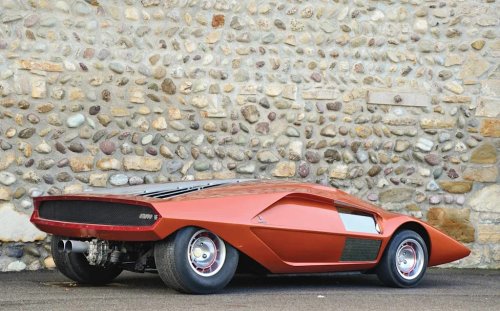
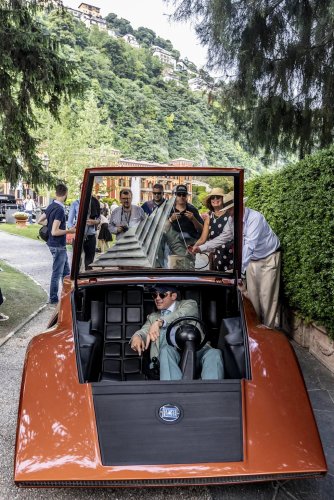
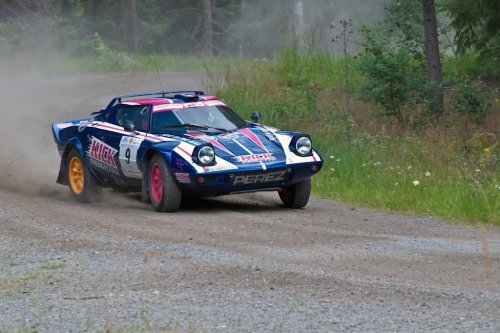
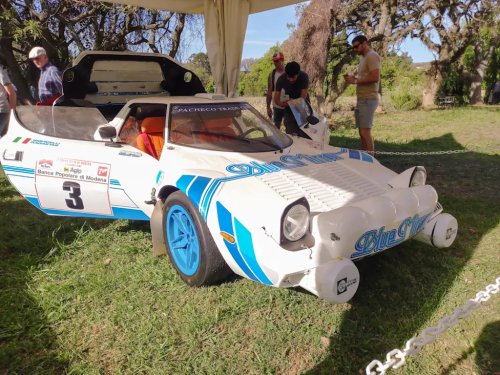
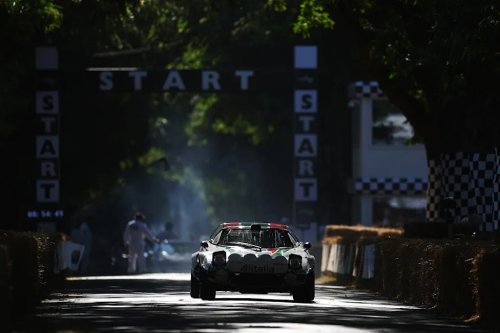


















Autoblog and Yahoo may earn commission from links in this article.Some experimental concept cars look like they belong on the silver screen rather than the road. A part of the wedge era, the Lancia Stratos HF Zero, or simply Stratos Zero, fits the bill. It made its debut at the 1970 Turin Motor Show, but the futuristic model didn't simply drop off the face of the Earth afterwards. From there, the Stratos Zero remained a one-off concept, but it ultimately served as the inspiration for a rally legend. Reimagining the future of performanceWhile design houses were at each other's throats in the 1970s, the true origins of the Stratos Zero lie in the Lancia Fulvia HF falling behind in the international rally scene. As a result, Marcello Gandini took the opportunity to create a rear mid-engine concept that would not only perform, but offer a glimpse into the brand's potential future sports car. Rather than deliver a static concept designed for looks alone, Gandini produced a one-of-one roadworthy vehicle.Matt Jelonek / Getty ImagesThe "Stratos" moniker is a nod to the era's obsession with the space age. Nuccio Bertone, owner of the automotive design house, originally suggested Stratolimite, a loose reference to "limit of the atmosphere," but it was shortened to Stratos. The "Zero" was derived from the project's internal name.AdvertisementAdvertisementSourcing parts may have been the simplest part of the job, as the Stratos Zero was mostly built from existing Lancia components. The chassis was built on-site, but the engine, sub-chassis, and suspension were sourced from a Fulvia HF. The fuel tank sits to the right of the engine, while the triangular powerplant directs air towards the radiator in the rear.On the mechanical side of things, the Stratos Zero utilized the same 113-horsepower mid-mounted 1.6-liter narrow-angle V4 engine as the Lancia Fulvia HF. It came mated to a five-speed manual transmission that sent power to the rear wheels. McPherson struts up front and a double-wishbone suspension with a transverse leaf spring arrangement at the rear filled out the sports car underpinnings.Thinking about selling your car? Get an instant cash offer online now. Click here to get started.Taking wedge to the extremeAt a glance, the Lancia Stratos HF Zero foregoes conventional styling in favor of an aesthetic that makes a statement. Put simply, the concept car takes the wedge era to the extreme. The vehicle stands at just 33 inches tall, and the mechanical components were positioned as low as possible in order to give Gandini more creative freedom in shaping the body.Bloomberg / Getty ImagesThe wedge-shaped concept features an angular design and has practically no ground clearance. The body is made almost entirely of fiberglass, with a row of ultrathin headlights that span the full width of the vehicle. At the rear, the Stratos Zero features a mesh grille, wide tires, and a dual exhaust. Like the front end, which consists of 10 bulbs, the rear is illuminated by 84 smaller bulbs. The sci-fi model lacks conventional doors. Instead, the interior is accessed via the windshield.AdvertisementAdvertisementInside, the Stratos Zero boasts a more aeronautical style. The retractable steering wheel makes it easier to enter the vehicle via the front-windshield door. Front bucket seats and a digital control screen round out the model's unique design.The Stratos Zero concept has changed hands a few times over the past 56 years, and it's currently owned by Philip Sarofim. It was professionally restored at Stile Bertone in 2000. While the car debuted with a copper finish, it was painted silver shortly after. The restoration saw the model returned to its original bronze color. It was later sold via RM Auctions in 2011 for $915,000 and has not returned to public auction since.Shopping for a new car? Click here to get a great deal on your next vehicle. Powered by Carvana, no haggle pricing, 100% online.Inspiring a rally legendThe road to the Lancia Stratos rally car was filled with curves. The automaker had traditionally worked with Pininfarina, a design house at odds with Bertone. In an effort to work with Lancia, Bertone drove up to factory gates in the Stratos Zero and, thanks to the car's sub-three-foot ride height, was able to drive beneath the security barrier. The move earned Bertone a positive reception, and Lancia agreed to develop a rally car based on Gandini's Stratos Zero. falun / Getty ImagesA year later, at the 1971 Turin Motor Show, Lancia unveiled the Stratos HF prototype. Rather than simply modify the Stratos Zero, Bertone and Gandini built a new vehicle inspired by the sci-fi concept. In short, the Stratos HF prototype remained compact with a short wheelbase and futuristic styling. The mid-engine layout carried over as well, but, unfortunately, the windshield-entry system was traded for conventional doors.AdvertisementAdvertisementRather than power the new rally car with the Fulvia's narrow V4 engine, Bertone cut a deal with Ferrari to secure 500 of the Italian marque's 2.4-liter Dino V6 powerplants. Rally models competing in Group 4 generated 280 horsepower. It came paired with a five-speed manual gearbox that transmitted power to the rear wheels.Sandro Leardini / Getty ImagesThe end result was a particularly agile rally car with plenty of power, but the model wasn't perfect from the get-go. The Stratos HF had problems during its 1972 events, but most of those issues had been worked out by the following year. The Lancia Stratos took home its first victory at the 1973 Firestone Rally in Spain.In order to qualify for Group 4, Lancia created approximately 492 examples of the Stratos equipped with a detuned version of the Dino V6 engine. Sold as the Lancia Stratos HF Stradale, it offered 190 horsepower. With the production requirement met, the Stratos dominated, winning championship titles in 1974, 1975, and 1976. While internal politics pushed the Lancia Stratos aside, the rally car remained a force to be reckoned with as late as 1981, when it won the Tour de Corse Automobile.Simon Galloway / Getty ImagesFinal thoughtsThere's no denying that the Lancia Stratos HF Zero is a work of art that inspired a rally legend. While Gandini never spoke much on the Stratos Zero, he generally regarded it as an experiment and stepping stone to bigger, better things. In a 1977 interview with Giancarlo Perini, the designer noted the futuristic concept car did exactly what it was designed to do.AdvertisementAdvertisement"The very first Stratos was designed as freely as the [Autobianchi] Runabout and reached the aim for which it was intended: to establish a bridge between Lancia and Bertone. Having established the bridge, Lancia asked us to come up with an idea for a new sports car that would go rallying in the world championships."Disclaimer: Autoblog aims to feature only the best products and services. If you buy something via one of our links, we may earn a commission.This story was originally published by Autoblog on Aug 27, 2026, where it first appeared in the Features section. Add Autoblog as a Preferred Source by clicking here.