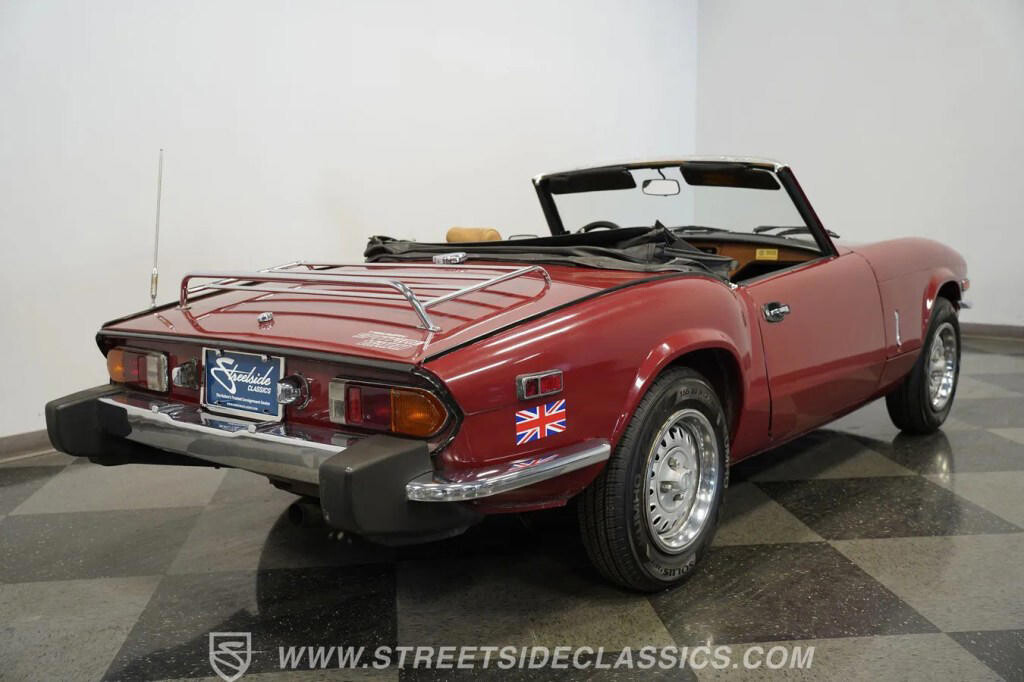
If you’ve earned it, why not flaunt it? That’s the philosophy followed by the manufacturers of the four cars offered for sale at Hemmings.com presented here. A string of victories in international competition is nothing to sneeze at, and so Jaguar, Porsche, Triumph, and Lotus decorated their production models with emblems showing off their achievements. Have you ever owned a car with a plaque celebrating its manufacturer’s racing wins, and if so, what has that meant to you? Let us know in the comments. 1978 Triumph Spitfire 1500 They Are the Champions: Four Cars That Celebrate Racing Victories For a humble, affordable roadster, the Triumph Spitfire compiled an enviable competition record that included a string of SCCA championships. Once the wins began to pile up, Spitfire dashboards were decorated with brass plaques that counted up the trophies; as it’s a 1978 model, this example records national class championships in 1965, ’68, ’69, ’70, ’71, ’72, and ’73. The plaques of later cars would be updated with further consecutive championships, right through the end of production in 1980. As the late Graham Robson, Triumph’s former competitions secretary, noted in Triumph Spitfire and GT6: A Collector’s Guide, Triumph originally had no intention of using the model in motorsports, but within four years had achieved impressive results at Le Mans, Sebring, the Tour de France, and the Alpine Rally. “The miracle is that it had all been achieved in such a short time, mostly with near-standard cars,” he wrote. This 1978 Triumph Spitfire 1500 from the Hemmings Classifieds is powered by the 1,493-cc inline four that took the place of the 1,286-cc four in late 1974, as Triumph struggled to cope with power losses resulting from U.S. emissions requirements. The original single-barrel Zenith-Stromberg sidedraft carburetor has been replaced with a two-barrel Weber downdraft, a popular modification. It’s been refinished in its original Carmine Red, and has a relatively new reproduction interior. Equipment includes a JVC AM/FM dassette deck with Alpine speakers and a trunk-mounted luggage rack. Asking price: $14,995. 1977 Porsche 924 There’s probably no automaker in the world that’s collected as many motorsports trophies as Porsche — we’ll bet that even the company archivists have lost count. Porsche celebrated in 1977 with a special, limited edition variant called the Martini Championship Edition, in honor of its sponsor Martini & Rossi. The cars had Police White paint, special graphics, a distinctive interior, and a brass plaque on the console marking the company’s 1969, 1970, 1971, and 1976 overall World Sportscar Championship victories. Porsche’s directors were no doubt anxious to imbue the new, entry-level 924 with some of the mystique that had been won on the world’s racing circuits. Introduced in Europe as a 1976 model, the 924 was the first of Porsche’s “transaxle” cars, which came to include the V8-powered 928 and the 924’s descendants, the 944 and the 968. Originally designed for Volkswagen, it represented a sharp break with Porsche’s past practices, with a front-mounted, water-cooled engine driving the rear wheels. Porsche being Porsche, the 924 was continually improved through its production run, but that evolutionary process had barely begun in 1977: the Martini Championship Edition, like the rest of the production cars, had a four-speed transmission, rear drum brakes, four-lug wheels, and the 2-liter, OHC inline-four borrowed from the VW LT cargo van. This example for sale among the Hemmings Classifieds was originally sold through a California dealership, and repatriated to Germany 12 years ago. There’s no mention in the ad whether the paintwork and upholstery are original, but they appear to be in excellent condition in the photos. You’ll find it with an asking price of $34,200. 1966 Lotus Elan S3 Each year, the Fédération Internationale de l’Automobile (FIA) awards the World Constructors’ Championship to the most successful Formula 1 constructor over the course of the season. Colin Chapman was not only the founder of Lotus, but the boss of its F1 team as well, and so when the company won constructors’ championships in 1963 and 1965, he made sure that the world knew about it by adding badges to his production cars. (Even though it hasn’t won a constructors’ championship since 1978, Lotus is still fifth on the all-time list, with seven.) With the Elan, Lotus pioneered the use of a steel backbone chassis with a fiberglass body, reflecting Chapman’s focus on simplicity and lightness. It also introduced to the world the Lotus Twin-Cam, which was essentially a 1.5-liter Ford Kent inline-four engine with a DOHC cylinder head. The Series 3, or S3, Elan was introduced in 1965, available as either a coupe or a convertible and with refinements like a more robust electrical system and a slightly plusher interior. Though it wasn’t intended for racing, its promise led Lotus to create a competition version called the Type 26R. According to the seller, this example, offered in a Make Offer listing, has received a full mechanical and cosmetic restoration with no expense spared. Included in the sale are service records, restoration documents, a period brochure, tools, and service manuals. It’s being offered with an asking price of $48,000. 1960 Jaguar XK150 S Designed with powering big, expensive sedans in mind, Jaguar’s XK twin-cam straight-six became a motorsports legend, powering the C-types and D-types that showed their taillights to the world five times at Le Mans in the space of seven years. Jaguar boss William Lyons created the XK120 as a sort of display case for the engine, never intending to put the roadster into volume production, but buyers had other ideas. The XK120 led to the XK140 and XK150, before passing the XK baton to the E-type. The XK140 was the first to wear a Le Mans badge on its trunk lid, celebrating wins in 1951 and 1953; by the time this 1960 Jaguar XK150 was built, the badge had been redesigned to squeeze in three more victories. When the XK150 was launched in 1957, it was clear that it was an evolution of the XK140, with a more horizontal fender line and one-piece curved windshield. This example, offered for sale among the Hemmings Classifieds, is what Jaguar called an Open Two-Seater, a body style that joined the Fixed-Head Coupe and Drophead Coupe in 1958. It’s powered by the “S” version of the 3.8-liter XK, which used a straight-port cylinder head and triple SU carburetors to make 265 hp, 45 hp more than the standard-equipment engine. The example shown here has been subjected to a complete restoration, and stored in a climate-controlled environment. “The finestcraftsmanship and British specialists painstakingly hand-built this car back to the glory it deserves,” the seller says. The asking price is $150,000.