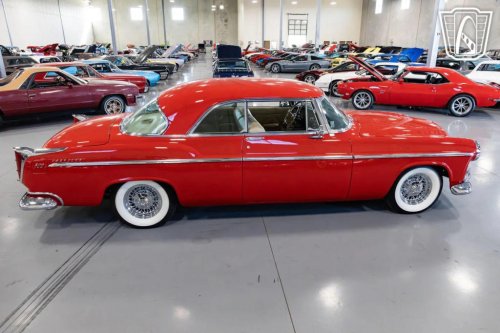
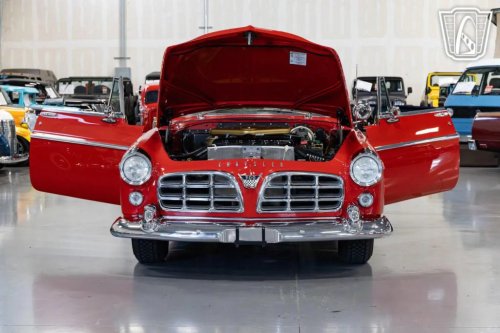
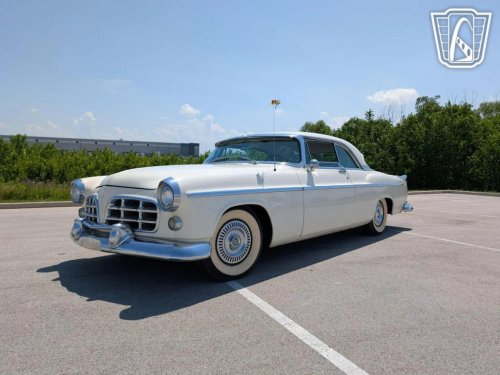
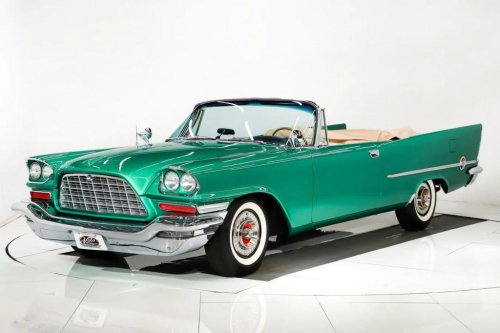



















In the early 1950s, a “fast” car was usually a floaty luxury barge that could eventually hit 80 mph if you had enough straight road and a following wind. Then came 1955. While the rest of Detroit was focused on chrome fins and pastel paint, Chrysler dropped a mechanical nuke on the automotive world with the 1955 Chrysler C-300. It was the first mass-produced American car to officially breach the 300-horsepower barrier, a feat so shocking it essentially birthed the “muscle car” blueprint a decade before the Pontiac GTO ever turned a key. 300 HP in 1955: The Revolutionary Engineering of the Chrysler C-300 To understand why this was a big deal, you have to look at the competition. In 1955, the Chevrolet Corvette was wheezing along with 195 horsepower, and the Ford Thunderbird wasn’t much better at 193 horsepower. The Chrysler C-300 didn’t just beat them; it had 50-percent more power than the flagship sports cars of the era. Chrysler achieved this “magical” figure by taking their 331 cubic-inch “FirePower” V8—the first-generation Hemi—and giving it a full race-spec makeover. The secret sauce under the hood included two massive Carter four-barrel carburetors and a race-profile camshaft engineered for high-RPM power. Engineers also utilized solid valve lifters which made the engine noisy but were essential for high-performance operation. When combined with an 8.5:1 compression ratio, which was a serious figure for mid-50s pump gas, the result was a powerhouse that redefined American performance. The Banker’s Hot Rod The C-300 earned a legendary nickname: The Banker’s Hot Rod. It was a car for the man who wanted to dominate the local drag strip on Saturday but still look respectable at the country club on Sunday. Designed by the legendary Virgil Exner as part of his “$100 Million Look,” the C-300 was a “mutt” in the best way possible. It used a Chrysler New Yorker body, a massive Imperial front grille, and Windsor rear quarters. To keep it focused on speed, Chrysler stripped away the excess chrome and offered it in only three colors: red, white, and black. Photos: 1955 Chrysler C-300 Newport listed for sale on Hemmings Marketplace. Dominance on the Track Chrysler didn’t just build the C-300 for the showroom; they built it for NASCAR. In 1955, “stock car” meant exactly that; you could buy the car at a dealership and race it on Sunday. The results were terrifying for everyone else. Mercury outboard motor tycoon Karl Kiekhaefer fielded a team of C-300s that swept the season, claiming 27 NASCAR victories in their first year alone. At Daytona Beach, Tim Flock drove a C-300 to a two-way average of 127.58 miles-per-hour, shattering the competition by over 7 miles-per-hour. Legacy of the Letter Series The “C-300” (the ‘C’ stood for Chrysler) launched the legendary Letter Series. Every year, Chrysler would release a new high-performance model with a subsequent letter: the 300B in ’56, the 300C in ’57, all the way to the 300L in 1965. Today, the 1955 original is a unicorn. With only 1,725 units ever built, finding one in good condition is a quest for the truly dedicated. The C-300 proved that Americans didn’t just want comfort; they wanted unapologetic power. It set the stage for the muscle car wars of the 60s and remains the grandfather of every Hemi-powered beast on the road today.