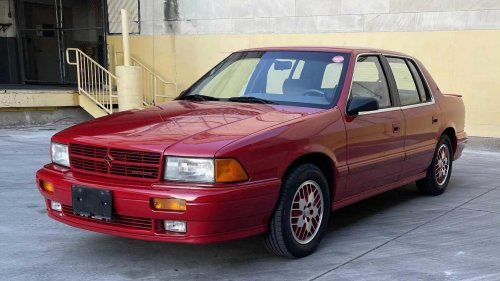
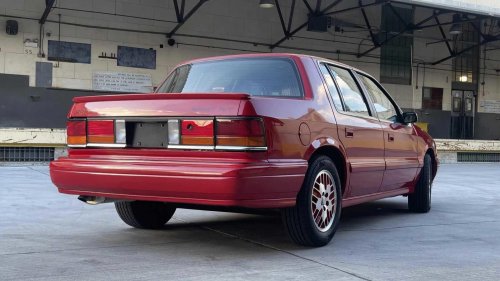
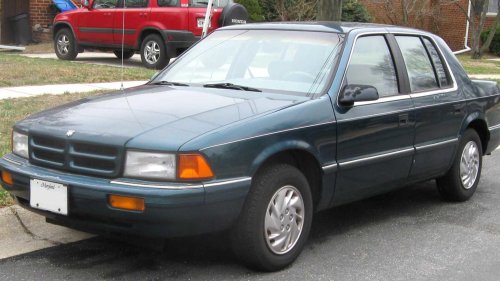
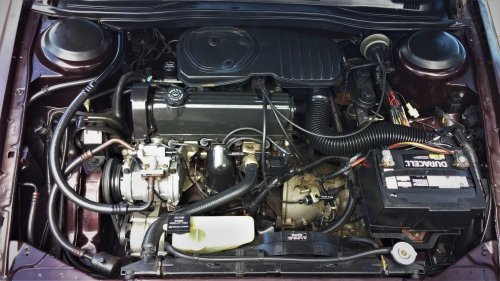
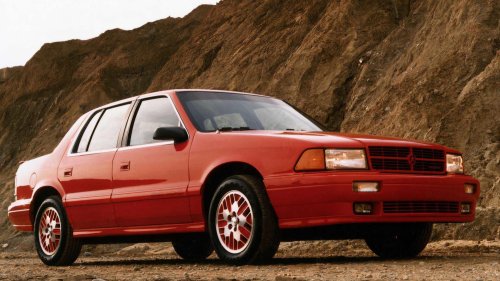
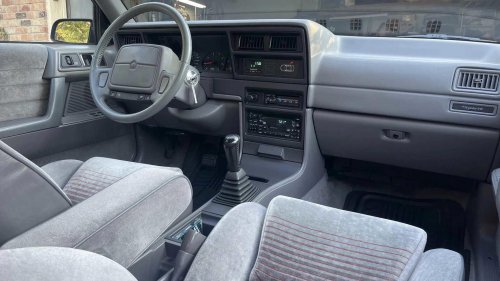
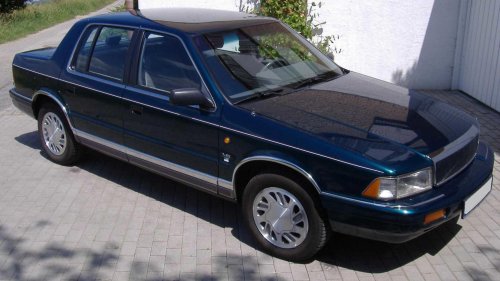
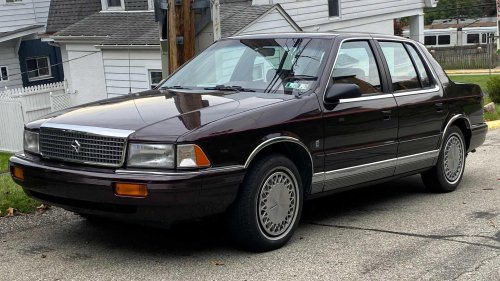
Records are a crucial part of the automotive world. Being able to claim that a model is the best at something, whether that’s acceleration, speed, or performance on a track (see Nürburgring records, highly coveted by automakers) is a highly successful marketing tactic.In some cases, however, a model that briefly gets to sit on the throne does not make a long-lasting impact on the automotive world, and later ends up being somewhat forgotten. This is exactly what happened to the Dodge Spirit R/T, a car that was once the quickest sedan sold in America thanks to its 0-60 mph time (lower than that of the contemporary BMW M5). This high-performance version of an equally obscure model, the Spirit, is now an automotive rarity thanks to the short amount of time it spent on the market. Let’s take a closer look at its history and its features. The Dodge Spirit R/T: An Overview Bring a TrailerThe Dodge Spirit R/T was a high-performance variant of the Dodge Spirit, a sedan introduced in 1989. The R/T version arrived not long after, being introduced for the 1991 model year.Dodge launched a competition with the goal of coming up with the best design for the Spirit R/T’s engine; among the contestants were Maserati, former racing driver Hans Herrmann, and Lotus. The latter won, designing a 2.2-liter inline-four engine equipped with a Garrett intercooled turbocharger. This engine produced 224 horsepower and 217 pound feet of torque; it was paired with a single choice of transmission, a five-speed manual. This transmission was built by New Process Gear, which had once been a standalone company before becoming a Chrysler division. Its construction also had some input from German firm Getrag.Bring a Trailer The Spirit R/T did not just have a more powerful engine than its more pedestrian counterpart. It was also fitted with features such as heavy-duty vented disc brakes on all four wheels as standard; anti-lock brakes were available as an option. The car also came with a few unique aesthetic features, such as 15-inch alloy wheels.The Spirit R/T boasted impressive performance for its time. It went from 0 to 60 mph in just 5.8 seconds, and managed to achieve a top speed of between 141 and 143 mph. It was advertised as “the fastest sedan made in America”, and managed to outperform the BMW M5 of the time, which had a 0-60 mph time of 6.3 seconds (although it had a higher top speed, electronically limited at 155 mph). The R/T’s performance record was also impressive when considering its relatively affordable price: the model was considered one of the quickest performance sedans offered at the time under the $40,000 mark.That description may have convinced you that maybe a Spirit R/T is the classic car for you; however, you might not have the easiest time finding one today. Only 1,399 examples of the model were sold in the US over the course of its two-year production run: 1,208 in 1991 and just 191 in 1992. The cars sold in 1992 came with some visual updates, such as woodgrain dashboard trim and black grille inserts, and some mechanical updates (including a lower first gear ratio for reduced turbo lag). Throughout the entire production run, 866 cars were finished in red, 502 in white, and just 31 in silver.Prices vary between around $10,000, for examples with a higher mileage and a poorer maintenance record, and around $20,000 for cars with better maintenance and fewer miles on the clock. The Spirit R/T's Parent Model: The Short-Lived Dodge Spirit IFCAR/Wikimedia Commons The Spirit R/T may have only been around for two years, but the model it originated from – the Dodge Spirit – was itself only on the market for six model years, between 1989 and 1995. The Spirit was introduced as a successor for three different models in the Dodge family: the Lancer, the Aries, and the 600. It was exclusively available with a four-door sedan body style, and could seat up to six passengers thanks to the optional split-bench front seat.A range of engines was available to choose from. The base engine was a 2.5-liter inline-four that produced 100 hp. A turbocharged version of the same engine, producing 150 hp, was available until 1992. For three model years (1993, 1994, and 1995), Dodge also produced a dual-fuel version of this engine, capable of running on fuel containing up to 85% methanol.Another available engine option was a 3.0-liter V6 built by Mitsubishi, which produced 141 hp. Last of all there was the R/T, the most powerful model in the lineup thanks to its 224-hp, 2.2-liter engine.Septagram/Wikimedia Commons A wide range of transmissions was offered, including a five-speed manual, three-speed automatic, and four-speed automatic, however Spirits with a manual transmission are quite rare (aside, of course, from the R/T version, which was exclusively equipped with a manual).The Spirit was eventually discontinued in 1995, after two of its trim levels and the R/T version had all been discontinued. Sales had peaked at 99,319 units in 1990, before dropping to just 12,991 during the Spirit’s last model year. The Spirit R/T And The Spirit In Mexico And South America Stellantis The Spirit R/T, along with the Spirit itself, was also sold in Mexico and a few other South American markets. The Mexican version of the model, however, was slightly different from its American-market counterpart, and was sold under the Chrysler brand rather than under Dodge.Two versions of the Spirit R/T were available. The base trim used an engine exclusive to the Mexican market: a 2.5-liter turbocharged inline-four which produced 168 hp. It was paired with a three-speed automatic transmission. This version of the model was sold a little longer than the American R/T (remaining on sale until 1995) and was also used by Mexican police departments of the era.Bring a Trailer The upper trim level was called the Spirit R/T DOHC. It was only available in 1992 and 1993, and shared the 2.2-liter engine also found in the American R/T. This time, the engine was paired with a five-speed manual transmission. The Mexican version of the model offered a wider range of optional features, including a sunroof, leather upholstery, and 16-inch alloy wheels. A wider range of color options was also available, unlike on the American market where only three paint colors were offered.A more premium version of the model was also sold exclusively in Mexico, under the name of Chrysler Phantom R/T. This version was also powered by the 2.2-liter engine, but shared some of its features with the Chrysler LeBaron, one of the Spirit’s many badge-engineered variants. The Spirit's Badge-Engineered Siblings Sec.of.def/Wikimedia Commons The Spirit was built on a platform launched in 1989, which Chrysler initially referred to as “A”. However, this caused confusion as the brand had used a platform with the same name in the 1960s and 70s; as a result, within a year the name had been changed to “AA”. The AA series was itself a subset of the wider K-Platform family.The other three models that used the same platform were all rebadged versions of the Spirit, sold in a variety of markets including America and Europe. These were the Chrysler Saratoga, the Chrysler LeBaron, and the Plymouth Acclaim. Let’s take a closer look at them.Chrysler LeBaron: The third generation of the Chrysler LeBaron sedan was introduced for the 1990 model year. It was discontinued in 1994, bringing the LeBaron sedan’s production run to a close. This generation of the LeBaron sedan was also sold in Mexico under the name of Chrysler New Yorker, effectively creating a fourth badge-engineered version of the Spirit.At the same time as the third-gen LeBaron sedan was being sold, a coupe/convertible of the same name was also on the market, which however was not built on the AA platform and was not related to the Dodge Spirit. This model was discontinued in 1995, a year after the sedan.Chrysler Saratoga: The Chrysler Saratoga was the version of the model built for export to the European market, and was not sold in the US. The launch of the 1989 Saratoga represented a revival for the Saratoga nameplate, which had first been used all the way back in 1939 but had been last seen on a Chrysler model in the mid-60s.Despite still being very close to the Spirit and its other badge-engineered versions, the Saratoga was slightly different from its siblings as it needed to comply with European safety regulations. Some of the modifications made included a change in the design of the headlights, mirrors, seatbelts, and engine control units.Cutlass/Wikimedia CommonsPlymouth Acclaim: In the same way as the Dodge Spirit itself, the Plymouth Acclaim did not revive a pre-existing nameplate, but rather introduced a brand new one (unlike the LeBaron and Saratoga). The model made its debut in 1989, and differed from the Spirit thanks to a few key features. These included unique tail lights, a unique grille, a different range of wheel choices, and different bodyside molding.The Acclaim initially offered three distinct trim levels (base, LE, and LX). However, from 1992 onwards, they were consolidated into a single trim level. The model lasted another three years, being discontinued alongside the Spirit in 1995.Sources: Dodge



















 +52 others