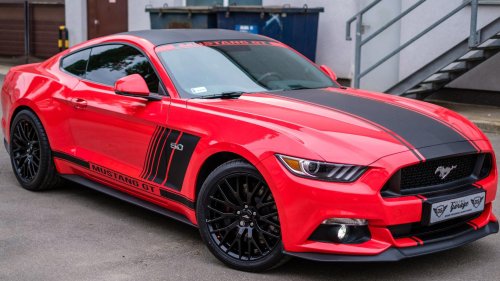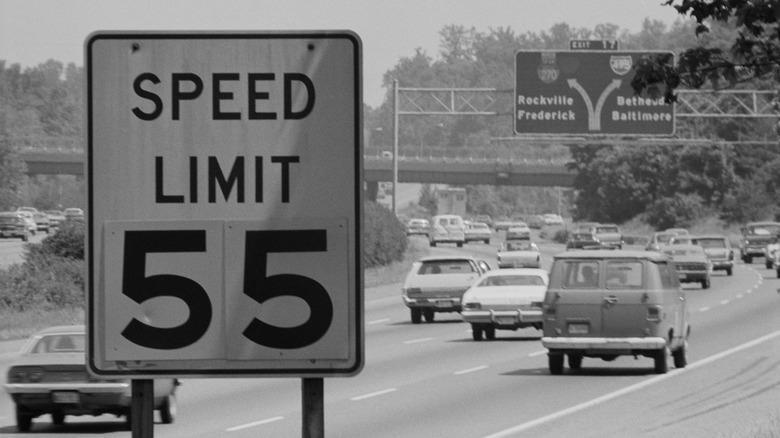
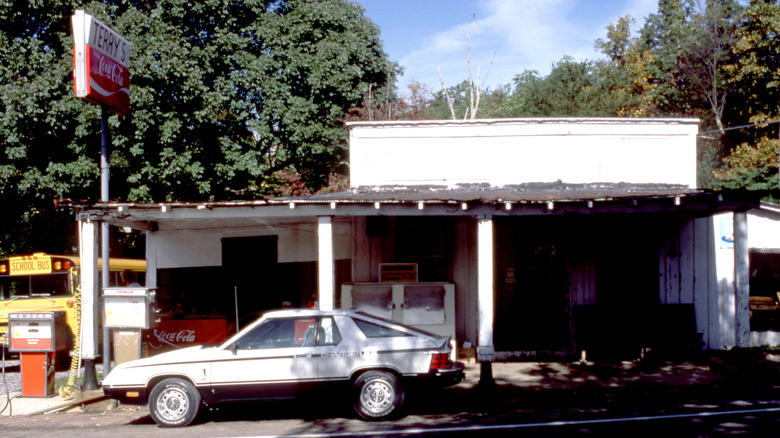



















Photoquest/Getty Images Car advertisements have always stretched the truth, but in the early 1980s, some manufacturers found a more creative way to do it: just change the finish line. If you've spent any time digging through old car ads, you've probably noticed something odd tucked into the performance claims of a few early-1980s models. These claims advertised 0-50 mph sprint times instead of the industry-standard 0-60 mph benchmark that had been in use since automotive journalist Tom McCahill pioneered it in 1946. McCahill likely chose 60 mph because state-level speed limits already hovered around 50-60 mph at the time. That logic flipped when President Nixon signed the 55 mph national speed limit into law in 1974 as a response to the 1973 oil embargo. Autoweek notes that car companies of the era "had to" advertise 0-50 times instead of 0-60, though there's seemingly no formal regulation that ever explicitly required it. Still, the practical incentive was clear enough on its own: 60 mph was now an illegal speed on American highways, and benchmarking against it felt increasingly disconnected from everyday driving reality. As Hagerty's Jack Baruth summed it up, 0-50 and 0-55 were the "bastard cousins" of 0-60. They were metrics that existed not because they were more meaningful, but because the cars couldn't look good without them. The trick was entirely legal, as there was no rule requiring a standardized sprint distance in advertising copy. Automakers facing an uphill performance battle simply picked a number that worked in their favor. The cars that made 0-50 (in)famous William Nation/Getty Images Chrysler was one of the most brazen practitioners of the 0-50 trick, and the 1982 Dodge Charger 2.2 – one of the worst cars from an arguably great automaker – is a notorious example. On paper, the car made 84 horsepower and 111 pound-feet of torque from a 2.2-liter four-cylinder in a body that traced its roots back to the economy Dodge Omni. Squaring that up against a Mustang GT or Camaro Z28 in a straight-line test was never going to end well. Because of that, Dodge brought the National Hot Rod Association in to officially clock the competition at 50 mph instead of 60, stamped the results on a magazine spread, and called it a day. Two years on, the 1984 Dodge Daytona Turbo Z repeated the formula. When MotorTrend put it head-to-head with the Mustang GT and Camaro Z28, the numbers told an uncomfortable story: the Daytona ran a 0-50 time of 6.01 seconds against the Camaro's 5.37 and the Mustang's 5.90. When scaling the disappointment to 60 mph, the gap only widened. The Daytona Turbo Z clocked 8.22 seconds against 7.41 and 7.43 for the Camaro and Mustang, respectively. Advertising 0-50 didn't make the Daytona Turbo Z fast — it just made the scoreboard easier to look at. Ironically, while Dodge was busy gaming acceleration benchmarks with the Daytona Turbo Z, it was simultaneously stuffing a Lamborghini V8 into a Daytona behind closed doors. Later on, the 1985 model year saw the arrival of the turbocharged Shelby variant. This gave the Daytona Turbo Z 146 horsepower to play with, and the whole 0-50 charade quietly disappeared from Dodge's ad copy. The law that ended it Toa55/Getty Images The 0-50 trick had a hard expiration date, and just like how it (supposedly) came, it was taken down with a presidential pen stroke. Bill Clinton signed the National Highway System Designation Act on November 28, 1995, handing speed limit authority back to individual states. A few U.S. areas still have low speed limits on the interstate, but 60 mph isn't as universally outlawed as it used to be. Following the repeal, 35 states moved to raise their limits to 70 mph or higher, and the rationale for advertising a 50 mph sprint collapsed overnight. Cars were getting faster, limits were climbing, and 0-60 reasserted itself as the only number anyone wanted to see in an ad. The only trace of the 0-50 era in modern times comes from a handful of archived magazine ads. These days, there are even a few factory cars that actually can hit 60 mph in two seconds or less. So the idea of bragging about a 0-50 sprint now seems less like a marketing trick and more like a punchline.