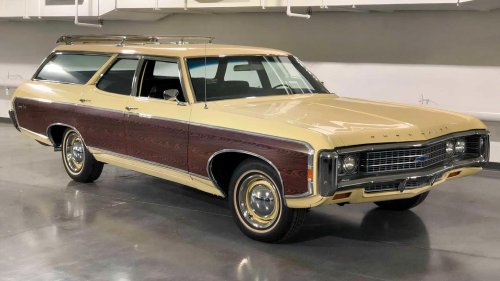
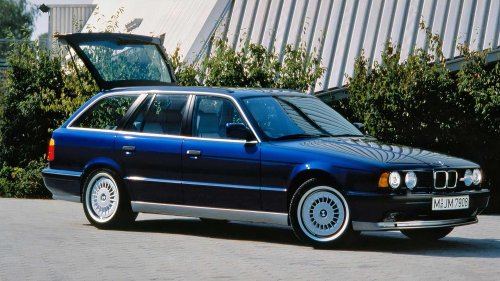
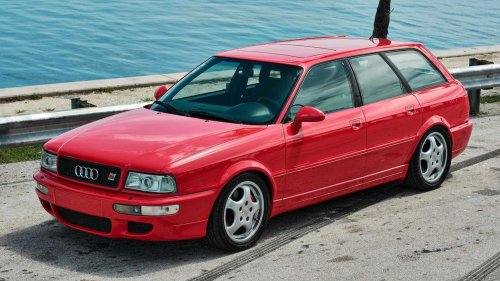
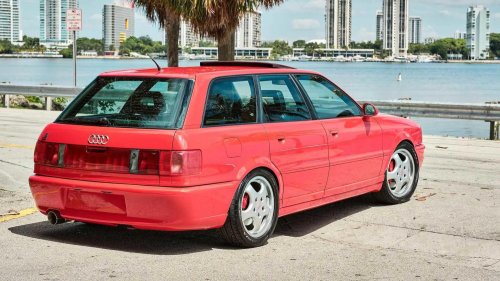
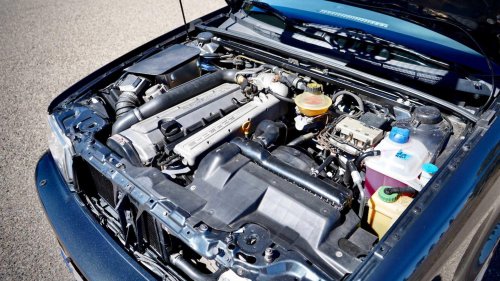
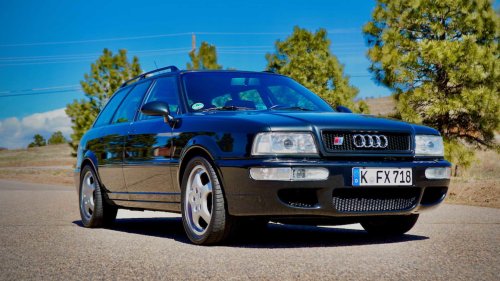
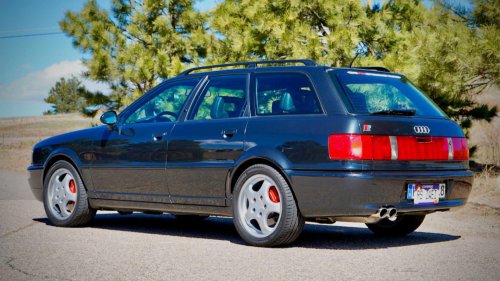
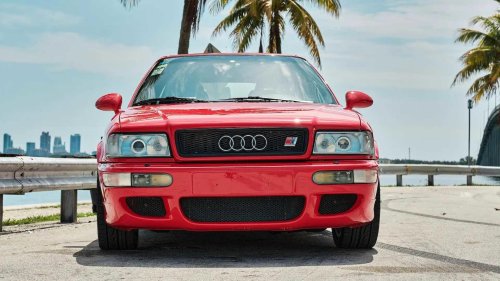
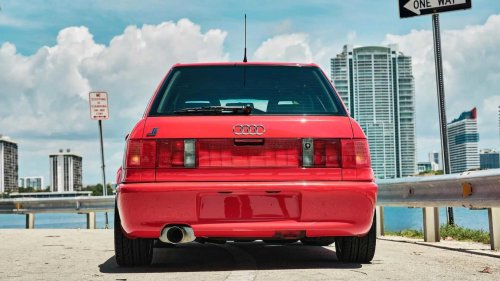


















While Audi absolutely dominated the 1980s rally scene with the Sport Quattro, it was nowhere near as dominant on the street, where BMW and Mercedes-Benz monsters ruled. In the mid-1990s, the Four Rings brand decided to change the status quo, launching the RennSport (RS) division with one simple mandate: to push the boundaries of everyday road cars by injecting them with the extreme power and pure motorsport technology needed to challenge established luxury performance divisions like BMW M and Mercedes-AMG.Most upstart performance divisions would have launched their offensive with a low-slung coupe or an aggressive sports sedan, but Audi went completely rogue. The RS division chose the humble silhouette of a family wagon as its first true weapon of mass disruption, partnering with the talented engineers at Porsche to guarantee its pedigree and give it instant street credibility. The result of this partnership was an all-weather ballistic missile that packed supercar-slaying acceleration into a shape meant for grocery runs. Americans Invented The Performance Wagon, But The Europeans Perfected It Bring a TrailerAsk most gearheads today where the performance wagon was born, and they will point a finger straight at Europe. It's a common misconception, and the Audi monster wagon we're covering today is a big reason why this notion persists, but the true birthplace of the performance wagon is actually the United States in the wild 1960s. During the fierce horsepower wars that raged on at the time, Detroit went through a glorious phase of stuffing tire-shredding, big-block V8s into family haulers, creating insanely powerful muscle wagons that probably shouldn't have made it past the focus group stage. We're talking brutes like the Ford Country Squire with a 428 Cobra Jet, the Chevrolet Kingswood Estate 427, or the unhinged Pontiac Tempest Super Duty Wagon.Sadly, that golden era crashed hard in the 1970s after fuel crises, crushing emissions laws, and skyrocketing insurance premiums killed off American muscle wagons. This sudden vacuum left the door wide open for European automakers to seize the crown. While Detroit saw a dead segment, European engineers saw a massive opportunity. They took the foundational American concept of a fast family wagon, injected it with sophisticated engineering, and perfected it for a new era of global dominance. The Golden Age of European Family WagonsBMWIn the '80s, Europe didn't just adopt the performance wagon formula — they completely revolutionized it. Leading the charge was Volvo, a brand best-known for offering boxy practicality and safety at the time. The Swedish brand stunned the automotive world with its turbocharged 240 Turbo and 740 Turbo wagons, kicking off the European performance wagon wave. In the years that followed, Mercedes-Benz partnered with AMG to drop high-output V8s into their S124 midsize wagons, while BMW's M division launched the E34 M5 Touring in the early 1990s with a screaming inline-six derived from the iconic M1 supercar.Suddenly, the fast wagon wasn't a niche experiment; it was a high-status arms race, and Audi wasn't going to sit around and watch as its rivals dominated the new exciting segment. To elevate its brand image and prove its road-going dominance against BMW M and Mercedes-AMG, Audi knew it needed a wagon so radically engineered, so brutally fast, and so mechanically elite that it not only obliterated any other wagon sold at the time but was also fast enough to threaten genuine supercars, and who better to partner with on such a project than the brilliant engineers from Porsche? Porsche Steps In: The RS2 Avant Is BornBring a TrailerThe star of the show is the 1994-1995 Audi RS2 Avant, which started life as the practical, five-door Audi 80 Avant before the masters of speed from Stuttgart converted it into the super wagon that turned the industry on its head. Audi chose to work with Porsche on the project for several reasons, including the fact that Porsche had a reputation for building some of the finest sports cars of the day, including icons like the 911 and 959.The bigger reason, however, was Porsche's financial troubles of the late '80s to early '90s era. After a global economic downturn, Porsche found itself in a pickle. Poor sales had left Porsche with excess factory capacity and an idle workforce, leaving the company eager for contract manufacturing work. Rather than give in and allow its talented engineers to jump ship, Porsche started offering engineering and manufacturing services to other automakers, leading to models like the iconic Mercedes-Benz 500E.Bring a TrailerKnowing the benefit that would come out of a partnership with such a legendary brand and seeing an opportunity to offer a helping hand, Audi handed the RS2 Avant project to Porsche. They didn't just borrow a few parts from Stuttgart; the collaboration required Audi to ship painted body parts and add-on parts to Porsche's historic Rössle-Bau plant in Zuffenhausen — the same factory that built the Mercedes-Benz 500E — where Porsche engineers hand-assembled the wagons alongside their own legendary sports cars. What came out of Zuffenhausen instantly rewrote the rules of what a performance car could be. 315 hp, 968 Brakes, And the Numbers That Shouldn't Add Up Bring a TrailerThe RS2 Avant wasn't just built with a little help from Porsche; it was literally born inside Porsche's most sacred walls. Audi supplied painted body shells and components not developed by Porsche. Once the painted Audi shells crossed the threshold of the Rössle-Bau facility, Porsche's engineering team essentially tore into the car's DNA to give it true sports car dynamics.For starters, they fundamentally re-engineered the 2.2-liter 20-valve inline-five engine. They ditched the factory turbo for a larger KKK turbocharger, bolted on a massive, heavy-duty intercooler, and threw in high-flow fuel injectors. Combined with aggressive new Porsche camshafts and a custom ECU, they dragged output up by nearly 100 horsepower, landing at a glorious 315 hp. This power was sent to all four wheels via a heavy-duty six-speed manual and Audi's revolutionary Quattro all-wheel-drive system. To ensure the wagon handled the power, Porsche lowered the chassis, dramatically stiffened the suspension, and track-tuned the geometry.Audi RS2 Avant specsPorsche then raided the parts bins of its own top-tier sports cars to add to the madness. Knowing that the heavy, high-speed family wagon would require far better stopping power than the stock brakes could provide, Porsche replaced them with massive four-piston Brembo calipers and high-performance 304mm ventilated front discs sourced from the Porsche 968 Club Sport. Those massive 968 Brembo calipers needed more room, so Porsche equipped the RS2 with authentic 17-inch "Cup 1" five-spoke alloy wheels, which were used in the 964 Turbo and Porsche's contemporary Carrera Cup race cars. The teardrop-shaped "Aero" side mirrors also came from Porsche's top sports cars of the day.At the Rössle-Bau line, Porsche technicians completed the final assembly entirely by hand and finished off the bespoke cabin with high-end Recaro sport seats and an exclusive Porsche-styled three-spoke steering wheel. Looking at the completed RS2 Avant rolling off the factory floor, no one could have imagined it was hiding such serious performance hardware underneath its long roof body. The only hints were the side mirrors and "PORSCHE" stamps on the brake calipers, intake manifold, and next to the RS badge.Fun Fact: According to Porsche project leader Michael Hölscher, roughly 20 percent of the RS2's components originated from Porsche, including parts of the suspension, brakes, mirrors, bumpers, wheels, and numerous detail components. When A Wagon Out-Launched The World's Fastest Supercars Bring a TrailerThe RS2 Avant earned its reputation as the ultimate 1990s performance wagon not just through nostalgic style, but through brutal, supercar-shaming metrics. Engineered by Porsche and utilizing Audi's legendary Quattro all-wheel drive, it rewrote the rules of what a family wagon could achieve not just in a straight line but also when the road got twisty. The 302 lb-ft hit like an absolute sledgehammer at just 3,000 rpm, allowing the 3,500-pound wagon to dash to 62 mph in just 4.8 seconds and top out at an electronically limited top speed of 163 mph. In 1994, this didn't just beat other wagons; it actively embarrassed the contemporary Ferrari 348 and ran absolute rings around the base Porsche 911 Carrera.Even more impressive was how the RS2 Avants dug out of the hole. In a famous 1995 Autocar magazine test, the RS2 blasted from 0 to 30 mph in just 1.5 seconds, beating both the legendary McLaren F1 road car and Jacques Villeneuve's contemporary Formula One car. Of course, both obliterated the RS2 after that but let that sink in for a moment: this family wagon could out-launch the fastest car in the world at the time and an F1 car.Bring a TrailerDespite putting up such insane numbers, there wasn't much about the RS2 that indicated that it was fast, which is why it's considered to be one of the greatest Sleeper Cars ever. It also didn't sacrifice the practicality wagon buyers expected and still offered five legitimate seats, up to 42.4 cubic feet of trunk space with the rear seats folded, roof rails, and luxury amenities like standard automatic climate control, power windows, electric mirrors, and an optional sunroof. From Forbidden Fruit To Collector GoldBring a TrailerThe initial plan was to build an ultra-exclusive, blink-and-you'll-miss-it limited run of just 2,200 units, but European demand was so overwhelming that Audi asked Porsche to squeeze out an extra 691 cars over the original plan. Porsche ultimately built 2,891 units, most of which remained on its home turf in mainland Europe and went on sale for the equivalent of roughly $71,400. The RS2 Avant was never officially imported or sold in North America, which means U.S. enthusiasts who knew about it had to wait until 2019 to be able to import one under the U.S. 25-year import rule.Fun Fact: The UK received only about 180 right-hand-drive RS2 Avants, making RHD examples significantly rarer than their continental European counterparts.Since then, American collectors have been hunting down the original European stock, pushing prices higher and higher. The Classic.com Market Benchmark indicates buyers can expect to pay around $62,701 for the RS2 Avant today, and while the vast majority of past U.S. sales have been in the $50,000 to $80,000 range, several six-figure sales in the past few years show that collectors are willing to pay top dollar for it.Bring a TrailerWhile the RS2 Avant wasn't the first wagon to offer performance, it will always hold a special place in the automotive history books because it became the absolute benchmark for '90s automotive lunacy. It wrapped genuine supercar metrics, genuine 911 hardware, and legendary rarity into a completely unassuming, five-door family shape, creating the entire modern segment of every day giant-killers.Sources: Autocar, Classic.com, Bring a Trailer