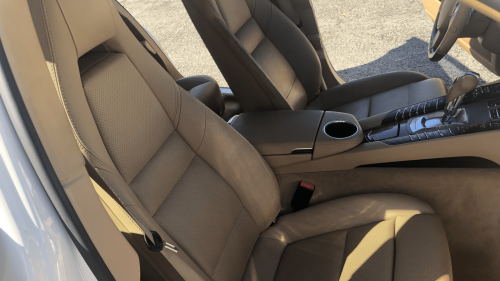
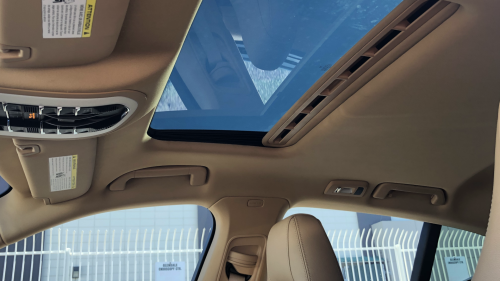
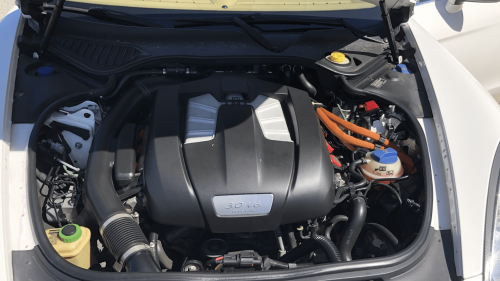
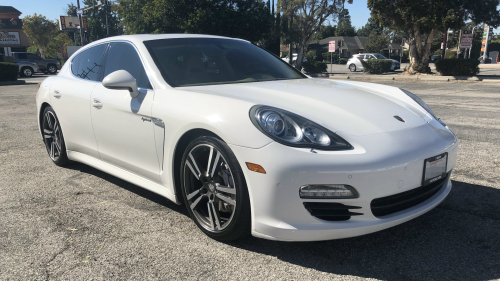
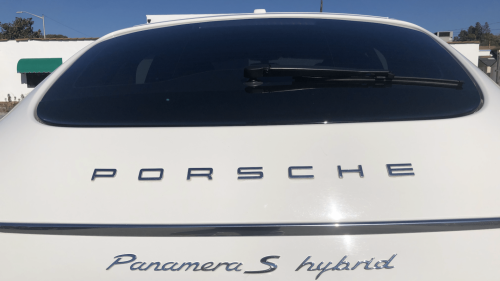
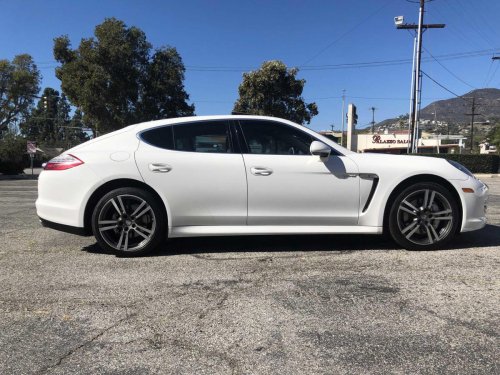
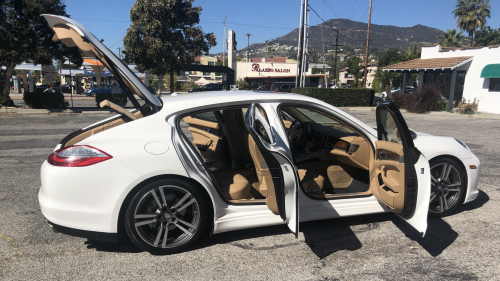


















Are you dreaming of a supercharged car with Porsche-tuned handling and Audi reliability—all for a bargain used price? If you shop smart, you may just be able to have your cake and eat it too.Porsche has built multiple high-performance supercharged cars. But after becoming part of Volkswagen Group and gaining access to Audi’s parts bin, Porsche pulled out all the stops. One of its first supercharged speed machines was easy to overlook when it launched. But today, it’s becoming an unignorable vehicle on the used market. Turbochargers—Not Superchargers—Gave The 911 Its Most Iconic Performance Trim Bring a TrailerFerdinand Porsche actually helped Mercedes-Benz develop the supercharged “S,” “SS,” and “SSK” models in the 1920s. But when he introduced his iconic 911 (1964), it was with an air-cooled and naturally aspirated flat-six-cylinder engine. The company didn’t take on forced induction for a decade.It was the Porsche 930 Turbo that pioneered exhaust-driven “turbocharger” technology for the 911. It also established the 911’s most recognizable performance badge, the “Turbo.”Bring a TrailerThe sports car’s 1990-1994 generation got the 964 Turbo with its turbocharged 3.3-liter and 3.6-liter six-cylinder engines. The 1995-1998 generation’s 993 Turbo was the first 911 with twin turbochargers, and the first Turbo with available AWD. Then came the 996 Turbo (2001-05), 997 Turbo (2007-13), 991 (2014-19), and 992 (2020-present).Though Porsche spent decades perfecting turbocharged engines, it never once dabbled in a supercharged engine (forced induction driven directly off the engine). Then along came Audi. Audi Helped Porsche Turn It Up To 11 Bring a TrailerVolkswagen was founded in 1937 to assemble a car developed by Ferdinand Porsche: the Beetle. (Porsche didn't found a company named after himself until 1948). In 2016, VW Group sold 10.3 million vehicles and became the world’s largest automaker. It now includes budget-friendly badges such as the Czech-based Škoda, and the Spanish brand SEAT. VW Group also includes heavy commercial vehicle brands such as Traton, Scania, and Man. And it includes luxury badges: Bentley, Lamborghini, Ducati, Bugatti, Rimac, and Audi.Between 2005 and 2008, Porsche secretly bought VW shares and attempted a hostile takeover. By 2009, the takeover had failed so dramatically that Porsche found itself in deep debt. VW bailed it out by buying 49.9% of the company and began to collaborate on future models to improve Porsche sales. The collaboration was successful enough that in 2012, VW Group bought the remaining 50.1% of Porsche.Bring a TrailerOne of the first power plants VW offered Porsche was Audi’s 90-degree, modular, V6/V8 family. This included a V6 with an Eaton TVS Supercharger that would find its way into multiple performance-oriented Porsche vehicles. The Panamera S Hybrid Was Secretly An Audi 2012 Porsche Panamera S Hybrid front three-quarterThe Panamera is a full-size luxury car that Porsche launched in 2009. While its front-end styling is reminiscent of the iconic 911, its numbers couldn’t be more different: It’s a 4,000+ pound, front-engine, RWD beast. It honestly has more in common with a Chrysler 300 than a 911. But if you’re shopping for four-door luxury cars, the affordable Autobahn-tuned Panamera is impossible to ignore.One of the most intriguing aspects of the 2011-2013 Panamera S Hybrid is where Porsche slotted the new powertrain into the original lineup. The entry-level Panamera and Panamera 4 (AWD) featured naturally-aspirated 3.6-liter V6s. The next trim level was the Panamera S and 4S. But if you think “S” stands for supercharged, think again. This trim level featured a 90-degree, 4.8-liter V8 that produced 400 horsepower and 369 lb-ft. The S started at $89,000 and the AWD could hit 60 mph in 5.2 seconds. Then in late 2011 (for the 2012 model year), the lineup got interesting.Bring a TrailerIf you spent another $6,000, you lost two cylinders. That’s right, the Panamera S Hybrid featured a 3.0-liter V6 that was essentially a shortened V8 block. But it made up for the lower displacement with a supercharger (a compressor spun by the engine that forces air into the cylinders). With the extra air, this V6 made 333 hp and 325 lb-ft of torque. But that's not all: an electric motor added another 46 hp and 221 lb-ft of torque. The result was ample low-end grunt, all sent to the rear wheels. Porsche claimed a 5.7-second sprint to 60 mph. Some reviewers did it in 5.2 seconds.The AWD V8 Panamera earned an EPA fuel economy rating of 16 city/24 highway MPG (19 combined). Its quick hybrid sibling earned 22 city/30 highway MPG (25 combined). A 4,000-Pound 911 Bring a TrailerWhile the Panamera is significantly heavier than the 911 (4,365 lbs), Porsche was still able to tap into its sports car handling expertise. The resulting sedan features 50/50 weight distribution with a very low center of gravity for its segment. It also has active suspension management (with active air) standard. The final bit of Porsche wizardry is Servotronic speed-sensitive steering. These ingredients come together for a smooth ride on straightaways and precise steering in the corners. Its pure RWD powertrain enables experienced drivers to adjust the balance with the throttle while cornering.The Panamera Hybrid S also differed from Porsche’s more budget-friendly sports cars with its luxury features. Dual-zone climate control, Bluetooth connectivity, power sunroof, LED daytime running lights, a cooled glovebox, auto-dimming mirrors, power-rear hatch, driver memory settings, and leather upholstery weren’t options. They came standard with the Hybrid trim.Bring a TrailerAll that said, the Panamera Hybrid S isn’t an option for a family of five. Yes, the rear seats have plenty of legroom for full-size passengers. But the Hybrid S came exclusively with rear bucket seats and a center console in back. No rear bench seat here. The Truth About A Used Panamera S Hybrid Bargain To be blunt, the Panamera Hybrid S borrowed its V6 powertrain from the top-trim Audi 4 (the S4) of the day. But with the best suspension and steering tech Porsche had to offer, it doesn’t corner like any old Audi. And Porsche was trying to make a splash in the hybrid luxury sedan market, so it threw all the high-trim options it had at the S Hybrid. The features in every first-gen Panamera Hybrid S feel almost modern, today.Considering most Panamera Hybrid S cars were optioned well into the six-figures when new, their depreciation is dramatic. Classic.com has tracked four sales over the past year. The average was just $21,200 with the most recent sale totaling $19,250. KBB puts a fair purchase price for an S Hybrid at $18,300. It's a true performance machine for the real world.