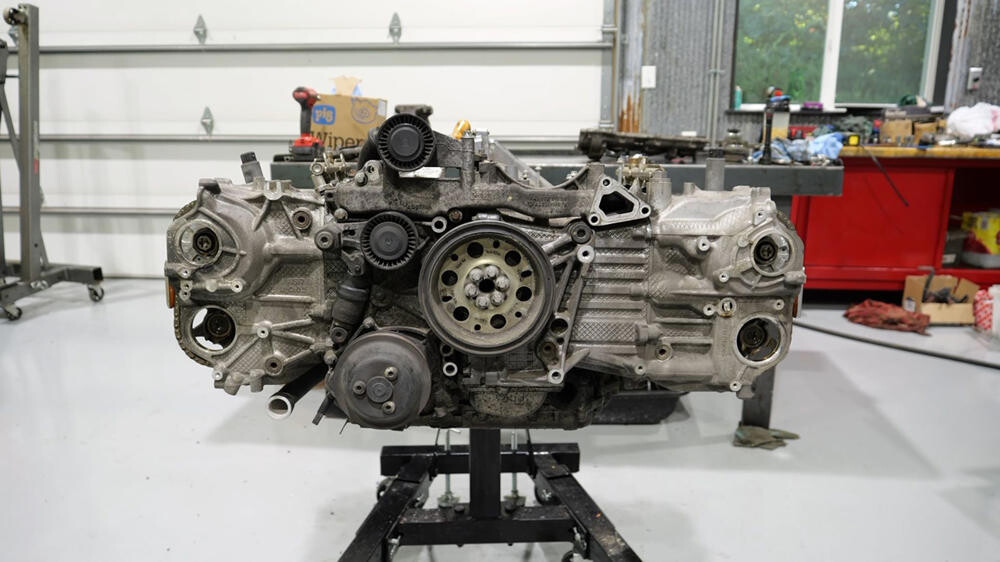
Few engines in the world are as iconic as the flat-six from Porsche. It has powered numerous iterations of the Porsche 911 for over a half-century, starting in the early 1960s as a small 2.0-liter air-cooled engine. Suffice it to say, the engine – like the 911 – has evolved significantly since then. But also like the 911, there's still a similar overall design. So, when we caught Eric of I Do Cars YouTube fame tearing apart a flat-six from a 2012 911, we had to tune in. Unless you're a schooled Porsche 911 mechanic, seeing one of these engines literally torn in two is a rare opportunity worth taking. And, as with all of Eric's teardown videos, this engine isn't healthy. Dissecting The Porsche 3.4-Liter Flat-Six Engine Specifically, this engine is the MA1.04 used in the confusingly named 991.1 generation of the 911. To be even more specific, this particular engine came from a 2012 911 Carrera, which produced 350 horsepower when new. The mileage on this engine is unknown, but as the teardown eventually reaches the bottom end, it's believed this engine has done quite a few miles. In other words, this 911 lived a good, proper sports car life. At one point, it was living such a good life that the engine was low enough to scrape the ground. Whether it was the result of taking a speed bump too quickly, or perhaps drifting too wide on a track and sticking the rear-engined car on a curb, we don't know. But the consequence was a small crack in the oil pan that allowed all the oil to drain away, apparently without the driver realizing it until the engine locked up. Bummer. How Complex Is A Porsche 911 Flat-Six Engine? Honestly, the best part of this teardown isn't getting to the inevitable carnage caused by no oil in a running engine. We're used to seeing V blocks and inline engines torn apart, but Porsche's flat-six is a work of art. It comes apart relatively easily, though it soon becomes apparent why nearly any notable engine work requires it to come out of the car. As for the MA1.04, the cams and cam gears are surprisingly simple to remove, and the heads on this engine appear to be in good shape. In fact, the top end in general looks good. However, getting a good look at the bottom end is a chore and a half. Specialized tools might make the disassembly a bit easier, but Eric resorts to some creative tactics to finally get the pistons out without causing additional damage. It's only then that we finally see the reason why the engine was locked up. One of the main bearings spun on the crankshaft, and by that, we mean it pretty much welded itself into place. In the process, it gouged one half of the engine block, effectively turning it into scrap aluminum. So, what does it take to kill a Porsche 911 engine? The same thing that kills other internal combustion engines – a lack of oil. In this case at least, it appears the failure happened at slow speed, but it was still a very costly error. According to the video, these engines in good used condition can easily sell for $10,000. CarBuzz Insight – Why This Matters: It's rare to see a Porsche engine disassembled to this level. The damage is unfortunate, but Eric points out something that can be applied to any internal combustion engine. Porsche owners tend to be very proactive on maintenance, and aside from the spun bearing, this particular engine actually looked pretty darned good inside. Some surfaces showed wear indicative of higher mileage, but it's a perfect example of why good maintenance and regular oil changes are important for a long-lasting, healthy engine. Just try not to scrape it across the ground if at all possible. Source: I Do Cars / YouTube