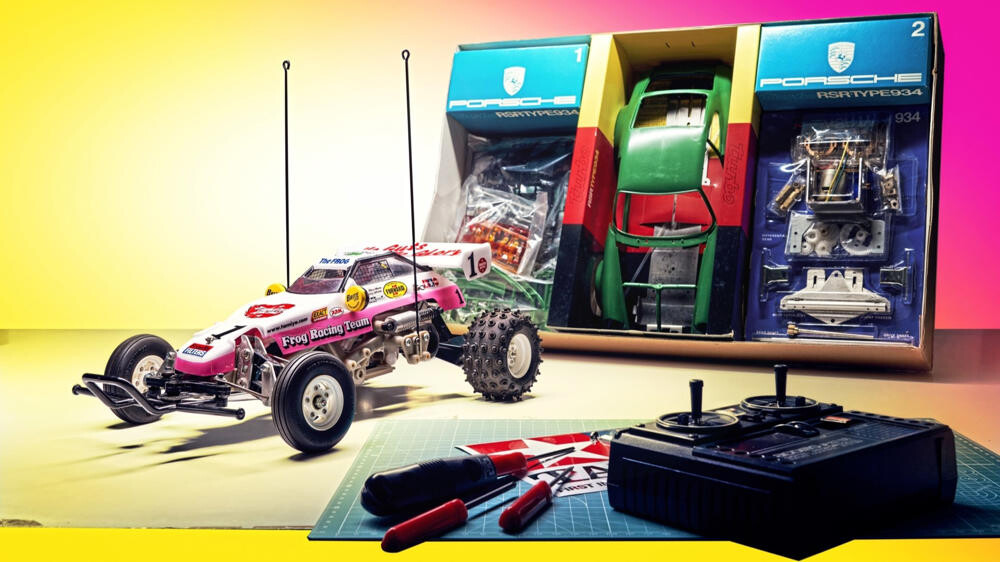
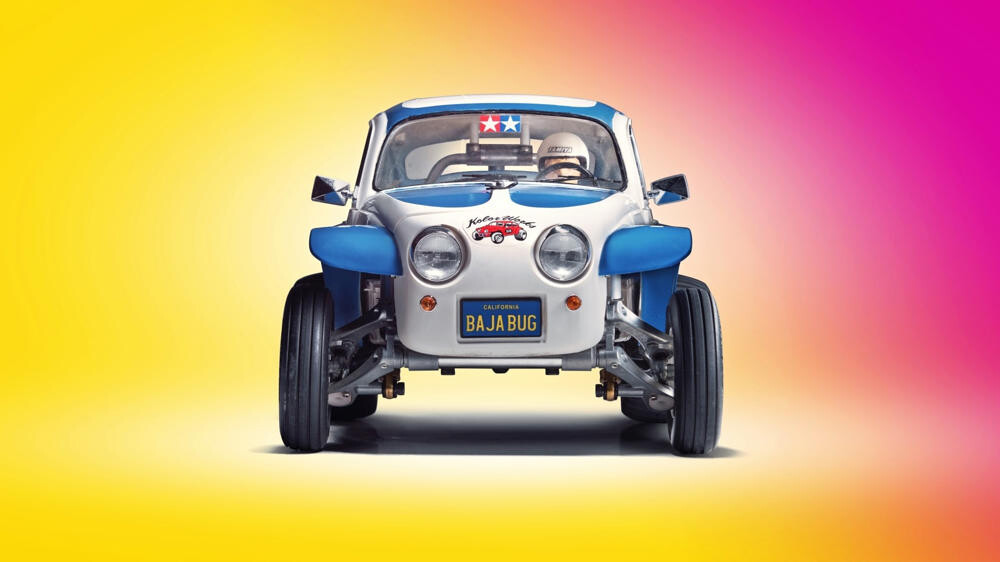
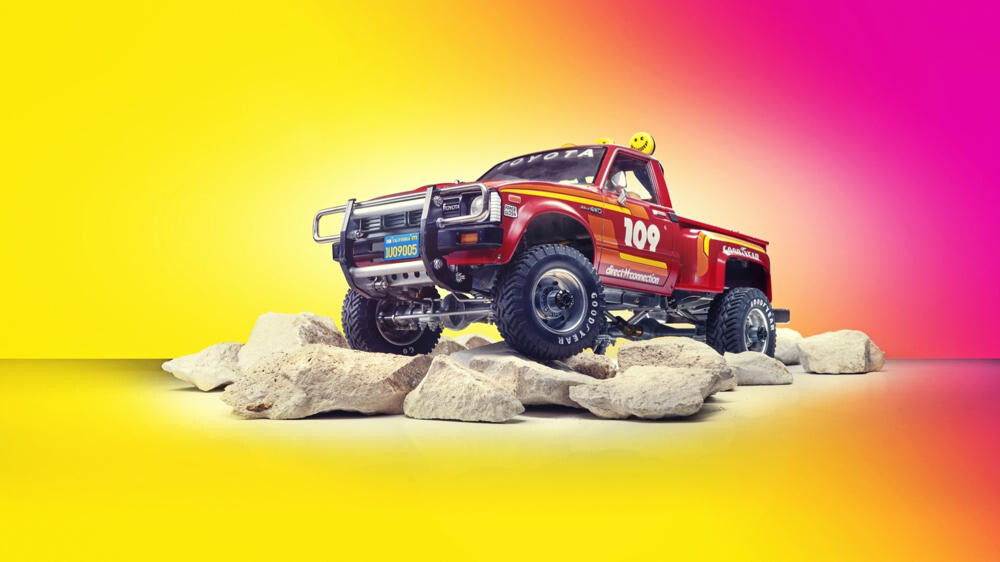
► The models that make petrolheads ► A history of the legendary toy company Certain objects in childhood acquire a gravity wholly disproportionate to their size. Small things that gather around them a seriousness that exceeds their material value. They become less possessions than companions to the developing imagination; objects through which a larger world fantastically reveals itself. For me, those objects were Tamiya radio-controlled cars. My first encounter arrived not as a kit but as a finished machine: a Martini Mk22 Renault Formula 2 R/C car. A hand-me-down. A speculative “Nicholas might like that” long shot taken by a family member who had, for some unfathomable reason, decided this exquisite miniature racing car wasn’t for them. For me, that disregard set a lifelong trajectory. I remember receiving that car, inspecting the suspension arms, the tiny fasteners, the precise relationship between bodywork and chassis. Even then it was clear that this was not quite a toy. Something about it suggested translation rather than invention – as though a real racing car had been carefully condensed while retaining its inner logic. Miniatures possess this curious authority. They are representations, yet they retain the syntax of the objects they imitate. But this was no display model. It was a radio-controlled car. One that promised movement. This Tamiya was therefore not merely a likeness of a machine; it was a mechanical system in its own right. Sadly, my family and I didn’t have the money to buy the radio gear – the servos, speed controller, receiver and handset – so the car sat on a shelf for several years, quietly impotent. The modern radio-controlled car itself emerged from a moment of mild irritation. In the mid ‘70s Shunsaku Tamiya – CEO of the company founded by his father – was sitting in his office when he heard a noise outside. ‘Oh, it’s him again,’ he thought. For months a colleague had been testing radio-controlled aircraft powered by tiny two-stroke engines in the air outside Tamiya HQ. Their high-pitched buzz had become a constant nuisance for those, like Mr Tamiya, working in their offices. That colleague was Dr Fumito Taki, a planning and development designer with a restless curiosity. But this time the noise was different. Dr Taki was not experimenting with an aircraft, but with a battery-powered radio-controlled car. ‘The minute I saw those batteries,’ Mr Tamiya later recalled, ‘a series of ideas burst off in my head like a bunch of firecrackers.’ You can almost imagine the chain of thoughts. Existing ICE radio-controlled vehicles: noisy and messy. Electric power: quiet. Batteries and motors: no engine, no exhaust. Cars that could be driven almost anywhere – even indoors. Mr Tamiya processed the possibilities quickly. ‘This might well prove a big hit,’ he remembered thinking. Ironically, freed from the constraints of a combustion engine, the scaled-down car could now resemble its real-world counterpart far more faithfully. The first Tamiya radio-controlled model to emerge from that intuition was a sublime Vaillant-liveried 1/12 Porsche 934 Turbo (top speed 12mph). By modern standards it was simple, yet it introduced an entirely new dimension to the model-makers hobby. Tamiya approached the R/C experience with the same rigour it applied to the model kits it had been building for years. The company understood that the discovery of the object was as fundamental to the experience as the finished, moving machine. The encounter therefore began, inevitably, with the box. Before a single screw is turned, the car exists as image. Tamiya understood packaging in a way that bordered on theatre. The lid did not simply display the product; it dramatised it. Much of that atmosphere came from the extraordinary artwork commissioned by the company – paintings of cars already alive with motion, desert racers cresting dunes, rally machines sliding through gravel. These illustrations were less descriptions than promises. They suggested what the object inside the box might become. To perfect the quiet ceremony of discovery (long before Silicon-Valley turned unboxing into a cultural ritual), you just need to lift the lid of a Tamiya box. There, arranged with almost monastic discipline, lie the elements of the machine: sprues of plastic components, small bags of screws, suspension arms, gears and bearings. The instruction booklet unfolds like a technical manuscript. The drawings possess a quiet artistry of their own – every component rendered with meticulous clarity, every stage accompanied by full-scale illustrations that allow each part to be recognised instantly. The effect is strangely intimate. You begin to feel that the designers themselves are present in the process, that Mr Tamiya and Dr Taki are standing quietly behind the builder, guiding the machine into existence. Tamiya understood that the meaning of the kit lay as much in the experience of building as in the finished object. ‘The most important thing,’ Tamiya insisted, ‘is whether you are taking the customer’s point of view into account when designing the model.’ Even the sequence of construction demanded careful thought. It was not merely a matter of ease of assembly but whether the order of assembly itself remained enjoyable. The model therefore existed in two phases: first as a set of components, then as a machine. My own first act of participation came with the first car I built myself: a 1/10th scale buggy – the Super Sabre. Until then I had admired these machines from the outside; now I was responsible for constructing one. The process was absorbing. Each component belonged to a network of relationships. Suspension arms pivoted on pins. Dampers controlled motion. Gear trains translated electrical energy into movement. When the completed car first ran under its own power, something subtle changed. The object became a system. It responded to terrain, to steering inputs, to friction and momentum. Playground tarmac and gravel driveways became landscapes through which the small mechanical organism expressed its behaviour. By the early 1980s Tamiya’s radio-controlled cars had already begun to develop their own visual mythology. Many of the early vehicles drew heavily on the iconography of Baja and desert racing. Cars such as the Sand Scorcher, the Frog and the Super Champ seemed to belong to a world of dust, heat and mechanical violence, even when they were being driven across damp British gravel or suburban lawns. Even the Brat and Hilux, though amplified and romanticised, still translated recognisable vehicles – the Subaru pickup and Volkswagen Beetle – into this sun-blasted off-road language. Then, almost imperceptibly, the language began to change. With cars such as the Hotshot, the company’s first 4×4 buggy, the Super Sabre and the Boomerang, Tamiya seemed to take the Baja concept and propel it somewhere far stranger. These were no longer miniature off-roaders derived from real vehicles. They were speculative machines. Concepts. These buggies were imagined by an era intoxicated with science fiction – an age of Star Wars – and the quiet assumption that the future would arrive in a burst of brilliant machinery. The thirteen-year-old me loved this utterly. This new wave felt space-age. Not as though they had been designed for the desert, but as though they might have been built to skim across the surface of the moon. Increasingly playful driver names began appearing on the bodywork – Crash Cramer, “Terrible” Tony Atkins, “Eager” Ted Edwards, Harry Hurryup – less like racing drivers and more like the call signs of experimental test pilots. And then came the Avante (and its driver, “Paranoid” Perry). The others looked as though they could drive on another planet. The Avante looked as though it had arrived from one. I had to have it. Saving for the Avante took nearly a year, which only intensified its aura. By then it existed in my imagination less as a toy than as an object of destiny. Even before the first component was installed, it seemed to belong to a different category of machine. The chassis plates were an exotic fibre-reinforced plastic composite, the suspension featured complex wishbone arrangements, and at its centre sat a differential distributing power between front and rear axles. Three diffs. Yep. Building it was less like assembling a model than constructing a miniature racing car from the future. For the first time I understood how suspension geometry worked. I discovered the purpose of differentials and the strange alchemy of weight distribution. These were not lessons delivered through theory but through assembly. Long before I understood the vocabulary of engineering, the Avante had already introduced me to its grammar. By the mid-1980s Tamiya’s radio-controlled kits were selling in their millions each year, fuelling what many enthusiasts still remember as the golden age of electric R/C. Entire playground economies revolved around them. Engineers, designers and racing drivers of a certain generation often speak of Tamiya with quiet reverence. Adrian Newey has spoken about building Tamiya model kits as a boy; Gordon Murray has described the formative importance of mechanical curiosity. For many of us the first real understanding of engineering arrived not in a classroom but through a cardboard box filled with precisely moulded parts. As a child I liked to imagine that some distant master-apprentice relationship existed between Shunsaku Tamiya and the builders of his models – a relationship conducted entirely through cardboard boxes and instruction manuals. Years later I finally met him. By then I had interviewed global automotive CEOs and Formula One world champions, yet meeting Mr Tamiya – for Car magazine at the 2009 Nuremberg Toy Fair – made me more nervous than any of them. For someone who had grown up building his machines, the encounter carried a strange emotional weight. Before our second meeting, again at the Nuremberg Toy Fair, I brought along something I had rediscovered at home: a stack of old school exercise books covered with pages from Tamiya catalogues. Mr Tamiya examined these exercise books with obvious amusement. Then, with the instincts of a lifelong perfectionist, he opened one of the books at random and began studying the contents. Unfortunately it was a mathematics exercise book. He peered down at the pages for a moment, scanning the sums with quiet concentration. I remember wishing very strongly that he would close it again. Mathematics had never been my strongest subject. Eventually he looked up with a mischievous chuckle – almost childlike in its warmth – and handed the book back. I was quietly relieved. What struck me most about my encounters was not simply the humour but the mindset behind it. Even in his eighties Mr Tamiya still approached the world with the curiosity of an engineer. Everything was a problem to be understood, a system to be examined. Reading his book /Master Modeler – Creating the Tamiya Style/ made that clearer. Again and again he returns to the idea that a model is not simply an object but an experience carefully designed for the person building it. ‘It’s very important,’ he writes, ‘to find the right balance between the parts you eliminate and the parts you reproduce intricately.’ The sentence captures something fundamental about the Tamiya approach. Too much realism and the kit becomes frustratingly complex; too little and the illusion collapses. Somewhere between those extremes lies a design that allows the builder to feel both competent and curious. Above all, the builder must enjoy the process. ‘This is not simply a matter of ease of assembly,’ he explains. ‘It is also a question of whether the order in which you assemble the parts is fun or not.’ That idea sounds simple, yet it explains why Tamiya kits feel so different. The construction sequence has a rhythm. One part reveals the logic of the next. The builder begins to sense the architecture of the machine emerging step by step. The seriousness with which Tamiya pursued authenticity could occasionally border on the absurd. When researching the 1/12th Porsche model that inspired the Vaillant R/C car, he decided that drawings and photographs were not enough. I recall him telling me that he bought a 911S car for reference, not for driving. ‘Disassembly was my only aim.’ Wheels came off first, then bumpers, then panels, until the car had been reduced to its constituent pieces. It was, he admitted, ‘a strange scene’, but the engineers were able to handle every component directly and gather the data they needed. At one point they discovered that the task had become so thorough that reassembling the car proved rather more difficult than taking it apart. The story says a great deal about the man. There was in Mr Tamiya a quiet conviction that accuracy mattered, that understanding how something worked was the surest route to appreciating it. For him the model was not merely a representation of a machine but a means of explaining the machine itself. And perhaps that is why those small boxes of plastic parts carried such power for so many children. They were lessons; not toys. Shunsaku Tamiya died in July 2025 at the age of ninety, leaving behind not simply a company but a culture – one built on the belief that curiosity, patience and good engineering could transform a box of plastic parts into a world of discovery. And today, Tamiya continues to offer a beguiling range of R/C cars – reissued classics and new models – that stand the test of time in a digital world. What makes Tamiya extraordinary is not simply the quality of its products but the worldview it implies. In its radio-controlled cars, these small reverential machines suggested that engineering was not an abstract discipline reserved for specialists but a form of creativity accessible to anyone willing to pick up a screwdriver and begin. In reducing the scale of the machine, Tamiya made logic visible. And in doing so it allows generations of enthusiasts to encounter the beauty of mechanical design not through textbooks or factories but in a garden, a driveway, or on your bedroom carpet (sorry, mum). Miniatures possess this curious authority. They are representations, yet they retain the syntax of the objects they imitate

 Liked by Gabriel Smith, Emily Tremblay





















 Liked by Gabriel Smith, Emily Tremblay