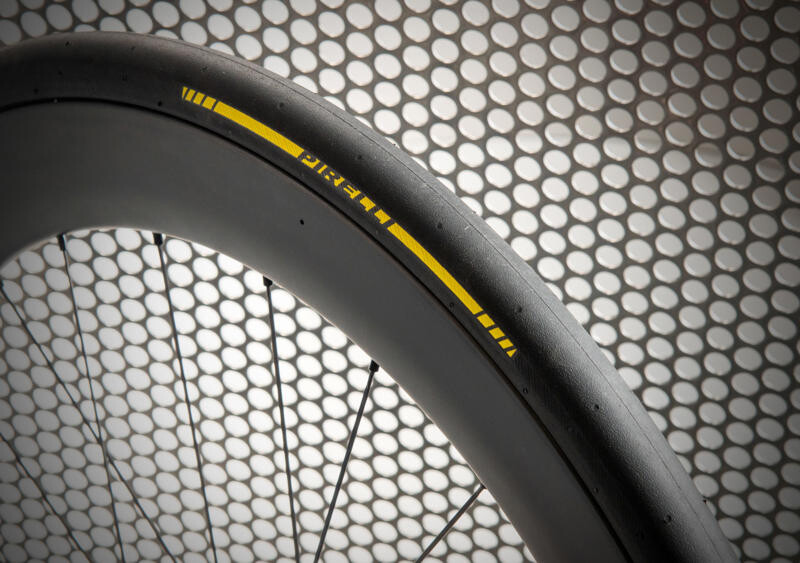
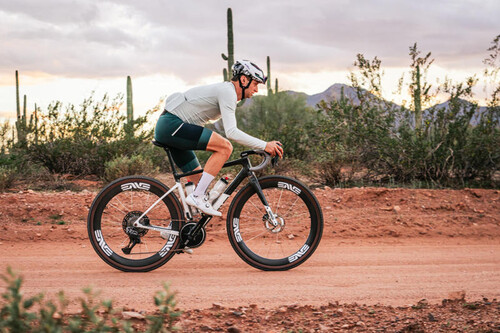
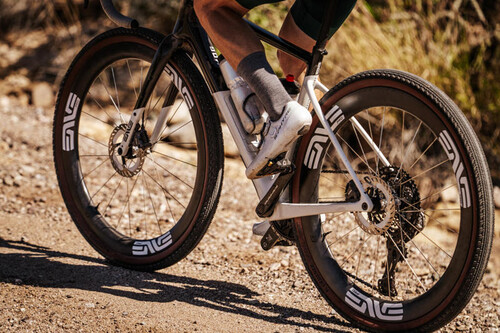
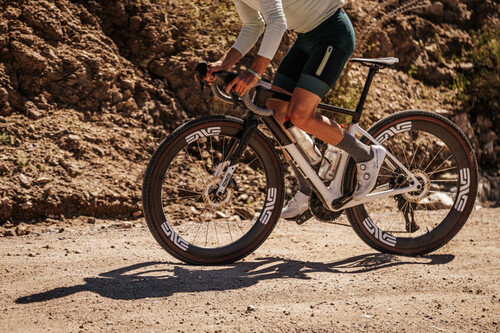
Pirelli has launched the brand new P Zero Race SL-R tyre today, which it claims is the ultimate road racing tyre, offering best-in-class aerodynamics, along with low rolling resistance, grip, handling and comfort.Along with these big claims, the brand claims a 2-watt normalised aero gain at 45km/h has been achieved relative to its P Zero Race RS - the brand's current flagship road tyre.The eagle-eyed out there may have spotted pro riders racing on Pirelli tyres marked 'Prototype' for quite a while now, and it appears the time is now right for Pirelli to officially reveal what these new tyres are. Pirelli has focused on the performance and aerodynamic drag of the wheel and tyre system overall. We recently caught up with Pirelli product manager Carlo Di Clemente to learn more. Di Clemente says that, although 80% of the drag when riding comes from the rider, of the residual 20%, up to 5% can come from the front wheel and tyre. This is increased by the trend to wider tyres on wide rims, which increases the frontal aero presented to the wind.It appears Pirelli has focused on this and sought to reduce flow separation at the interface between the front tyre and wheel rim and maximise the sailing effect to improve aerodynamic performance.The development of the P Zero Race SL-R drew on Pirelli’s expertise in aerodynamics and CFD simulation and used tools from Pirelli’s MotoGP and F1 divisions in an 18-month development programme.Over 14 iterations, analysis included a range of proprietary techniques such as unsteady flow simulations borrowed from Pirelli’s other divisions.Pirelli also took the tyres to four different wind tunnels over eight testing sessions. Di Clemente says that although the results for different wind tunnels weren’t precisely the same, they were consistent.Patented PAAS technologyPreviously, brands have made tyres more aero by utilising features such as the vortex generators used in the Continental Aero 111 tyre and the new Cadex Aero tyre. Others, such as the previous generation Cadex aero tyre, have a narrow and tall section. Another option is to use a tyre that’s narrower than the rim to reduce frontal area, a design which can be observed on Roval Rapide front wheels. Di Clemente claims that these approaches have their deficiencies. Vortex generators work better at high yaw angles but may increase drag at low yaw angles, while a pointy tyre can impact handling, and both can increase rolling resistance. Meanwhile, a narrower tyre has to be run at higher pressure, which can result in the by now well-known impacts on rolling resistance and comfort.In contrast, the P Zero Race SL-R has a standard profile and a slick tread. Its aero performance instead comes from its patented PAAS technology. This adds rubber at the tyre’s side, increasing the tyre’s width in the space above the rim, helping to smooth the tyre-to-rim interface.Signifying Pirelli Advanced Aerodynamic System, PAAS results from Pirelli’s research finding that there’s a specific positioning of the tyre’s widest point relative to the tyre’s height, when mounted on the rim, which provides optimal aerodynamic performance. As such, the PAAS profile is tyre-width specific, although the effect is seen across a range of rim profiles and yaw angles, particularly at higher yaw. Pirelli says that PAAS continues to be effective even as the tyre tread wears.It’s similar to how Trek tried to smooth the airflow between the tyre and rim with its Bontrager R4 320 tyre, which was launched over a decade ago. However, Di Clemente says that Pirelli’s approach still allows the tyre to be mounted and removed easily. Interestingly, he claims that the small groove around the edge of the tyre above the rim doesn’t affect the new tyre’s aerodynamics.Pirelli found that the width of the PAAS layer needed to vary by tyre width, so the brand will be launching the P Zero Race SL-R in just 28mm and 30mm widths, with a larger 32mm size scheduled to follow in October. The 28mm tyre has a 275g claimed weight, 15g less than the P Zero Race RS, although we weighed a pair at 286g and 288g.2 watts faster than the P Zero Race RSPirelli's results show a marked decrease in drag at high yaw angles versus the P Zero Race RS (Image credit: Pirelli)As well as multiple wind tunnel runs, Pirelli tested its new tyre on four different rims, including hooked and hookless designs and popular models from Zipp and DT Swiss.We asked for a little more information on the brand's wind tunnel testing procedures and learned that a 60mm deep, hooked wheel was tested, which had a 23mm internal width. 28mm tyres were tested at an airspeed of 45km/h.Overall, the brand's wind tunnel testing shows a 2-watt aero gain in weighted average drag over the P Zero Race RS, normalised over yaw angles of up to 20 degrees at lower speeds. In a high wind test, this increased to 5 watts, due to a greater sailing effect at higher yaw angles.At a high yaw angle of 15 to 20 degrees, Pirelli claims it found a huge 15-watt saving versus the P Zero Race RS 28mm tyre in a single measurement point. Di Clemente says that this is likely due to the absence of a tread pattern on the new tyre, as Pirelli found that adding a grooved tread, which the P Zero Race RS has, impacted aerodynamics. The 15-watt figure is an edge case and peculiar to Pirelli’s tyres; the energy saving is less marked, but still significant, relative to competitors’ tyres it also tested at lower yaw angles. Overall, the key takeaway is roughly a 2-watt claimed saving over the previous Pirelli range topper; it's unrealistic to expect huge 15-odd-watt real-world savings just by switching tyres. In its quest for aero optimisation, Pirelli has also reduced the font size of the embossed tyre info, which is mandated for all tyres, to the permitted minimum to avoid aerodynamic interference. 10% lower rolling resistanceTurning to rolling resistance, Pirelli uses the same Smart Evo 2 rubber compound in its P Zero Race SL-R, derived from its motorsport tyres, as in its P Zero Race RS tyre, which came out mid-pack in our CN Labs own rolling resistance tests of 24 tyres. Nevertheless, it says that there’s a 10% decrease in rolling resistance, amounting to 2 watts saved per pair of tyres, due to its new LiteCore 120 TPI tubeless-ready casing.The lighter casing is claimed to be more supple, increasing ride comfort and grip, as well as lowering weight.Despite a lighter casing, there’s still a puncture protection belt built into the tyre, and Di Clemente says that the mileage you can expect is the same as for the P Zero Race RS tyre.Pirelli is also likely to launch a time trial version in future, Di Clemente states.The P Zero Race SL-R is also the first tyre in the P Zero range not to be sold in 26mm width. It’s already been used in the pro ranks and has ridden to two stage wins and the points classification in the 2026 AlUla Tour, as well as Stage 7 of Tirreno-Adriatico, by Lidl-Trek’s Jonathan Milan. Matheu van der Poel himself also appeared to be using the tyres at Milan-San Remo. Mounting and first ride impressionsAs with many tubeless tyres, mounting the P Zero Race SL-R tyres was a bit of an ordeal. But once on the rim, I seated both tyres first time with just a track pump, and they held air immediately. On a 19mm hooked rim, they measured exactly 28mm.A ride of a couple of hours suggested that they provide good comfort on typical UK road surfaces, and they felt as if they rode performance tyre fast, even if I had no basis to assess the aero claims. Pirelli P Zero Race SL-R prices Both the 28mm and 30mm width of the Pirelli P Zero Race SL-R tyre are priced at £94.99 in the UK, or £99.99 for the Team Issue tyre with yellow logos, as ridden by Mathieu van der Poel. In Europe, both the standard and Team Issue tyres cost €99.99.