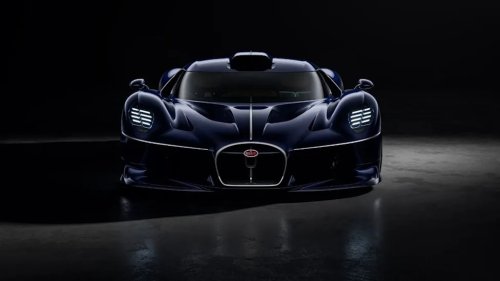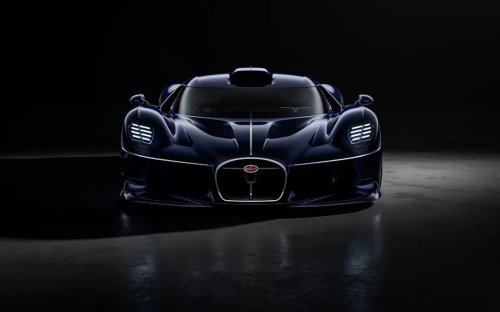
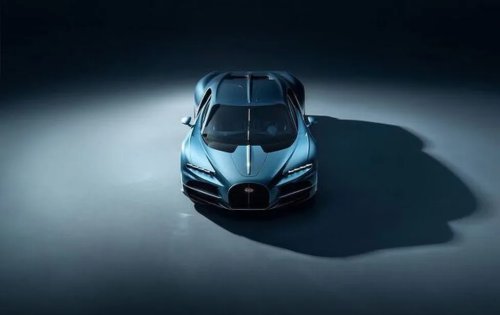
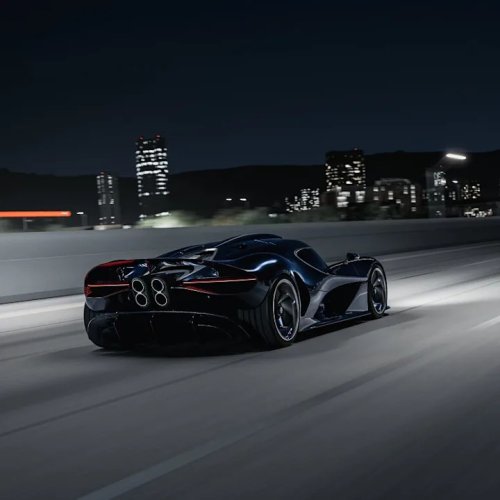



















performance is becoming secondary as supercars enter a new eraThe multi-million-dollar hypercar market is officially splitting from mainstream passenger vehicles.While that has always been more or less the case, there will soon be fundamental differences in the underlying technology. Digitized, low-cost electric vehicles and software-defined mass-market automation will dominate everyday transportation, while the highest tier of performance cars will rely on analog engagement from internal combustion engines for decades to come.That is the verdict from Bugatti Rimac CEO Mate Rimac, who told CNBC that ultra-luxury sports cars are undergoing a fundamental transformation similar to the high-end watch market.AdvertisementAdvertisement"For normal cars, normal people, the vast majority will be electric," Rimac said. "The upper segment, like sports cars and upwards, are going to stay combustion for a very long time, exactly like watches. Only like 5% of watches are made in Switzerland, but that's where 90% of profits are made. An Apple Watch or any kind of smart watch can do so many more things. But no one will pay $200,000 for it."The mainstream market is shifting toward commoditized, appliance-like EVs-many originating from budget-focused Chinese manufacturers. However, hypercar buyers paying top dollar demand loud, emotionally engaging internal combustion engines rather than silent electric batteries.Performance numbers alone no longer justify hypercar prices when a mass-market EV can deliver brutal off-the-line acceleration for a fraction of the cost.The strategic vision translates directly into Bugatti's current product strategy. When Rimac Group took control of Bugatti alongside Porsche in 2021, industry watchers widely assumed the merger would yield an all-electric Bugatti hypercar. Instead, Rimac spearheaded the development of the Tourbillon-a hybrid hypercar built around an 8.3-liter naturally aspirated V16 engine.AdvertisementAdvertisementDeveloped alongside Cosworth, the massive 1,000-horsepower V16 pairs with three electric motors to deliver a combined 1,800 horsepower."It's kind of ironic that I'm now making the world's biggest combustion engine," he said. "You have the crazy situation now at our facility in Croatia. On the same production line, you have the world's most powerful electric car being built right next to the world's biggest combustion engine. Life is strange sometimes."2026 Bugatti Tourbillon: 16 Cylinders, 3 Electric Motors, 1,800 HPThe 2026 Bugatti Tourbillon is the first all-new Bugatti since the Chiron. It's a big deal, and for the first time, the Tourbillon takes the brand hybrid. This latest model features a hybrid V16 powertrain, eschewing both the automaker's preferences for both W16 engines and pure combustion output. But the news of a hybrid system almost pales in comparison to some of the headlining figures: this V16 engine will produce 1,800 horsepower, displace 8.3 liters, and rev to 9,000 rpm - all to say nothing of the monster 664 lb-ft of torque driving all four wheels. But the hybrid powertrain is still worth discussing. Bugatti tells us the Tourbillon's front axle carries two electric motors with a third located in back to help spin the massive rear tires. These, by the way, are underpinned by 3D-printed suspension components to help reduce weight. Only 1,000 of the car's stratospheric horsepower is provided by the new V16 - the other 800 comes courtesy of the 25 kWh battery pack mounted in the center of the car. The system adds functionality and drops weight when compared to the Chiron, seemingly disobeying the principle of the conservation of matter. Bugatti says the Tourbillon, despite its 555-pound engine, is still lighter than the Chiron while simultaneously allowing it to cruise around town for up to 37 miles without ever firing one of the massive V16's many cylinders. Bugatti doesn't say how long it'll take to charge the hybrid system but assume it's brisk given the car's 800-volt architecture.Chase BierenkovenExclusivity and bespoke personalization remain the primary profit engines for hypercar manufacturers. Production of the Tourbillon is strictly capped at 250 units globally, with a starting price tag of roughly $4.5 million. Despite the steep entry price, average buyers spend an additional $600,000 to $700,000 on custom paintwork, unique leather stitching, and one-off interior materials.AdvertisementAdvertisement"You can get a car that's faster than any performance car from 10 years ago for like $50,000 from China," he said. "Performance is really becoming secondary. It's more about what I call the celebration of human skills. When you look at these cars, you see the amount of ingenuity and art and beauty. The car is, like, the most complex object you can buy. It's art, but it's art that needs to go 250 miles per hour and be safe, have downforce and survive in a crash test and go in the snow and extreme heat, and all those things."To capitalize on this demand, manufacturers like Bugatti, Ferrari, and Lamborghini are leaning heavily into bespoke builds and coachbuilt one-offs-such as the track-focused Bugatti Destrier unveiled at Monterey Car Week.Become an AutoGuide insider. Get the latest from the automotive world first by subscribing to our newsletterhere.