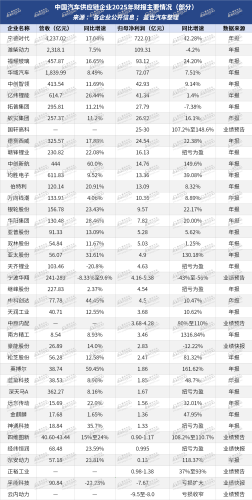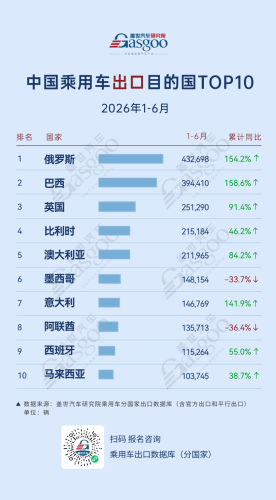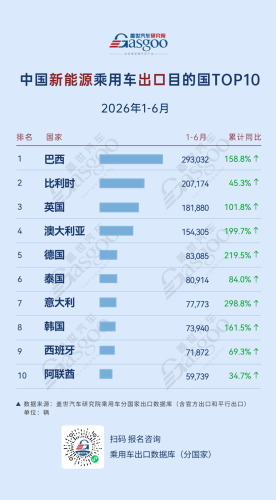
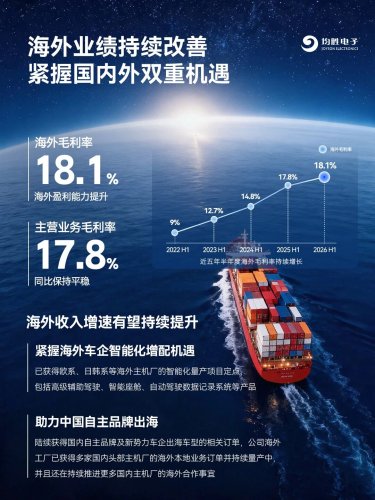




















Gasgoo Munich- Price wars for finished vehicles keep coming, and parts suppliers are seeing sales grow without profits. Even upstream lithium miners, whose profits multiplied, largely rode a cyclical recovery in hindsight. The domestic market is getting crowded, and cash is tight across the supply chain. Going global has become the common choice for many parts makers.In the first half of 2026, China's vehicle exports exceeded 5 million units. Suppliers following their customers abroad are arriving in waves, and news of factory construction overseas has been almost non-stop.Yet, going overseas often sounds better than it looks on paper. Are profits in overseas markets really fatter than at home? Building a factory abroad—is it finding a new profit source, or just swapping one set of costs and risks for another?Image Source: General Science TechnologyIs money easier to make overseas?Data from Gasgoo and East Money Choice shows 275 listed auto parts companies logged 822.65 billion yuan in revenue in the first half—a 5.3% annual increase. But net profit fell 9.52% to 45.67 billion yuan. Overall, sales are up, but profits aren't.Among the half-year reports, the companies that fared better either saw rapid growth overseas or saw declines abroad that were milder than at home. Almost all carried an "overseas" tag.Direct exports at the industry level are holding up. Data from the China Association of Automobile Manufacturers, citing customs statistics, shows parts exports hit $51.03 billion in the first half—up 7.6% year-on-year. June alone saw $9.73 billion, a 19% jump, as momentum picked up in the second quarter.Compare that to finished vehicles: exports reached 5.096 million units in the first half, surging 65.3%. By value, vehicle exports totaled $91.8 billion, up roughly 54%. The growth rate for direct parts exports is far flatter.First, distinguish the metrics. Customs data tracks the value of goods shipped out. For listed companies, "overseas revenue" is a broader bucket—it includes local production and sales from foreign factories.An earlier analysis by *Economic Information Daily*, using data from iFinD, found that among 37 companies reporting by August 19, 29 broke out foreign revenue. That total came to 32.67 billion yuan—a 15.42% rise, significantly outpacing the sector's 5.3% sales growth.Companies with a higher share of overseas business generally saw steadier revenue in the first half. But that stability comes with a caveat: if exchange rates swing or new factories struggle to ramp up, a heavy overseas exposure can backfire.Gross margins tell the clearer story. For companies that break out revenue by region, selling similar products abroad generally yields fatter margins. The extent of that premium—and what drives it—varies.Xinquan's overseas revenue jumped 43.34% to 2.115 billion yuan, with a gross margin of 27.6%—4.8 percentage points higher than a year ago and above its domestic level. It has expanded capacity to Mexico and Slovakia to stay close to customers in North America and Europe.Joyson Electronics has an even bigger overseas footprint. First-half revenue abroad hit 21.36 billion yuan with an 18.15% margin, compared to 6.59 billion yuan at home with a 16.65% margin. The company says its overseas margins have risen for five straight half-years, climbing from 9% in the first half of 2022 to over 18% this year.Image Source: Joyson ElectronicsFar East Transmission tells a similar story. Overseas revenue rose 27.93% to 75.97 million yuan, making up 8.40% of sales. Gross margins there hit 32.22%—up nearly 2 points and more than 8 percentage points higher than the domestic business's 24.13%. The profitability of its overseas operations is clearly superior.The gap is even wider for battery giants, though they aren't counted in that group of 275 parts makers due to industry classification.CATL's overseas revenue surged 42.35% to 87.13 billion yuan, with a gross margin of 29.97%—nearly 9 points higher than at home. Gotion High-Tech and EVE Energy also saw foreign margins of 18.05% and 15.48%, respectively, beating their domestic figures.The domestic market has been battered by price wars year after year. Automakers pass "annual price reduction" mandates down the supply chain, forcing suppliers to undercut one another. Overseas markets—especially the global supply chains of North American and European automakers—are less cutthroat. The pressure to cut prices is milder.Crucially, breaking into those Western supply chains usually requires specialized, certified technology—not commodity parts where price is the only factor. Fat margins are reserved for those who clear the high barriers to entry, not for anyone who simply ships goods abroad.Lumping together direct exports, factory building, and global integration risks overestimating how widespread these profits are. Whether going abroad is a better business depends entirely on which path a company takes.Same destination, different paths to profit"Going global" means very different things for different players. Broadly, there are three paths: direct exports, building factories abroad, and overseas mergers. The capital required, the payback timeline, and the risks involved vary wildly.Direct exports are the lightest lift. Produce at home, ship abroad. No land, no factories, and quick cash flow. But the low barrier to entry means anyone can play, and commodity parts offer little pricing power. You're also fully exposed to tariffs and currency swings.The fact that industry-wide direct parts exports grew just 7.6% in the first half shows the limits of this route.Building factories overseas is far heavier—and it is now the main battlefield.Often, building abroad isn't a choice; it's a necessity. Tariffs and trade barriers are making direct exports increasingly difficult.Customers also demand proximity. Western automakers want suppliers nearby. Some host countries mandate local content and offer tax breaks. As BYD, Tesla, and others expand overseas, their suppliers are being pulled along with them.A clear map emerges from where these companies are landing: North America, Southeast Asia, and Europe-North Africa.To the north, Mexico is the hot spot. Over 20 Chinese parts makers have set up shop there by the end of 2025, adopting a "China tech, Mexico manufacturing, North America supply" model. Meeting USMCA rules on local content is easier, allowing compliant entry into the U.S. market.To the south, Southeast Asia is a key target. Chinese firms are planting flags in Thailand, Vietnam, Indonesia, and Malaysia. Kabei is investing 250 million yuan in Vietnam. Guangdong Hongtu is building a base in Thailand. Xinquan is spending $42 million in Malaysia to serve the region. Hongfa has a base in Indonesia and is building in Vietnam. Jifeng's seat production hub in Southeast Asia is already running.Further west, Morocco has become a springboard into Europe and North Africa. Ningbo Gaofa built its first non-Asian factory in Tangier, while Sentury Tire is planning capacity for 12 million tires. In Europe itself, Desay SV is setting up in Spain, Xinquan is expanding in Slovakia, and Jifeng's base is under construction.Building factories overseas is a heavy-asset game with slow returns. Early depreciation and the struggle to ramp up production usually mean losses in the beginning.Sailun Tire's Mexico plant, designed for 6 million passenger-car tires, started production in May 2025. In the first half of this year, it was still ramping up. The company admitted in May that it hadn't broken even yet. By June, it confirmed gross margins had turned positive. By September, it clarified that the Mexican factory had achieved monthly positive gross margins in the second quarter—profit improvements are just beginning.Linglong Tire's Serbian factory generated 1.48 billion yuan in revenue in the first half but still booked a loss of about 15.03 million yuan. That's a massive improvement from the 126 million yuan loss a year earlier, nearly breaking even. Building a factory doesn't mean instant profits; depreciation crushes earnings until capacity utilization rises.Similar early losses aren't limited to the tire industry.Image Source: Tuopu GroupTuopu Group, which makes lightweight chassis parts, thermal systems, and electronics, saw overseas revenue rise 14.41% to 3.33 billion yuan, outpacing domestic growth of 7.18%. Overseas sales now account for over 20% of the total. Its Mexico plant is ramping up, production lines in Thailand are starting, and a second phase in Poland is planned.But depreciation from ramping up overseas factories, currency losses, rising raw material costs, and new domestic capacity all weighed on the bottom line. First-half net profit fell 21.03%. Overseas sales are up, but profits haven't caught up yet.The third path is overseas M&A—buying mature technology, customers, and a global network. Integration is the hardest part. Cross-border management, cultural clashes, and goodwill write-downs are major hurdles. But for those who survive, the upside is the biggest.Jifeng Holding is the classic case. It acquired Germany's Grammer years ago. In the first half, Grammer's revenue rose 2.21% to 7.77 billion yuan, while net profit jumped 83.18% to 171 million yuan. In the second quarter, the operating margin in Europe hit 8%, and North America moved closer to break-even.Combined with its own passenger seat business—which surged 110.62% to 4.18 billion yuan—Jifeng's total revenue climbed 24.28% to 13.08 billion yuan. Net profit soared 137.26% to 365 million yuan. The acquisition burden has turned into a global seat supply network.Others fail to digest their acquisitions. Ningbo Huaxiang's European operations lost money for over a decade. In 2025, it sold six European subsidiaries and North American assets, booking a 1.03 billion yuan loss in the first half of last year alone. This year, it returned to profitability with 723 million yuan in net profit, but revenue fell 20.42% as the overseas units were deconsolidated. Overseas revenue now accounts for just over 8%.These three paths outline the broad direction, but the specifics of execution vary in weight.Zhang Yongwei, head of the Chebaihui Research Institute, notes that pure trade—just shipping goods out—is increasingly viewed by host countries, especially in Europe, as contributing nothing in jobs, taxes, or industry. Regulations will only tighten. But localization doesn't always mean building your own factory. Leasing existing capacity or contract manufacturing are lighter, more flexible options.For suppliers, he favors a partnership model: using tech licensing, joint ventures, and digital upgrades to turn wary local companies into partners. This defuses conflict and outsources the headache of local complexities.The tire industry illustrates the risks and rewards best. It went global earliest, has the broadest footprint, and sees the starkest divergence—pushed furthest by tariffs. Its experience offers lessons, but tariff pressures vary by sector, so direct comparisons are tricky.Sailun Tire's overseas revenue hit a record 15.24 billion yuan in the first half. It has the largest planned overseas capacity among Chinese tire makers. Net profit rose 17.97% to 2.16 billion yuan. General Science Technology, riding on its Thailand and Cambodia bases, saw profit jump 114.84% to 138 million yuan as its Cambodian phase II reached production.On the other end of the spectrum, Linglong Tire's net profit collapsed 88.13% to just 101 million yuan. Sentury Tire fell 37.47% to 420 million yuan. Both built factories abroad, yet the results are worlds apart.The divide comes down to location choices, tariff strategies, ramp-up speed, and currency management—precisely where profits leak out.Where do the profits leak?Overseas margins are higher and growth is faster, yet there's a catch in the earnings reports: some companies with heavy overseas exposure saw net profits plunge. Between gross margin and the bottom line lie exchange rates, depreciation at new plants, tariffs, and shipping costs. The more you go abroad, the bigger the exposure.On the road overseas, there are several obvious leaks.The most common is currency. The higher the overseas revenue share, the greater the exposure to yuan fluctuations—a variable largely outside management's control.Image Source: Fuyao GlassFuyao Glass is the prime example. It booked an 803 million yuan currency loss in the first half, compared to a 602 million yuan gain a year earlier—a swing of roughly 1.4 billion yuan. Strip out currency effects, and total profit actually rose 4.78%. Instead, net profit fell 17.37% to 3.97 billion yuan.Linglong Tire swung from a 691 million yuan currency gain to a 342 million yuan loss—a gap exceeding 1 billion yuan. That was a major driver behind its near-90% profit drop.Smaller player Daimaishi saw exports rise 24.28% to 111 million yuan while domestic sales fell. Overseas sales were strong, yet net profit still dropped 36.55%. Currency losses were the main culprit.When your business is abroad but your books are in yuan, a single swing in the currency can wipe out months of operational gains.Trade barriers keep shifting. Companies move factories to Southeast Asia to dodge tariffs, only to face new trade remedy investigations targeting that region. The window for low tax rates is closing.In July 2026, the EU finalized anti-dumping duties on Chinese passenger-car and light-truck tires. Rates for cooperating firms were set at 24.4%, and 45.3% for others. Combined with previous anti-subsidy measures, the space for direct exports to Europe was squeezed tight—ironically benefiting those who had already built factories abroad.The U.S. is conducting rolling reviews, too. That same month, an administrative review set the duty rate for Prinx Chengshan's Thai plant at 2.9%. These reviews happen annually, and rates are reset each time. Companies can't rely on a single setup forever; Southeast Asia is no permanent safe haven.Companies are forced to scatter capacity to Cambodia, Mexico, and Morocco—each new factory is a fresh capital expense. Western rules of origin are getting stricter. Simple assembly in a third country, with core processes remaining in China, can still trigger tariffs. Early movers must constantly chase the shifting barriers.Zhang Yongwei sees four sources of uncertainty: geopolitics, tariffs, non-tariff barriers, and localization rules. Beyond tariffs, forced tech transfer and local IP requirements are rising—barriers that can't be bypassed.Localization demands are tightening. The EU's "Industrial Accelerator Act," proposed in March, sets thresholds for foreign investment in strategic sectors like batteries and EVs. Even emerging markets like Thailand, Indonesia, and Malaysia are adding local content rules. The direction is clear.Overseas factories and operations themselves leak profits. Early depreciation is heavy, and it takes time to get yields and capacity utilization up. Losses are likely at first, as seen with Sailun's Mexico plant and Linglong's Serbia factory.Some companies see profits thin as overseas sales grow. Shanghai Auto Parts saw foreign sales jump 17.96% to 545 million yuan, surpassing domestic sales for the first time at 50.01%. Yet net profit fell 24.45%.Add to that compliance costs, volatile shipping rates, high labor and management costs abroad, and over-reliance on a few customers—all of which chip away at overseas profits.Do the math, and the picture is clear: parts makers are making money abroad, but only a select few. Overseas markets offer the most certain structural opportunity right now—higher margins, faster growth, and weaker competition are real. But this is no safe haven from domestic competition. Tariffs, factory building, and currency swings act as filters. The divergence is even starker than at home.The real winners are those who moved early, picked the right locations, and sell products with high barriers to entry. They managed their currency risks and the pace of new factory ramps-up, turning overseas revenue into actual profit.From shipping goods to building factories to running a global network, the bar keeps rising. Going global isn't a retreat from domestic competition; ultimately, it tests your ability to lay out a global footprint and operate across borders.