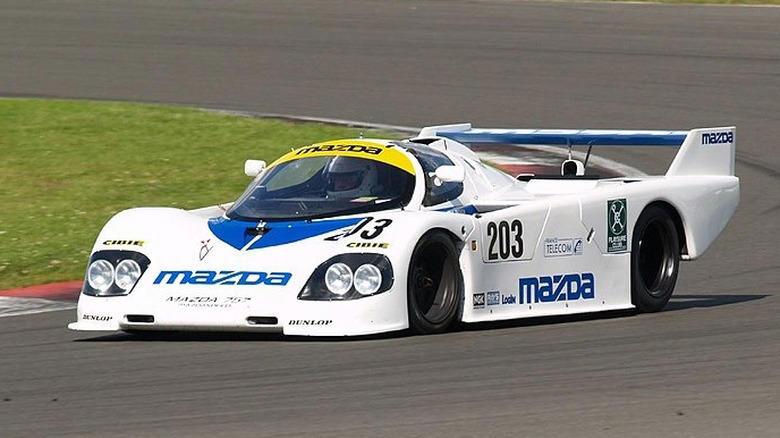
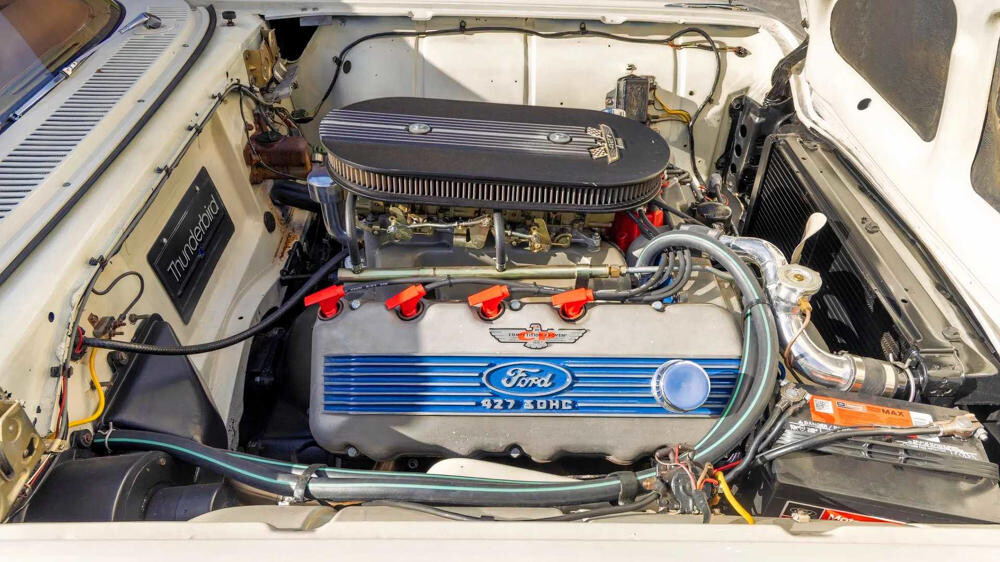
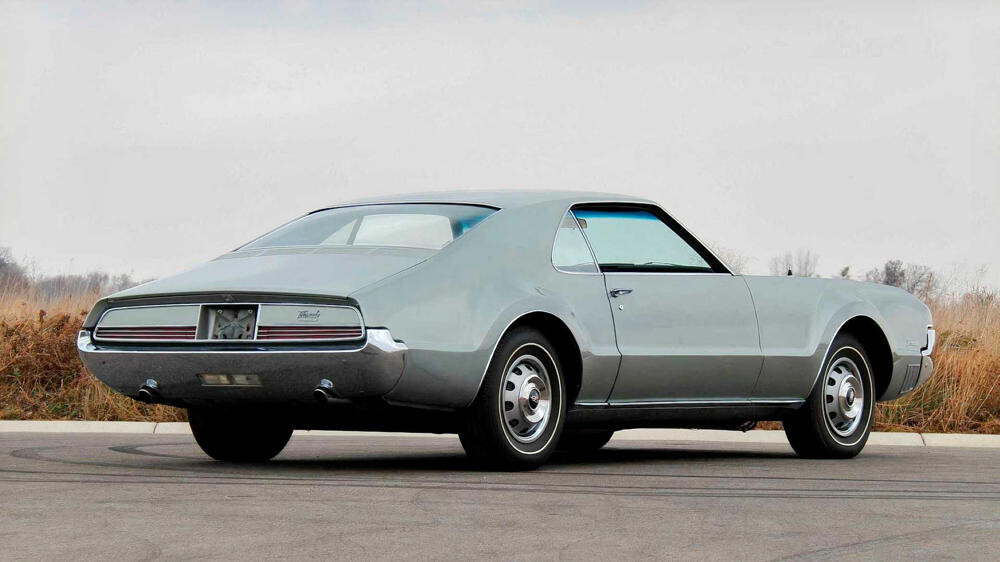
In 1966, Detroit knew how to make big claims: add cubic inches, go for horsepower, and let the rear tires fight for their lives. One General Motors division faced a stranger challenge: it needed a 385-hp V8 to power a massive luxury coupe through its front wheels without stealing precious passenger space. The engine also had to fit beneath a low hood and deliver the smooth performance wealthy buyers expected. Ford And Chevrolet's 427 V8s Were Built To Win Races During the 1960s, 427 cubic inches became a magic number in American performance. Racing regulations and fierce manufacturer competition helped drive engine development. Ford's FE-based 427 V8 became a NASCAR favorite thanks to its high-rpm performance and durability. Street versions with dual four-barrel carburetors produced a factory-rated 425 gross horsepower. Ford also developed specialized racing variants, including the side-oiler, which improved lubrication under sustained racing loads. The 427 also powered Ford's GT40 Mk II to its historic victory at the 1966 24 Hours of Le Mans. Chevrolet had its own heavyweight contender in the Mark IV 427. The L72 version, offered in the 1966 Corvette, produced 425 gross horsepower and 460 lb-ft of torque with an 11.0:1 compression ratio. Both engines earned reputations through racing and high-performance road cars. Putting Nearly 500 LB-FT Through The Front Wheels Was The Real Challenge While Ford and Chevrolet chased racing success, another Detroit engineering team faced a very different problem. Most powerful American cars used front-mounted V8s and rear-wheel drive. This familiar arrangement worked well, but the transmission and driveshaft required a bulky tunnel through the passenger compartment. Eliminating that tunnel promised more usable interior space, particularly in a luxury coupe designed around passenger comfort. Front-wheel drive offered a solution, although fitting a big American V8 into such a layout was far from simple. Engineers needed to package a longitudinal engine, automatic transmission, and differential together while sending enormous torque through the steered wheels. The drivetrain also had to remain quiet, durable, and smooth. Their answer involved a heavy-duty automatic transmission, a specially engineered chain drive, and a modified V8 that could squeeze beneath a remarkably low hood. The 1966 Oldsmobile Toronado's 425 V8 Was An Engineering Breakthrough The mystery machine was the 1966 Oldsmobile Toronado, powered by a special version of the 425-cu-in (7.0-liter) Super Rocket V8 family. Officially called the Toronado Rocket V8, it produced 385 gross horsepower and 475 lb-ft of torque. Its specifications included a 10.5:1 compression ratio, a Rochester Quadrajet four-barrel carburetor, a 4.126-inch bore, and a 3.975-inch stroke. The Toronado became America's first mass-produced front-wheel-drive car since the Cord 810/812 disappeared in 1937. Oldsmobile designed it around comfort and innovative packaging rather than drag-strip glory. Engineers modified the 425 to accommodate its unusual installation. A specially depressed intake manifold and low-profile air cleaner provided clearance beneath the low hood. A unique oil pan, revised engine mounts, and other specialized components helped everything fit. The centerpiece was Oldsmobile's Unitized Power Package (UPP), which combined the longitudinal V8 with a Turbo Hydra-Matic 425 three-speed automatic and front differential. Developed from GM's proven TH400, the TH425 placed its torque converter behind the engine and its transmission gearset alongside it. A two-inch-wide Morse Hy-Vo silent chain transferred power from the converter to the gearbox. The differential then delivered torque through axle shafts and constant-velocity joints to the front wheels. Engineers also refined the steering geometry to limit torque steer, a serious concern when nearly 500 lb-ft reached the front tires. All that engineering delivered a benefit passengers could actually appreciate. With no conventional driveshaft or transmission tunnel, the Toronado offered an almost completely flat floor. The spacious front bench accommodated three occupants, while rear passengers enjoyed additional foot room. Buyers could also choose a more luxurious contoured front bench with a folding center armrest. The drivetrain's compact layout helped Oldsmobile combine bold styling, generous interior space, and serious V8 performance. That's quite a payoff for a chain hiding beneath the sheet metal. The Toronado Proved Big-Block Power Could Serve Luxury The Toronado looked as unconventional as its drivetrain. Hidden headlights, dramatic wheel arches, a long hood, and a sweeping fastback roof gave it a distinctive appearance. It was also enormous, measuring 211 inches long and weighing roughly 4,500 pounds at the curb, with some contemporary test cars approaching 4,800 pounds. Fortunately, the 425's considerable torque made the big coupe surprisingly quick. Motor Trend recorded a 9.5-second sprint to 60 mph and a 17.2-second quarter-mile run. The magazine also named the Toronado its 1966 Car of the Year. Oldsmobile built 40,963 Toronados for 1966, proving its radical drivetrain could work in regular production. The same basic front-wheel-drive philosophy later influenced the 1967 Cadillac Eldorado. Oldsmobile even explored the wild side with the Hurst Hairy Olds, a twin-engine exhibition drag racer based on the 4-4-2. Its two supercharged 425 V8s powered separate axles and generated outrageous performance. However, that tire-smoking monster had little to do with the production Toronado's engineering mission. Oldsmobile's 425 Deserves A Place Alongside The Famous 427s Ford's 427 became famous through NASCAR and Le Mans, while Chevrolet's version helped cement the Corvette's performance reputation. Oldsmobile's 425 took a less glamorous route: its 385 hp fell short of the hottest 427s, but engineers had to send 475 lb-ft through a chain-driven front-wheel-drive system without compromising luxury-car refinement. That required a different kind of ingenuity. The Toronado's greatest achievement was something owners experienced every day. Its nearly flat floor created practical passenger space, while its compact drivetrain preserved the coupe's dramatic proportions. Ford and Chevrolet proved what big-block V8s could accomplish on racetracks and drag strips. Oldsmobile demonstrated how the same American appetite for displacement could solve a packaging problem. The 425 Super Rocket deserves recognition for making a powerful, spacious front-wheel-drive luxury car possible, even if its biggest victory came without a checkered flag. Source: Oldsmobile, MotorTrend

 Liked by Hannah Wilson, Henry Walker




 Liked by Hannah Wilson, Henry Walker