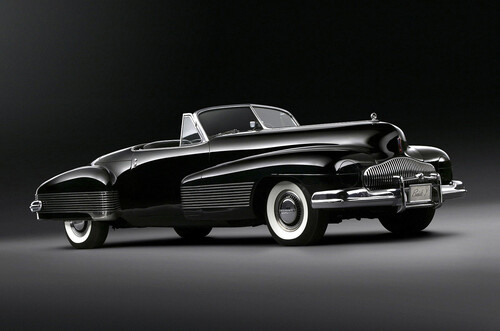
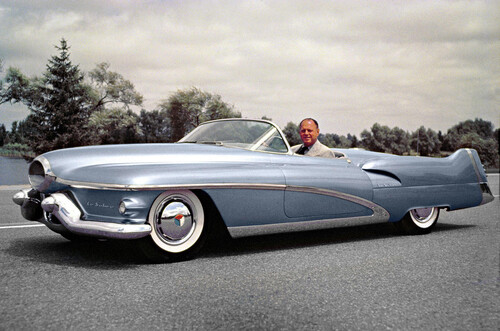
The Best American Car Designs of All TimeAlan Muir - MotorTrendThe automobile may not have been invented here, but the notion that automotive styling could be a vitally important driver of car sales equal to or exceeding that of technical specifications arguably was. General Motors is often credited with making this so in 1927 by creating its now famous "Art and Colour Section" headed by the legendary designer Harley Earl.Perhaps not surprisingly, then, when we cast our editorial eye over the panoply of American automobiledom, nothing much catches our eye prior to Earl's time. Here's our list of the best American car designs of all time to date. Some have outsized historical significance; others sparked seminal changes in the industry's design direction. All of them are cool, beautiful, fast, and desirable, and all played a part in changing design history—either at home or globally. As always, your list (and opinions) may vary.1) 1938 Buick Y-Job: Styling Becomes a Corporate DisciplinePhoto credit: MotorTrendAs the world's first true concept car, the 1938 Buick Y-Job earns a place on this list as it fundamentally altered the way corporations went about designing automobiles. For most of the prewar era, engineering largely dictated a car's architecture, with styling adapting itself around the mechanical package. Harley Earl, who was helming the industry's first dedicated automotive styling department, decided his team needed test mules like the ones engineering used—a drivable car that could test future styling themes and features, gauge executive and public reaction, and serve as inspiration for his designers.AdvertisementAdvertisementAlthough it wasn't formally shown to the public until 1940, Earl drove the Y-Job for nearly a decade, using it to gauge public reaction to its integrated fenders, hidden headlamps, and flush door handles before committing them to production. That new feedback loop helped design become a corporate-led, strategic discipline rather than an afterthought subordinate to engineering. By changing not just what cars looked like but how they came to look that way, the Y-Job may be the most influential automobile on this list.2) 1935 Auburn 851 Boattail Speedster: Art Deco PerfectedPhoto credit: MotorTrendFamed designer Gordon Buehrig was firing on all eight supercharged cylinders when he penned this Streamline Moderne Art Deco masterpiece. Everything about the Boattail Speedster's design—its flowing hood louvers, steeply raked V-shaped windshield, pontoon fenders, tapering rear bodywork, low-cut doors, and external exhaust pipes—help make it look like it's going 100 mph when standing still.Indeed, Al Jenkins broke 70 American speed records in an 851C, and every car carried a dash plaque certifying that before delivery, it had achieved 100 mph in testing. Perhaps best of all, Buehrig managed to achieve his custom coachwork look by reusing unsold speedster bodies and assembling the dramatic new fenders using stampings made on existing dies, which kept the price quasi-accessible while minimizing costs for the struggling company.3) 1936 Cord 810/812: Automotive Modernism BeginsPhoto credit: MotorTrendHow does a designer follow up on the pinnacle of a present-day aesthetic? By making it obsolete one year later with a look that presaged the future of car design. Buehrig's coffin-nose Cord rewrote all the styling rules. Gone were both the standard radiator grille and the headlamps that flanked it, replaced by horizontal louvers that wrapped around the hood. Headlamps disappeared into the fenders. Running boards and exposed door hinges? Gone. Chrome trim? Reduced to the max. The floor and silhouette were also lowered, thanks to front-wheel-drive engineering removing the need for a propellor shaft passing under it.AdvertisementAdvertisementBuehrig wanted the car to look as though it was carved from a single block as opposed to being assembled from pieces, and his design emphasized horizontality. No wonder the Museum of Modern Art selected it for its landmark 1951 Eight Automobiles exhibition, the first time the museum treated automobiles as industrial art. Sadly, the impressive but underdeveloped 810/812 was unable to reverse the company's fortunes, and Cord exited the business after only 2,900 were built.4) 1940-41 Lincoln Continental: Elegance Replaces OrnamentPhoto credit: MotorTrendEdsel Ford, son of founder Henry, wanted to build a stylish, elegant grand touring car that he could drive around. A natural designer himself, he and Ford's leading stylist at the time, E.T. "Bob" Gregorie, worked to transform a two-door Lincoln Zephyr, moving the passenger compartment backward and extending the hood about a foot, lengthening the fenders, lowering the roof, removing the running boards, mounting the spare tire in back, and exercising extreme restraint with the chrome trim.Ford drove the car while on vacation in Florida in 1939, and so many of his wealthy friends wanted one that he had Gregorie revise the design for production (reducing the hood extension to 8 inches). This clean, long-hood, short-deck beauty is a triumph of prewar American modernism, and it established the template for countless personal luxury coupes to come like the Riviera, Toronado, and Thunderbird. It's the only other American design that was featured in the MoMA's Eight Automobiles exhibition.5) 1961 Lincoln Continental: Modernism MaturesPhoto credit: MotorTrendAmerica's Bauhaus sedan was the work of Elwood Engel, and it served as a Hail Mary design pass aimed at saving the Lincoln brand after $60 million in losses incurred by the expensively developed unibody "forgotten Marks" (III, IV, and V) of 1958–1960. The brand consolidated multiple models to this single slab-sided beauty adorned with spare ornamentation and minimalist surfacing.AdvertisementAdvertisementThe 1961 Lincoln Continental marked quite a departure from recent industry excesses (could the extravagantly finned 1959 Cadillac really have been considered fashionable just two years earlier?). Engel's design was originally pitched for the Thunderbird, and indeed this sedan is based on a lengthened version of the 1961 T-Bird's chassis, as the corporation was only too eager to distance itself from the catastrophic ultra-long-wheelbase Continental Mark series. It worked. Sales and profits rebounded, as did the brand's reputation.6) 1963 Chevrolet Corvette: The Sports Car From America's Greatest Design YearPhoto credit: MotorTrendHarley Earl may have created the Corvette, but fellow General Motors design stars Bill Mitchell and Larry Shinoda transformed the 1963 Corvette into rolling sculpture. Mitchell was obsessed with European GTs, but his interpretation of their aesthetic is uniquely American: longer, lower, more muscular and theatrical, and yet admirably restrained. It features a single dominant shoulder line, clean fender forms that seem stretched taut over the running gear, near-perfect greenhouse proportions, beautifully integrated bumpers, and minimal ornamentation.Then there's Mitchell's Bugatti Type 57SC Atlantic-inspired split rear window. Shinoda argued against it, and customers complained about the compromised visibility, so it was a one-year wonder. But should anyone be surprised that when Europeans make lists of best car designs, this is usually one of the few American designs to be included? Also, as you read the next two entries, ask yourself: Did American car design peak in 1963?7) 1963 Buick Riviera: The Personal Luxury Coupe of America's Greatest Design YearPhoto credit: MotorTrendThe Riviera is perhaps the finest expression of Bill Mitchell's "transparent look," deriving its beauty primarily from proportion, stance, and surfacing without relying on drama, novelty, or visual impact. Mitchell was struck by this vision for his personal luxury coupe after seeing a sharp-edged Rolls emerge from a fog bank, and the team applied that aesthetic over a forward-leaning, aggressive, athletic stance reminiscent of contemporary Ferraris.AdvertisementAdvertisementDesigner Ned Nickles is credited with penning the initial sketches that made the original Riviera such a design icon. What's more, the Riviera bucked the trend of flashy annual design updates instituted by Earl, with the 1964 and '65 revisions augmenting rather than diluting the original—in fact, 1965's clamshell concealed headlamps arguably completed the look. And to think, it was originally pitched to Cadillac, which gave it a pass.8) 1963 Studebaker Avanti: A Futuristic Independent's Take on America's Greatest Design YearPhoto credit: MotorTrendThis triumph of American modernism pointed the way to the future—not just the near future's newfound restraint in ornamentation and Coke-bottle side contouring (dubbed "wasp-waist" in the day), but the more distant electric-vehicle grilleless body-color nose future. What's almost more remarkable about the Studebaker Avanti design is that Raymond Loewy's Palm Springs design team (Tom Kellogg, Bob Andrews, John Ebstein) produced it in an astonishing 40 days.The Avanti's style is also due in part to the work of Studebaker engineers who managed to repackage a lower induction system for the base V-8 and to snuggle the R2 model's Paxton supercharger down around the engine to clear the low hood. The edgy Avanti also helped demonstrate the breadth of design flexibility afforded by fiberglass bodywork, as it looked nothing like a Corvette. No wonder it's featured in so many design museum collections.9) 1966 Oldsmobile Toronado: American GT Drama Reaches Its ZenithPhoto credit: Bring a TrailerAs gorgeous as the Riviera was, it had to be tempting to reuse some of its themes for this sister brand's personal luxury coupe. Instead, Bill Mitchell's team amped everything up. When the unprecedented challenge of packaging a high-torque front-wheel-drive system resulted in unusually high-offset wheels, the designers further exaggerated the Toronado's fender arches and wheel openings for them to bulge out of. They gave the car a long hood and a more steeply raked windshield. And yet, the 1966 Oldsmobile Toronado is architecturally harmonious.AdvertisementAdvertisementNothing about the Toronado's design feels gratuitous because every proportion supports a unified visual theme. Here again, as front-wheel drive enabled a lower floor and encouraged greater width, Mitchell's designers responded by emphasizing horizontal, sculptural forms. In this way, Toronado is a spiritual grandson of the Cord. Few subsequent American grand tourers would display the same self-confidence, as European influences increasingly shaped luxury car styling.10) 1984 Jeep Cherokee XJ: SUVs as Architectural Objects, Not TrucksPhoto credit: MotorTrendIf the Toronado was sculpture, the Jeep XJ is pure architecture. Rather than designing a truck with station-wagon windows, as had been done on Wagoneers, Suburbans, Travelalls, Broncos, and Blazers, Dick Teague's AMC studio designed a building. All lines are rectilinear, windows are large, pillars are thin and near vertical, the beltline is straight and near horizontal, and the wheel openings are trapezoids. Almost nothing is decorative and absolutely nothing is fake. Its uniframe design helped lower the floor and hence the roof and tightened the packaging to allow five people and luggage to fit in a 167-inch-long shape. It features short overhangs for good off-road clearance. There's no pretense, no attempt to impress. It's nearly Bauhaus. That's architecture.11) 2005 Chrysler 300: The Formal American Sedan Design Is RebornPhoto credit: Bring a TrailerChrysler designer Ralph Gilles' 2005 Chrysler 300 returned confidence to the American sedan. When it burst onto the scene, most sedans were cab-forward, rounded, soft, anonymous jellybeans. Gilles rejected this aesthetic in favor of a return to a classic long hood/short deck, high beltline, chopped greenhouse look on big wheels in exaggerated wheelhouses. The look was expensive and clearly telegraphed its classic front-engine/rear-drive underpinnings.The form language of the 300 was square, upright, symmetrical. It exuded confidence—American confidence—not with ornamentation but instead through its proportions. With nothing to distract, attention is drawn to the wheel-to-body relationship, the long hood, the short glass. Stance was everything. This design drove higher beltlines, shorter windows, larger wheels, and rear-drive stance—even in front-drive cars that followed. Europeans loved it (buying it as the Lancia Thema). And it reintroduced the concept of allowing architectural formality to reign over ornamentation.12) 2005 Ford GT: Retro Design Grows UpPhoto credit: MotorTrendIf the Chrysler 300 was primarily an American design milestone, the 2005 Ford GT is an international one. It illustrated to the world how a retro design should not copy the past but rather translate it. The iconic and historically significant Ford GT40 wasn't merely famous, it was sacred. The Ford that conquered Ferrari. Its silhouette was sacrosanct. Deviating far risked angering enthusiasts; extreme fidelity risked caricature. So GT40 superfan/designer Camillo Pardo (who'd helped reinterpret the design as the GT90 ten years earlier) instead leaned into the essence of the original: a cab-forward greenhouse, flying buttresses, an impossibly low roof, broad shoulders, dramatic rear haunches, and visual tension between the cockpit and the rear wheels.AdvertisementAdvertisementBy focusing on these elements, his design became a contemporary interpretation, not a pastiche. Not retro. The automotive design community added the GT to its "best design" lists for transcending national identity. Pardo invented a modern philosophy of heritage design, and in so doing inspired a generation of similar tributes, including the 2007 Fiat 500, 2008 Dodge Challenger, 2010 Chevy Camaro, and 2020's Ford Bronco and Land Rover Defender.