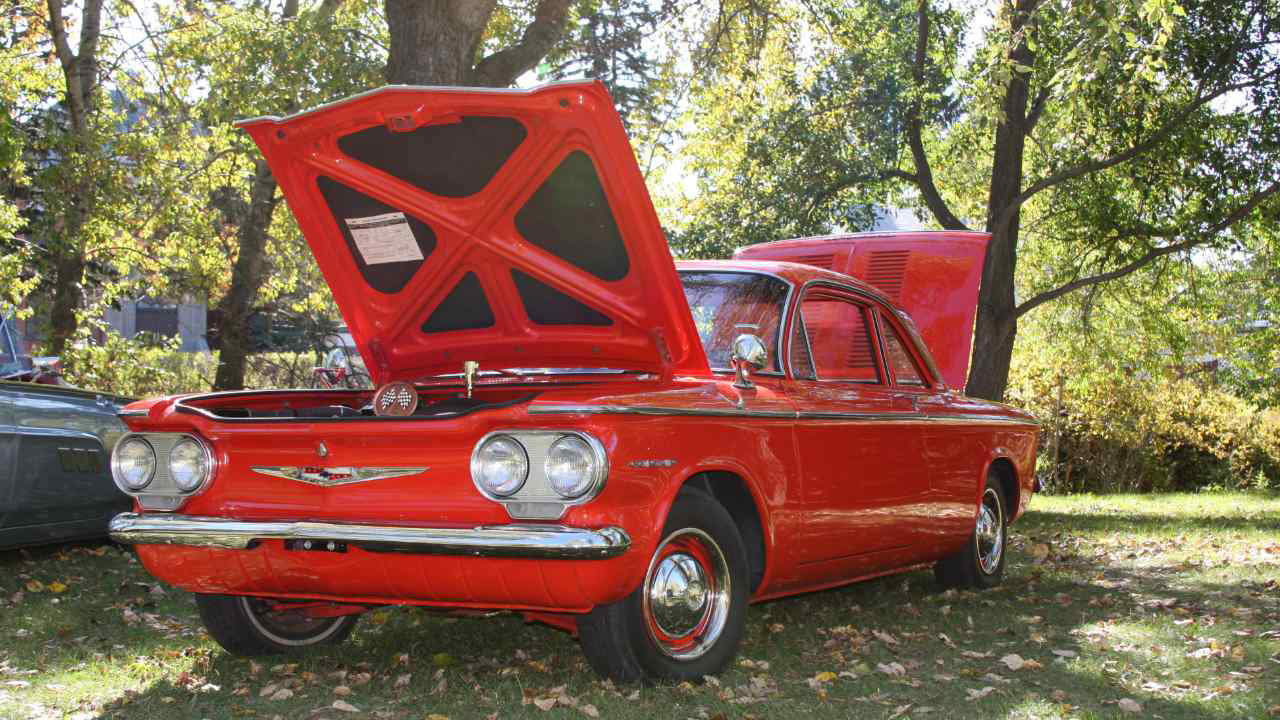



















Mechanics warn the 1960 Chevrolet Corvair’s design made handling unpredictable for driversThe 1960 Chevrolet Corvair arrived as a stylish answer to compact imports, but veteran mechanics remember something else about it: a car that could change character midcorner. On paper, it promised light, agile handling. In real traffic, its rear-engine layout and cost-cut suspension could turn a routine maneuver into a spin, a skid, or worse. Those traits helped turn the Corvair into a symbol of automotive risk, a car that drivers and technicians argued about long after production stopped. The debate over how dangerous it really was still echoes, yet on one point there is little disagreement among those who worked on them: the original design made the car’s behavior hard to predict for ordinary drivers. The radical compact that rewrote the rulebook When Chevrolet launched the Corvair in 1960, the company broke from the front-engine, solid-axle formula that defined Detroit sedans. The new compact carried its flat-six engine in the rear, freeing up cabin space and promising better traction on slippery roads. To keep weight down and costs in check, Chevrolet paired that engine layout with a swing-axle rear suspension instead of a more expensive fully articulated design. Rear engines and swing axles were not new. The layout had already appeared on European cars such as the Volkswagen Beetle and other small imports. What made the Corvair different was how that package met American highways, higher speeds, and drivers accustomed to forgiving understeer rather than a car that could pivot around its tail. Mechanics who saw early Corvairs in their bays often found owners who loved the smooth ride and quiet engine but complained that the car felt fine until it did not. That gap between expectation and behavior would become central to the car’s reputation. Ralph Nader and the birth of a safety crusade The Corvair might have remained a niche engineering story if not for a young lawyer named Ralph Nader. Through his later public work and his book about car safety, Nader argued that American automakers prioritized styling and cost over basic crash protection. His advocacy turned one controversial compact into a national case study. The book that carried his argument, Unsafe at Any, focused heavily on how design choices could bake danger into a car long before any driver turned the key. In that framework, the first-generation Corvair became Exhibit A for what he saw as avoidable engineering compromises. Later analysis of Nader’s campaign, including public health reviews of the dangers he described, framed the Corvair story as part of a larger tragedy of cost-cutting. Those assessments argued that the tragedy was overwhelmingly the fault of cutting corners to shave costs, and that this kind of decision happened all the time in the automobile industry. For Nader, the Corvair’s handling quirks were not just a quirk. They were a warning sign that the industry needed outside pressure to take safety seriously. His name became inseparable from the car, to the point that a simple search for Ralph Nader still pulls up references to the Corvair controversy alongside his later political work. The mechanical recipe for unpredictable handling Mechanics who worked on early Corvairs tend to describe the danger in practical terms rather than legal ones. The rear engine placed a large share of the car’s weight behind the rear axle. The swing-axle design let each rear wheel move in a large arc, which changed the tire’s angle to the road as the body rolled in a corner. Without an anti-roll bar to limit that motion, the outside rear wheel could tuck under the car during hard turns. Owners and technicians in later discussions have described how, without an anti-sway bar, oversteer was a real issue, and that rearward weight balance only added to the drama. One enthusiast group explained that without that stabilizing hardware, the car could transition from mild understeer to sudden oversteer if the driver lifted off the throttle in midcorner. That shift turned what felt like a stable line into a sharp rotation of the tail. Modern explainers on the model’s history echo that description. A detailed video on why the Chevrolet Corvair was cancelled notes that the early swing axle rear suspension led to handling quirks such as understeer, followed by sudden oversteer if the driver lifted in a turn. The piece also points out that the rear engine placement, which aimed to create a lighter and more fuel efficient car, came with that tradeoff in stability. Viewers can see that argument laid out in one analysis that walks through the rear-suspension geometry. Mechanics at the time had a simple way to describe the result. The car felt one way when the driver first turned the wheel, then behaved very differently if the driver panicked and eased off the gas. That two-stage response could surprise even experienced motorists. The tire pressure trap that few drivers followed Chevrolet’s engineers understood that the Corvair’s weight distribution needed special tuning. Instead of fitting an anti-roll bar on early models, General Motors relied heavily on tire pressures to manage balance. The factory specification called for much lower pressure in the front tires than in the rear, with some technical discussions citing recommendations as extreme as 15 psi in front and 24 psi in the rear. Advice shared later by owners and mechanics has been blunt. One widely circulated comment argued that the problem with the Corvair was people putting too much air in the front tires. That was the problem with trying to overcome a design flaw by specifying a totally critical pressure split that few drivers understood and even fewer service stations respected. Other technical conversations have noted that General Motors could have compensated for the layout by adding an anti-roll bar to tune the suspension, instead of relying on such precise tire pressure settings. One engineer’s explanation on a question-and-answer forum describes how GM chose not to include that bar and instead tried to tune the suspension via tire pressures, which magnified the risk when owners or shop attendants simply filled all four tires to the same value. That perspective is laid out in a detailed discussion of GMs. For mechanics, the pattern was familiar. A Corvair would come in after a spin or a near miss, and a quick check would show all four tires inflated to a uniform number that made sense for a conventional sedan but not for a rear-engine compact that depended on a front-rear split to stay predictable. When swing axles bite: tucking wheels and sudden spins The geometry of a swing axle creates a particular kind of failure when pushed too far. As the body leans in a turn, the outside wheel can tilt, reducing the tire’s contact patch. On the Corvair, that effect, combined with rear weight bias and the lack of an anti-roll bar, creates a scenario where the rear wheels could tuck under the car during sharp maneuvers. A museum exhibit on the model’s history describes how the Corvair’s wheels were susceptible to tucking under the vehicle when taking sharp turns. In that account, the rear wheels would lose traction, tuck under and make the car skid out of control or tip over. The description captures what many mechanics saw in bent control arms and damaged wheel rims after a crash. Video tests produced decades later echo those concerns. One well known piece titled “Will the Corvair Kill You?” explains that the Chevy Corvair had a curious handling, due to a design flaw in the rear suspension that allegedly made it likely to flip over during abrupt maneuvers. The segment notes that the weight distribution and swing-axle layout made the car prone to oversteer and potential loss of control when pushed beyond its comfort zone. That assessment appears in a widely viewed driving review. In enthusiast circles, some owners argue that a well maintained Corvair on correct tires and pressures behaves safely. Yet even those defenders often concede that the car can feel fine up to a point, then switch quickly to a slide or spin if the rear suspension runs out of travel. Mechanics’ verdict: a car that kept drivers guessing For working technicians, the most troubling aspect of the first Corvair was not that it always misbehaved. It was that it did not always misbehave in the same way. A driver could cruise for months without incident, then encounter a sudden emergency lane change or a decreasing-radius off-ramp and discover a very different personality. One enthusiast’s summary that channels period mechanics describes how the rear-engine, swing-axle design made the car unpredictable. According to that account, one wrong move and the car would flip or spin or both. The same discussion asserts that General Motors knew about the behavior and cut corners anyway to save money, a claim that reflects the frustration many technicians felt when they saw repeat patterns of crashes. That view appears in a pointed owner commentary that has circulated widely. Another enthusiast post recalls how Nader’s sharp criticisms focused on the Corvair’s unconventional design, particularly its rear-engine placement and swing-axle suspension system, which he claimed made it a one-car accident waiting to happen. That phrase captures how some mechanics described the car to customers who asked whether their compact was safe for a teenage driver. The argument is summarized in a retrospective on Nader. Mechanics also saw the way small maintenance lapses could turn into big risks. Incorrect tire pressures, worn shocks or tired springs all made the rear suspension more likely to tuck. Unlike some other cars of the era that telegraphed their limits with gradual body roll and squealing front tires, the Corvair could go from composed to sideways with little warning. Cost-cutting, missing bars, and a changing industry Why did Chevrolet ship such a configuration in the first place? Period engineering summaries and later historical videos point to cost. To keep the Corvair competitive on price, General Motors initially omitted anti-roll bars and relied on the simpler swing axle. One detailed video on the rise and fall of the model notes that to keep costs down, the rear suspension initially used swing axles similar to the Volkswagen Beetle, and anti-roll bars were omitted. Other technical commentaries argue that GM could have compensated for the layout by adding an anti-roll bar, which would have reduced camber change and made the car more forgiving. Instead, the company tried to manage the issue with tire pressure recommendations that many owners ignored. Public health analyses of the era’s safety battles frame this as part of a broader pattern. In the review of Nader’s work mentioned earlier, researchers argued that the tragedy was overwhelmingly the fault of cutting corners to shave costs and that this happened all the time in the automobile industry. The Corvair’s early suspension became one example among many where accountants overruled cautious engineers. More from Fast Lane Only Unboxing the WWII Jeep in a Crate 15 rare Chevys collectors are quietly buying 10 underrated V8s still worth hunting down Police notice this before you even roll window down